The Future Is Hybrid: how Dexa’s rebranding reflects 24 years of digital evolution
Strategic Branding

A rebranding is never just a visual overhaul. It happens when a company pauses, looks back at its own journey, and decides, with intention, how it wants to be seen from here on. The visual change is only the surface. Underneath it lies a question: does the way the market perceives us still match what we actually do?
For Dexa, the answer called for change. Since 2002, we have followed every digital shift, delivering different solutions to our clients along the way. We were born with design in our DNA and, over time, built a technical reputation in development, becoming a leading reference in Drupal and DXPs in Brazil and internationally.
But in recent years, it became clear that business challenges no longer arrive in neat, separate packages. Brand, experience, technology, and marketing need to work together to solve real problems and drive growth. That is where Dexa’s rebranding comes from.
Keep reading to learn about this story.
Why a rebranding now?
Dexa was founded in 2002 as a design studio. At the time, digital meant presence and visual identity. Our work was helping brands take their first steps online and create their earliest points of contact.
The market changed. Digital stopped being a storefront and became the central infrastructure of business. Today, websites concentrate data, content, operations, and conversions. Digital products are direct revenue channels. Entire platforms support complex user journeys. Brand, experience, technology, and performance operate in sync to drive results.
And Dexa followed every step of that shift from inside the ecosystem.
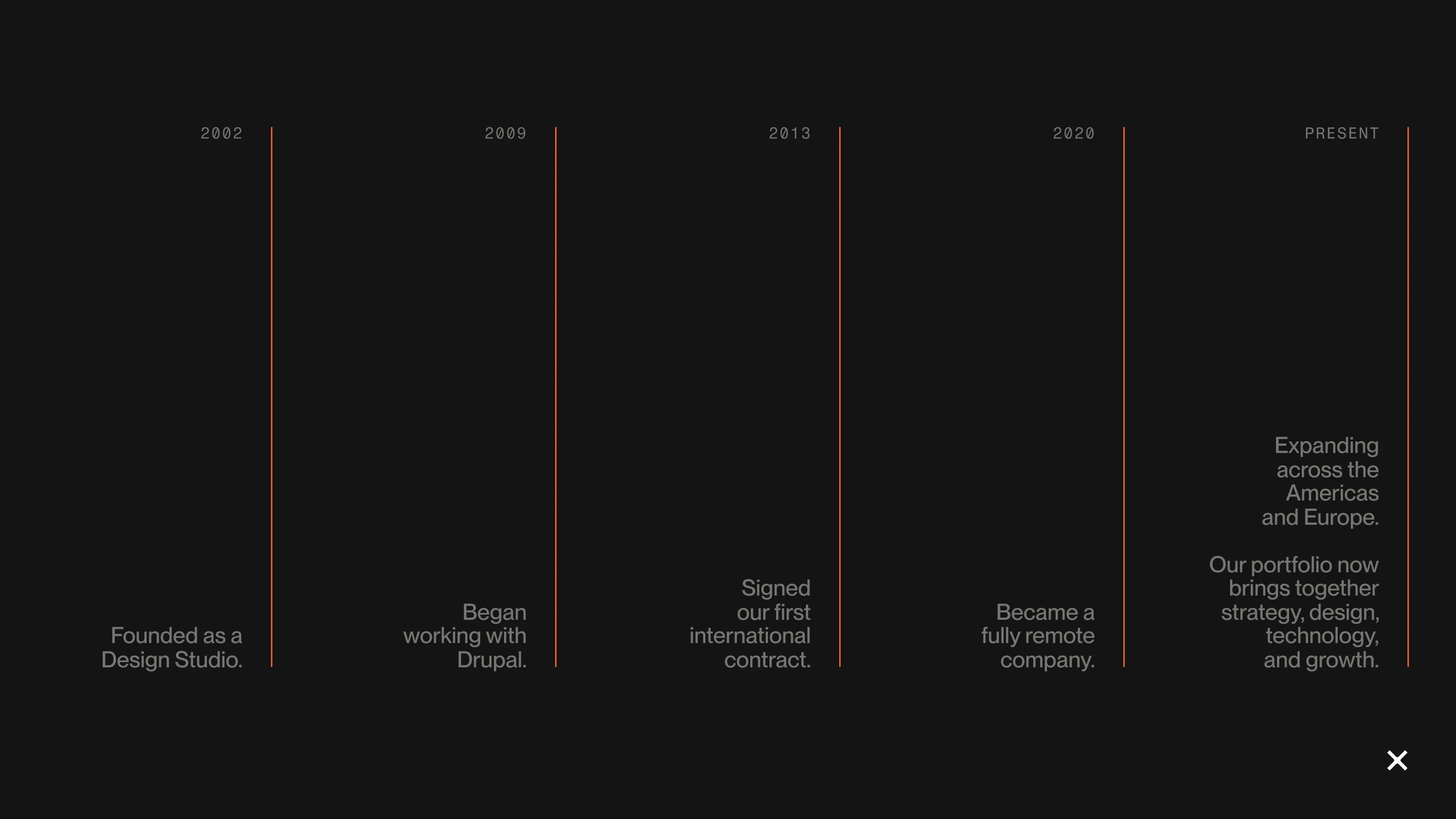
From design studio to enterprise technology specialist
Our first major transformation came in 2009, when we began working with Drupal. That move led us to far more robust projects, ones that demanded scale, security, governance, and continuous evolution.
That chapter established our reputation. Dexa became recognized for its ability to develop, sustain, and evolve complex digital ecosystems. We gained deep expertise in CMS, DXP, Drupal, integrations, and mission-critical operations.
Our previous visual identity reflected that moment: blue communicated solidity, trust, and the technical precision of a company known for its engineering.
When perception fell short of delivery
Technical specialization opened doors. It brought us into major enterprise projects, expanded our mastery of Drupal and DXP, and positioned us for demanding digital operations.
But that same strength ended up narrowing how the market saw us. Dexa came to be perceived as just a technology and maintenance company. The perception was not wrong. It was incomplete.
Clients already needed more than technology
In practice, our work had always been far more strategic. Before writing a single line of code or designing an interface, we would immerse ourselves in the business to understand the user journey, positioning, content, and governance.
"It’s very common for brands to come to Dexa asking for a new website or platform. But during the diagnostic, we almost always find problems that come before development: gaps in positioning or an offer that isn’t yet clear to the market. Digital only reaches its full potential when brand and business strategy are aligned."
— Diego Martinez, Founder & CEO of Dexa.
With that lens, we were already solving those pain points alongside every technology project, drawing on our experience in strategic and experience design.
The market became hyper-specialized
With the hyper-specialization of the 2010s, it became common practice to hire multiple agencies simultaneously: one for branding, another for UX, a software house for development, a dedicated SEO partner, a separate consultancy for paid media.
What emerged was a kind of corporate Tower of Babel. When vendors don’t share the same business vision, they can’t work in sync, and problems follow.
The brand ends up speaking five different languages across channels.
The promise built during branding gets lost the moment the user lands on the site.
Campaigns drive clicks, but the landing page doesn’t convert.
Rigid technology blocks the marketing team’s autonomy.
Data sits in silos and no one extracts real intelligence from it.
The end user feels that disconnect immediately. Each vendor delivers their piece, but none of them fit together into the same puzzle.
Read also: What does a digital agency do, and how do you choose the right one?
AI accelerated the need for integration
In 2025, 88% of organizations surveyed by McKinsey reported using AI regularly in at least one business function, up from 78% a year earlier. But without an integrated strategy, AI only multiplies processes and generic content, without generating any real advantage.
The same applies to the development market, of which we are a part. Processes, tools, and technologies are being rethought. Established CMSs are beginning to show their age, and keeping pace with that requires expertise.
What we became
In 2026, our second major transformation takes shape. We are reinforcing our positioning as a Digital Experience Agency, a strategic partner for brands that want to turn digital into a genuine competitive advantage.
We now operate end to end: from strategy to growth, spanning design, technology, and marketing. This positioning is grounded in a simple conviction: digital can either accelerate or stall a business’s growth.
When strategy, design, technology, and marketing work in silos, results don’t materialize. When they work together, the ecosystem becomes clear, efficient, and scalable.
The new Dexa honors the technical expertise we built over two decades, while understanding that the future demands greater integration. We were born from design, grew through technology, and now lead complete digital experiences with marketing and AI.
"We are living the consolidation of the hybrid future, with Artificial Intelligence integrated into all our processes. The goal is to give teams more productivity and analytical capacity, with technology accelerating scale, without ever compromising the quality that defines our work."
— Micaela L. Rossetti, Head of Marketing at Dexa.
What does the design say about this transformation?
A repositioning only becomes tangible when it takes form, color, and behavior. Rather than a rupture, Dexa’s new visual identity was designed to reflect our current maturity: it expands the two-decade technical heritage and opens space for a broader, multidisciplinary reality.
"The previous identity represented a solid and experienced company. The challenge of Dexa’s rebranding was not to break from that, but to expand the brand’s ability to represent the company as it is today."
— Rafael Andrighetti, Head of Design at Dexa.

The ‘Add Future’ concept
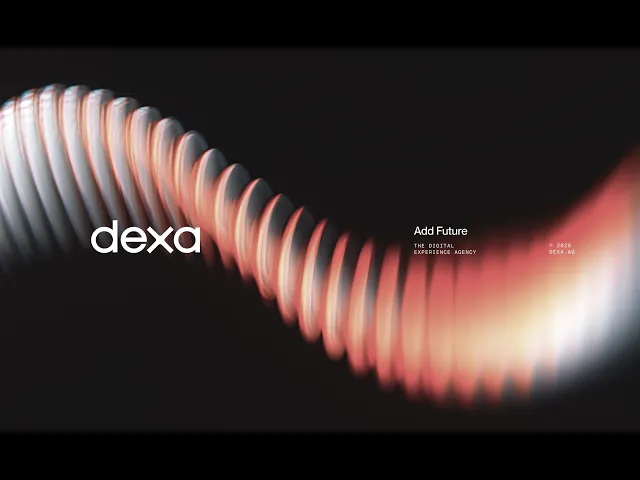
More than a tagline, the concept that guides us translates Dexa’s role in clients’ ecosystems: to be an engine of continuous evolution. Visually, this shows up in dynamic graphic elements, luminous atmospheres, and gradients that turn the idea of the future, once abstract, into something palpable and under construction.
"Dexa doesn’t just execute projects. It helps companies evolve, grow, and build new business scenarios. That’s where the Add Future concept was born."
— Rafael Andrighetti, Head of Design at Dexa.

Visual unity for a complex ecosystem
The design challenge was to build a system elastic enough to speak to enterprise developers, growth managers, and brand directors, without fragmenting brand perception. The answer was an integrated visual ecosystem with consistency and graphic flexibility across all our fronts.
"The visual identity translates this idea of continuous evolution. It materializes the elements that help build this future: digital experiences, systems, connections, transformation, and impact."
— Rafael Andrighetti, Head of Design at Dexa.

Orange as the signature of energy
In the color palette, black and white bring sobriety, contrast, and the technical precision of our engineering DNA. The shift comes with orange, which functions as a catalyst in the layout to convey movement, closeness, and innovation.
"More than a color accent, orange is an emotional signature for the brand. It balances the rationality of technology with a more human, creative, and aspirational dimension."
— Rafael Andrighetti, Head of Design at Dexa.
In practice, this combination balances two forces that today’s market demands: the precision of cutting-edge technology and the sensitivity of design made for people. The result is a natively digital brand that performs with equal strength in code, complex interfaces, campaigns, or offline applications, without losing recognition.
How does this vision translate into our services?

In this new phase, Dexa organizes its work across four connected fronts: Experience Design, Enterprise Technology, Digital Growth, and Strategic Branding. Each one addresses a layer of the digital ecosystem, but the real value emerges when they work together, personalized to what your business actually needs.
"The silos that used to separate design, technology, and marketing no longer generate results. Hyper-specialization was valuable because it forced each segment to evolve, but integrating all of it is essential. With different vendors, that becomes even harder. At Dexa, we have specialists from multiple fronts working together to deliver real growth for clients."
— Micaela L. Rossetti, Head of Marketing at Dexa.
Experience Design
Experience Design is about how a person understands a brand, finds what they need, navigates without friction, and moves forward in the digital journey. This front translates business objectives into clearer, more useful experiences. Good design isn’t just in the layout. It shows up when users understand the value proposition, when internal teams can scale patterns, and when the experience holds up the brand’s promise.
Key services:
Digital Strategy: direction for awareness, experience, content, and growth, connecting business objectives to digital presence;
Websites: intuitive, high-performance sites aligned with UX, UI, development, and marketing;
Product Design: support for teams managing digital products, from journey mapping to UI Design;
Design System: components, visual standards, and guidelines for scaling consistency across interfaces;
Motion Design: animations and visual assets for products, websites, and institutional channels;
Design Ops: design squads and specialists integrated into client operations, with greater governance and speed.
Read also: 7 Foundations for a Memorable Digital Experience
Enterprise Technology
Every digital experience needs a technical foundation that keeps pace with the business. Without it, even a solid strategy runs up against platforms that are hard to evolve, fragile integrations, and low performance.
In the Enterprise Technology front, Dexa builds, sustains, and evolves that foundation. It’s the backstage work that determines whether a digital ecosystem can grow with security, stability, and governance.
Key services:
Web and Mobile Development: websites, web apps, and digital solutions of varying complexity;
Digital Experience Platforms (DXP): platforms that give marketing and technology teams autonomy without sacrificing security or governance;
Drupal Services: development, migration, evolution, and maintenance of Drupal projects in enterprise contexts;
Managed Services: monitoring, maintenance, optimization, and continuous evolution of platforms;
Technology Outsourcing: specialists and agile squads to accelerate delivery with technical control and continuity.
Digital Growth
Digital Growth doesn't come at the end of the process. It starts from the beginning. Growth is treated as an integral part of the digital ecosystem from day one. When brand, experience, and technology are aligned, content performs better, media delivers stronger results, and data evolves from reporting into decision-making.
This practice connects strategy and execution to attract more qualified audiences, improve conversion rates, and turn digital channels into a continuous learning engine.
Key services:
Digital Strategy: market, competitor, and audience analysis to build brandformance strategies designed for sustainable growth.
Digital Optimization: performance assessments focused on SEO and CRO, followed by continuous improvement plans.
Content, SEO, GEO, and AEO: editorial strategies driven by search intent, topical authority, and emerging AI-powered discovery experiences.
Social Media: planning and managing a consistent social presence aligned with brand positioning, audience behavior, and market dynamics.
Paid Media: defining channels, campaigns, and messaging strategies to drive awareness, qualified acquisition, and conversion.
Inbound Marketing: designing workflows, automations, landing pages, newsletters, and gated content to nurture leads and generate business opportunities.
Strategic Branding
Many times, the digital problem begins before the interface. It begins when the brand fails to communicate what it delivers, when positioning has become generic, or when the company has evolved but is still seen as it was years ago.
The Strategic Branding front organizes that foundation. It brings clarity so that communication, experience, technology, and growth all point in the same direction. When a brand knows what it promises, digital sustains that promise with far greater consistency.
Key services:
Brand Diagnostic: analysis of business, market, competitors, and audience to identify friction, strengths, and opportunities;
Brand Strategy: definition or revision of purpose, mission, vision, values, brand DNA, and unique value proposition;
Visual Identity: logo, colors, typography, graphic elements, and visual system;
Verbal Identity: tone of voice, key messages, language attributes, tagline, and slogan;
Positioning and Rebranding: Brand Equity analysis, tangible and intangible assets, perception gaps, and the construction of a new brand expression.
AI as culture
Across all four fronts, Artificial Intelligence is already part of our daily routine. We use the technology to accelerate research, automate repetitive tasks, analyze data, and refine strategies in design, marketing, and technology. Every application is designed to give teams more speed and improve decision quality. The final word and the review are always human.
Where AI shows up in our day to day
Routine automation: flows that eliminate manual work, organize data, and connect our tools;
Specialized agents: assistants and skills that accelerate diagnostics, review content, and organize project information;
Development and technology: support for engineering teams in technical documentation, requirements mapping, and code review;
Security and governance: rigorous criteria to protect confidential data and respect the limits of each project.
What changes for your business starting today?
This evolution in Dexa’s services changes how we support your company’s growth. In practice, you stop managing multiple intermediaries and reduce the risk of misalignment between strategy and execution. By bringing the fronts together, your company gains:
Agility: strategic ideas become live platforms in far less time;
Brand consistency: your value proposition shows up the same in the ad, on the site, and in the user experience;
Investment efficiency: the growth budget stops being wasted on fragmented journeys or pages that don’t convert;
Governance and evolution: infrastructure prepared to scale, with security and autonomy for Marketing and IT teams.
Clients and projects behind the new Dexa
Dexa built this vision over more than two decades of work, since 2002, with projects in Brazil, the Americas, and Europe. We have supported brands including Unicef, Backroads, Yale, Labatt, BR Mania and Cemig Saúde across challenges in technology, experience, governance, performance, content, and growth.
"Looking back at our journey of more than two decades makes it clear that digital was never a final destination, but an organism in constant evolution. This new cycle for Dexa is not a change of direction; it is the consolidation of our maturity. We are ready to lead the intersection between technical precision and brand strategy, preparing our partners for the next 24 years."
— Diego Martinez, Founder & CEO of Dexa.
For us, the future is not a talking point. It’s a track record: deliveries, international projects, long-term partnerships, and deep technical mastery of platforms that need to work, scale, and evolve.
A century-old brand, a new digital presence
See how Dexa repositioned Vinagres Prinz and carried its new brand expression into digital.
If your business needs to grow with consistency, reduce friction between teams, and prepare operations for the next cycle, talk to a Dexa specialist and discover how to add future to your strategy.
Bring brand, experience, technology, and marketing together
At Dexa, Strategic Branding, Experience Design, Enterprise Technology, and Digital Growth run with one team and one business vision. Talk to a specialist to see which practices address your company's challenges today and how they connect in your next growth cycle.
What is a digital experience agency?
Does Dexa still work on Drupal projects?
Can I hire just one of the four practices?
Is Dexa the former MMDA?