
A brand can publish content consistently and run a sleek website, yet still watch its organic visibility collapse. The cause? Poor crawling, indexing errors, and a rigid site architecture. In mature operations, organic search declines almost always stem from hidden issues across infrastructure, data, and user experience.
Hiring an SEO firm that stops at delivering a technical report creates more noise than clarity. Massive audit documents without execution priorities paralyze engineering and marketing teams. Real value happens when this technical diagnostic is turned into an executable backlog, prioritized by revenue impact, and tracked all the way through deployment.
Beyond traditional search engines, the rise of AI assistants like ChatGPT, Perplexity, and generative search has redefined how buyers discover brands. Today, SEO, GEO, and AEO must operate in sync on the same technical and editorial foundation, ensuring your brand shows up wherever your buyers choose to search.
Below, we break down how effective SEO consulting works, which specialists lead each phase, when to choose a one-off project versus an ongoing partnership, and how to select a partner aligned with your actual business goals.


What an SEO consultancy actually does
A solid SEO partner identifies the bottlenecks holding back your site’s organic visibility, turns those findings into execution priorities, and guides or handles the necessary fixes. This work spans multiple disciplines, covering technology, content strategy, and business analytics.
Established industry standards reinforce this multi-faceted scope, from search intent research and technical development audits to optimizing for modern search habits like generative AI. Because it connects marketing, content, and engineering, SEO is a cross-functional discipline, it does not belong to just one department.
The term "consultancy" doesn't dictate who actually makes the day-to-day updates. While some partners operate on a purely advisory model, handing recommendations to your internal team, others manage the hands-on execution, content updates, and monitoring. Your contract must clearly define who is responsible for execution, approvals, and quality assurance at every step.
Key deliverables of an SEO consultancy
A mature operation functions like a modular system across ten interconnected tracks, where discoveries in one stage reshape priorities for the next.
1. Business Diagnostic
Maps your revenue model, sales targets, buyer personas, and historical traffic to pinpoint high-conversion pages (money pages). This stage sets the project baseline, aligning expectations and keeping the focus on revenue generation rather than vanity metrics or raw traffic volume.
"Growing organic traffic without impacting revenue is just a vanity metric. A mature consultancy delivers more than a ranking report; it provides a strategic roadmap that turns website visibility into predictable revenue. Above all, a good partner must understand your business."
— Micaela Rossetti, Head of Marketing at Dexa
2. Keyword Research
Analyzes search intent and buyer behavior across every stage of the sales funnel. This step maps market questions, objections, and needs to structure the topic universe your brand must own, identifying competitor gaps and keyword cannibalization risks before any site changes occur.
3. Technical Audit
Inspects server files, source code, and infrastructure to fix issues blocking content discovery. It evaluates crawl directives (robots.txt, x-robots-tag), XML sitemaps, HTTP response codes, JavaScript rendering, structured data (Schema.org), and page speed (Core Web Vitals), ensuring search bots crawl your site without errors or wasted resources.
4. Information Architecture
Optimizes site hierarchy, navigation menus, taxonomies, breadcrumb routes, and URL structures. This reorganization improves user journeys while showing search engines how topics connect, ensuring an efficient flow of internal authority (link equity) to high-value pages.
5. Editorial Strategy
Plans original content production anchored in Search Quality Rater Guidelines (E-E-A-T) and Information Gain. It establishes editorial guidelines, content formats, and publishing calendars, ensuring your content provides deep, primary insights that AI tools cannot easily replicate.
6. On-Page Optimization
Refines individual code and text elements on new and existing pages. This includes header tag hierarchy (H1–H6), title tag optimization, meta descriptions, internal linking, semantic formatting, and direct answer blocks designed to capture featured snippets and generative search placements.
7. Conversion Rate Optimization (CRO)
Evaluates mobile usability, perceived load speed, above-the-fold visual hierarchy, and CTA placement. It identifies and removes friction points in forms and landing pages, ensuring organic traffic leads seamlessly to concrete business outcomes.
8. Authority Building & Digital PR
Maps the quantity, relevance, and quality of external domains linking to or mentioning your brand. It develops legitimate Digital PR campaigns, linkable assets, and media outreach to raise domain authority and insulate your brand against algorithm shifts.
9. Log Analysis & Backlog Execution
Translates technical recommendations into a prioritized backlog, balancing business impact against engineering effort. It tracks daily bot activity through server log files and validates code directly after technical deployments, ensuring fixes deliver their intended results.
10. Performance Measurement & Attribution
Connects organic traffic growth directly to business performance metrics. Using integrations between Google Analytics 4 (GA4), Search Console, and your CRM, it tracks keyword rankings, lead generation, and pipeline revenue impact.
"The biggest enemy of SEO isn't an algorithm update; it's the audit report left forgotten in a folder. The real value of a technical diagnostic happens when we turn discoveries into a clear execution backlog, measured by business impact versus engineering effort."
— Micaela Rossetti, Head of Marketing at Dexa
How deliverables connect in practice



To see how this works in practice, look at Dexa’s work with Pactum, a tax consultancy. The project highlights why the sequence of strategic decisions matters as much as the deliverables themselves.
"Before thinking about keywords or publishing frequency, we dove into Pactum’s specific challenges and business goals. We recognized that their growth required a rebuilt SEO foundation—starting with a new website, restructured architecture, and clean technical setup. Only after fixing the technical core did we roll out a long-term content strategy."
— Micaela Rossetti, Head of Marketing at Dexa
With the new structure in place, targeted keyword research guided topic clusters connected to core services, tax pain points, and buyer decision stages. This foundation fed search strategy across SEO, GEO, and AEO, as well as social media, email, and marketing automation.
Within six months, the operation delivered a 93% increase in organic clicks and a 378% increase in search impressions. The impact came from sequencing technical health, architecture, content quality, and attribution, not from isolated quick fixes.
The roles that make up an SEO consulting team
Team size and required roles depend on project scope. While a standard corporate site can be managed by a single lead, complex digital environments require a dedicated cross-functional team.
Enterprise portals, e-commerce sites, global multilingual platforms, and complex web apps require distributed expertise across technical SEO, content engineering, and marketing governance.
Role / Function | Project Responsibility | When It Becomes Critical |
SEO Strategist | Defines strategy, priority backlog, KPIs, and business alignment | When dealing with high market opportunity but limited execution capacity |
Technical SEO Lead | Analyzes crawling, indexing, architecture, rendering, schema, and performance | Complex sites, migrations, heavy JavaScript frameworks, or sudden traffic drops |
Dev & Architecture | Implements page templates, redirects, canonicals, site performance, and pipelines | When fixes require code changes, CMS updates, infrastructure, or CI/CD pipelines |
Content Editor | Maps intent, builds briefs, produces, edits, and maintains content freshness | When scaling content coverage without publishing generic commodity content |
UX / CRO Specialist | Evaluates user journeys, readability, navigation, forms, CTAs, and A/B tests | When pages drive traffic but fail to convert visitors into pipeline |
Data & Analytics Lead | Configures tracking events, integrates data sources, and maps search to revenue | When leadership needs to prove SEO ROI and prioritize by business impact |
Product & Sales Alignment | Validates business priorities, lead quality, and sales cycle alignment | In any enterprise B2B operation measuring SEO beyond traffic volume |
Team composition should be a key hiring criterion. An SEO firm can deliver great analysis and still fail if it cannot collaborate with the teams managing your CMS, codebase, editorial calendar, and web design.
Clear signs your business needs SEO consulting
Hiring an SEO firm makes sense when facing clear growth bottlenecks or preparing for major technical shifts:
Organic traffic has plateaued or declined: You publish content regularly, but key product and service pages fail to rank for high-intent business queries.
Critical pages are missing from search indexes: Crawl errors, canonical conflicts, duplicate content, or rendering issues prevent pages from indexing.
A site migration or platform change is coming: Redirect mapping, URL inventories, canonical tags, and monitoring must be planned before code deployment.
Content volume grew without structural architecture: The site suffers from keyword cannibalization, duplicate topics, orphan pages, and articles disconnected from your offer.
Traffic arrives, but conversion remains flat: Search intent, value proposition, user experience, and CTAs are out of alignment.
Leadership cannot connect SEO to revenue: Reports track rankings and visits, but fail to show lead quality, pipeline contribution, or closed deals.
Your brand is invisible in AI-generated search: You need to audit technical eligibility, content authority, entity clarity, and citations across AI engines.
One-time project vs. long-term engagement
Engagement duration should match the nature of your challenge. One-time projects work well when you have a defined scope and internal technical capacity. Ongoing engagements suit environments where technology, content demand, and search algorithms evolve constantly.
Engagement Model | When It Makes Sense | Key Constraints to Plan For |
One-Time Technical Audit | Sudden traffic drops, second opinions, or building an initial roadmap | Without dev support to implement, reports age quickly without driving results |
Migration Project | CMS changes, domain rebrand, architectural updates, or URL shifts | Must start before development and extend through post-launch stabilization |
Implementation Sprint | Validated technical backlog requiring hands-on dev execution | Solves specific technical debt but does not replace long-term governance |
Ongoing Consulting | Competitive niches, large site footprints, or continuous product updates | Requires steady delivery cadences, clear ownership, and milestone tracking |
Hybrid Model | Deep diagnostic followed by targeted implementation and monthly advisory | Contracts must split initial project deliverables from monthly retainer duties |
During migrations involving URL changes, Google documentation recommends mapping destinations, testing redirects, updating canonical tags, and maintaining redirects for at least 365 days. Planning for temporary fluctuations and post-launch monitoring is essential. This work cannot be compressed into a post-launch review after the site is already live.
How SEO, GEO, and AEO work together
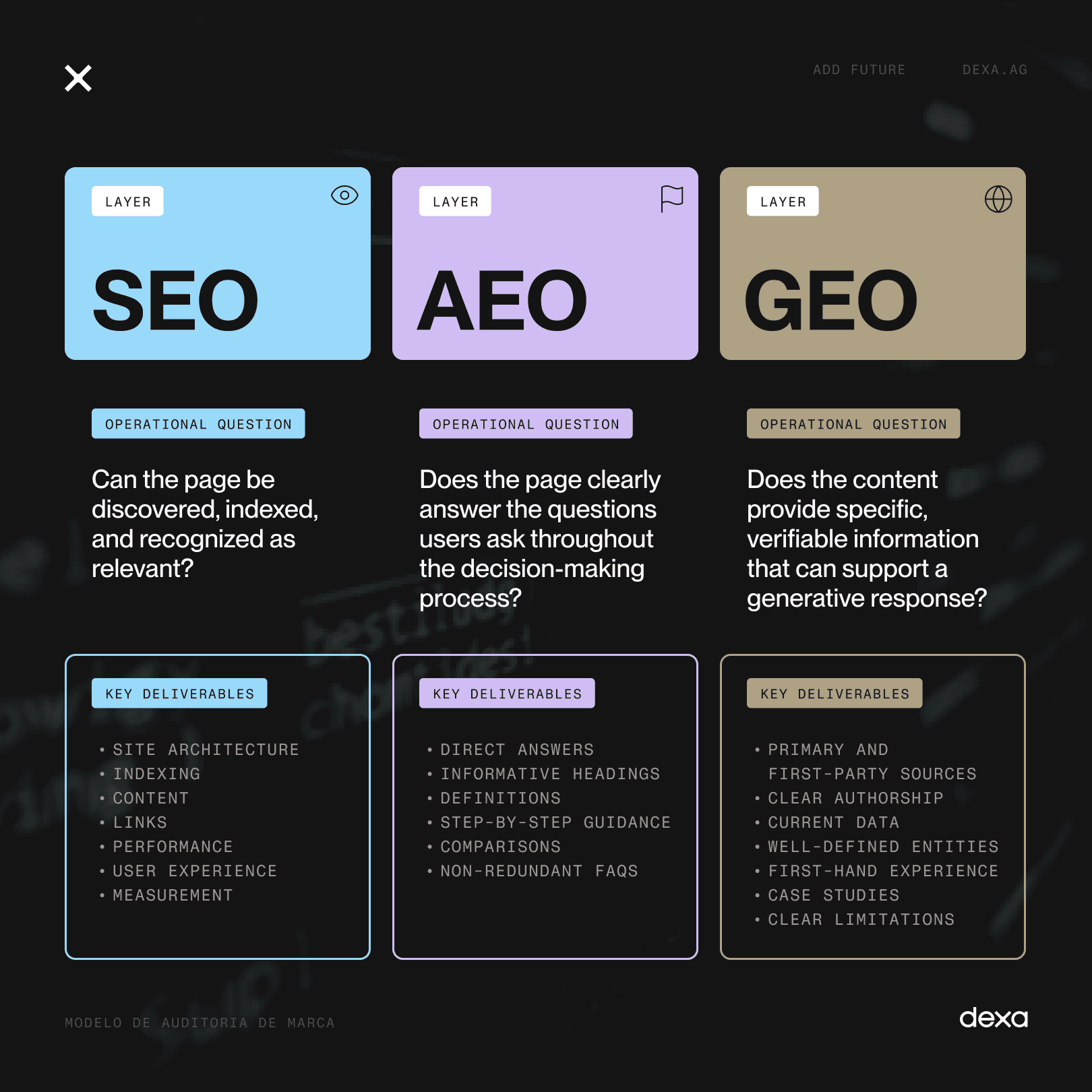
While SEO, GEO, and AEO share a technical foundation, each targets a distinct way users find information online. SEO serves as the bedrock, keeping your site visible, well-structured, and relevant on traditional search engines.
Answer Engine Optimization (AEO) formats content to answer direct questions clearly and immediately. Generative Engine Optimization (GEO) builds contextual depth, verifiable evidence, and domain authority so AI models cite your content as a primary source.
Unifying these three disciplines prevents duplicate effort and conflicting page updates. For content to succeed today, it must be crawlable by search bots, match user intent, deliver direct answers, and provide credible insight. You cannot optimize content for AI engines if traditional search bots cannot crawl or parse your pages.
This separation between SEO, GEO, and AEO is an operational framework to organize strategy, not an official distinction made by search engines. For search platforms, all three are part of modern, expanded SEO: answering user intent with high-quality content, strong technical authority, and solid UX. When a site meets these standards, it naturally earns eligibility across traditional results, featured answer blocks, and AI search tools.
Important Technical Considerations
Structured data helps search engines understand page context and can qualify content for rich results. However, schema tags do not guarantee AI citations nor are they strictly required for inclusion in generative AI engines. Google's official documentation notes that no special schema, mandatory formatting, or llms.txt file is required for generative search eligibility.
Other platforms enforce different access controls. To appear in ChatGPT search responses, your site must allow the OAI-SearchBot crawler. OpenAI's documentation separates this search crawler from GPTBot, which is used for AI model training. Access policies should be managed per bot environment rather than treating all web crawlers equally.
Measurement has evolved as well. Beyond impressions, clicks, indexed URLs, and conversions, consulting teams track AI platform referral traffic, branded search lift, cited URLs, and brand share-of-voice in AI answers.
"In practice, we don't build one page for SEO, another for GEO, and a third for AEO. We build a single URL that is technically clean, editorially sharp, and backed by verifiable data. Then, we measure how it performs across every search environment."
— Micaela Rossetti, Head of Marketing at Dexa
The link between organic search, leads, and revenue
Organic search initiates, deepens, and closes sales cycles. A prospective buyer might discover a problem on Google, compare approaches through an AI answer, read a case study days later, and convert on a branded search. The final touchpoint tells only a fraction of the story.
Tracking rankings and sessions is no longer enough. Performance monitoring must track multi-touch metrics across four distinct levels:
Eligibility & Visibility: Valid indexed pages, search coverage, impressions, position tracking, unbranded query reach, and AI generative features.
Acquisition & Behavior: Organic clicks, user sessions, entry pages, engagement rate, click-through paths, and CTA interactions.
Conversion: Form completions, demo requests, contact submissions, content downloads, and primary event actions.
Commercial Quality: Marketing Qualified Leads (MQLs), Sales Accepted Leads (SALs), deal pipeline velocity, average deal size, and closed-won revenue.
Integrations between Google Analytics 4 (GA4) and Search Console bridge search queries, landing page performance, and user actions. CRM integrations complete the picture by verifying lead quality, pipeline progression, and closed revenue. Attribution models should avoid enforcing false linearity—GA4 multi-touch attribution distributes revenue credit across touchpoints, demonstrating organic search impact across the entire funnel.
How long SEO takes to show measurable results
SEO does not follow a single timeline because different outcomes operate on different schedules. A technical fix can process as soon as search bots recrawl the site. A competitive content piece requires time to accumulate authority signals. Enterprise B2B revenue may take months to reflect in the sales pipeline.
Google notes that recrawling can take anywhere from a few days to several weeks, with no guarantee of instant indexing. During site migrations, small-to-medium sites may require several weeks to process URL changes, while enterprise operations take longer. These timelines reflect discovery and processing speed, not instant page-one rankings or closed deals.
First Clock (Eligibility): Fixes to crawl blocks, redirects, canonical tags, sitemaps, and rendering process as search bots recrawl updated pages.
Second Clock (Visibility): Impression growth, new query rankings, improved CTR, and position gains demonstrate strategic traction.
Third Clock (Business Impact): Qualified leads, sales pipeline, and revenue velocity depend on total market demand, site conversion rates, and B2B sales cycles.
Market size, domain authority, technical execution quality, competition, and publishing frequency influence performance velocity. A reliable partner sets clear interim milestones and hypotheses rather than promising a fixed date for page-one rankings.
SEO runs on three distinct clocks: the time it takes search engines to process technical changes, the time it takes pages to earn keyword visibility, and the time it takes that visibility to impact your sales pipeline. Blending these timelines creates expectations no serious partner can support.
How to evaluate an SEO firm before hiring
Selecting an SEO partner starts with evaluating how deeply they analyze your business context. Industry best practices recommend reviewing past enterprise work, vertical experience, expected outcomes, measurement frameworks, and communication cadences. Be skeptical of any agency promising guaranteed top rankings. A solid firm explains its strategic reasoning and clearly outlines what depends on technical execution.
Relevant Case Studies: Review starting baselines, project timeframes, technical interventions, and commercial outcomes with clear context.
Execution & Engineering Integration: Confirm who handles CMS updates, codebase changes, templates, content publishing, and analytics tagging.
Experience in Similar Operations: Domain size, market complexity, tech stacks, internationalization, and page volume dictate project methodology.
Cross-Functional Expertise: Verify the firm brings or coordinates strategy, technical SEO, content engineering, web dev, UX/CRO, and data analytics.
Backlog Prioritization Methodology: Ask how the team evaluates business impact, dev effort, technical dependencies, and risk to sequence tasks.
Tool Stack Purpose: Analytics tools, site crawlers, speed tools, and log analyzers must serve specific strategic questions. No external tool has access to Google's internal ranking code.
Business-Driven Reporting: Reports must separate visibility, user acquisition, conversion performance, and lead quality while logging deployed updates.
Data Ownership & Transparency: All property permissions, analytics accounts, and data assets must remain fully under your company's ownership.
What determines the cost of SEO consulting
SEO consulting fees reflect the effort required to analyze, implement, and maintain an enterprise search operation. Pricing a project based solely on target keywords is insufficient, as true complexity involves multiple technical, operational, and business factors.
Site Scale & Footprint: Page volume, multi-domain setups, content types, and international localization.
Technical Complexity: Modern JavaScript frameworks, headless architecture, legacy CMS platforms, and custom integrations.
Accumulated Technical Debt: Historical redirect loops, indexation errors, duplicate content, and failed past migrations.
Content Scope: Market research, content brief creation, technical editing, original writing, and ongoing content optimization.
Execution Scope: Advisory-only recommendations versus hands-on code implementation, deployment management, and vendor coordination.
Market Competition: Regional, national, or global search competitiveness within your vertical.
Governance & Data Depth: CRM integration, custom BI dashboards, executive reporting, and cross-departmental alignment.
Standard engagement models include fixed-scope projects, dev implementation sprints, monthly retainers, or hybrid models. When evaluating proposals, focus on scope alignment, clear responsibilities, and success metrics rather than monthly cost alone.
What Dexa does differently to drive organic growth
At Dexa, SEO doesn't end with an audit report, nor is it confined to the marketing team. Our differentiator is connecting Digital Growth, technology, user experience, content engineering, and analytics into a unified execution plan.
Every engagement begins with an analysis of your business model and digital ecosystem. Technical debt, architecture gaps, content needs, and conversion barriers are organized into an executable backlog prioritized by impact, dev effort, dependencies, and risk.
"In SEO, technical analysis must become an executable backlog with clear ownership, priorities, and deployment benchmarks. Connecting strategy, tech, content, and business goals prevents SEO from ending up as just another ignored report."
— Micaela Rossetti, Head of Marketing at Dexa
This integrated model allows us to fix crawling blocks, restructure site architecture, build high-performing topic clusters, produce content tailored for SEO, GEO, and AEO, and manage deployment directly with your engineering team.
Measurement goes beyond rankings and traffic volume. By integrating Search Console, GA4, and CRM data, we track how organic search expands visibility, drives high-intent leads, and builds measurable sales pipeline.
Transform your SEO into a high-performing organic growth engine.


