Anyone researching business website cost quickly runs into quotes that sit far apart for what looks like the same request. The gap exists because 'build us a corporate website' can describe very different projects behind the scenes, and the way the site is built has a direct effect on what it does for the business.
That is why starting with price leaves many leadership teams frustrated. The question that should guide the decision is a different one: what results should the site deliver over the next three years? Generating qualified leads, supporting the company's reputation with customers, investors, and job candidates, letting marketing publish without waiting on a vendor, or connecting to internal systems. Each answer changes what goes into the project, and the price changes with it.
This article covers what is included in the price of a corporate website, the factors that weigh most on a quote, the warning signs in proposals that look too cheap, and how to compare vendors with the post-launch cost in view.
Scope first, price second
Dexa works with you to define goals, journeys, content, and integrations so the quote reflects the right project from the first conversation.
How much does a business website cost?
There is no single price for a corporate website. Costs vary widely from one project to the next, depending on what the site needs to deliver and how it will run after launch. These are the factors that carry the most weight in a quote:
Number of pages and templates: page count alone says little about cost. Ten service pages built on the same structure take less work than three pages with different layouts, because design and development effort goes into the page template, not into how many times it gets filled in.
Project complexity: a lean corporate site, a portal serving several business units, and a family of brand sites on a shared platform call for architecture, content, and governance at very different scales.
CMS and editorial autonomy: the platform determines licensing costs and how much the team depends on the vendor. A CMS that lets marketing assemble landing pages from ready-made components costs more to set up and much less to run day to day.
Localization: every additional language expands the architecture, the content, and the maintenance load.
Content and migration: writing from scratch, editing existing copy, and migrating hundreds of pages are jobs of very different sizes. Large migrations require scripts, as with the more than 2,000 pages migrated automatically across Hospital Sírio-Libanês's portals.
Integrations: each connection to a CRM, marketing automation platform, ERP, careers platform, or customer portal involves its own data mapping, development, and testing.
Strategy, design, and technical SEO: discovery, journey mapping, a custom visual identity, and a redirect map that protects organic traffic take more work than adapting an off-the-shelf theme.
Compliance: regulated industries such as healthcare and financial services bring audit, uptime, and data protection requirements that shape the project from the architecture up.
Hosting and ongoing support: infrastructure, monitoring, security updates, and continued development stay on the bill for years after launch.
Timeline: a compressed schedule means more people working in parallel.
None of these factors adds cost without a reason: cutting one usually means paying for it later, with more urgency and less planning. For an enterprise website with multiple brands, integrated systems, and governance requirements, the investment is defined through a discovery assessment.
Site builder or custom build: which one fits your company
Builders such as Wix, or WordPress with a ready-made theme, work well for a company that needs a basic online presence: introducing the business, listing contact details and location, and posting a few updates a year. For that goal, paying for discovery, information architecture, and integrations would be wasted money.
The math changes once the site carries a meaningful share of the commercial operation. These signs indicate the project already calls for a custom build:
Leads from the site need to reach the CRM with source and context, not land in an email inbox;
The marketing team publishes pages and content often and doesn't want to file a ticket for every change;
The site runs in more than one language or brings together more than one brand;
Forms collect personal data, and the company is accountable for it under privacy laws such as the CCPA in California or the GDPR in the European Union;
The brand has been repositioned, and the website is the first place the change will show.
What's included in the price of a corporate website
Company website cost also depends on which phases are built into the final number, and they don't always appear under the same name in every proposal. The table below shows what each one involves and what happens when it's left out of the quote, which is where the gap between two prices for the 'same' site comes from.
Phase | What it involves | If it's cut from the quote |
Discovery and strategy | Stakeholder interviews, analysis of current site data and competitors, goals and metrics | The site is designed on assumptions, and rework shows up after launch |
Information architecture and content | Sitemap, page hierarchy, copywriting or editing, migration of existing content | Content arrives late, off-standard, or with no place in the approved layout |
UX and UI design | Journeys, wireframes, layouts, and a reusable component library | Every new page has to be designed from scratch |
Development and CMS | Front end, back end, CMS configuration, and editing permissions | Marketing depends on the vendor for every change |
Technical SEO | URLs, headings, structured data, performance, and redirect map | The new site loses the organic traffic the old one had |
Accessibility and privacy | WCAG conformance, plus consent management for forms and cookies under applicable privacy laws | Part of the audience is shut out, and the company is exposed to legal claims |
QA and launch | Cross-browser and cross-device testing, form and integration testing | Bugs surface on the live site, in front of customers |
Training and documentation | Team training and technical documentation for the project | Any change of vendor or team means starting over |
Accessibility is often treated as optional, and it isn't. The U.S. Department of Justice has consistently taken the position that the ADA applies to the web offerings of businesses open to the public, such as retailers, banks, and hotels. For state and local governments, the rule the DOJ issued in 2024 sets WCAG 2.1 Level AA as the technical standard, a useful reference for private companies measuring their own conformance. When one proposal costs a third of another, check whether accessibility and other phases in the table were dropped from the package or handed to your team.


Warning signs in a website quote that's too cheap
A low price on its own doesn't mean a bad project. The risk appears when the price drops because everything that isn't visible on launch day has been taken out of the package. These are the most common signs.
The proposal doesn't spell out what's included
A proposal with a single line reading 'corporate website design' followed by a number leaves open the number of page templates, rounds of revisions, content production, and integrations. Every undefined item tends to turn into a change order or a mid-project dispute, at a point when switching vendors is already expensive.
The domain, code, and accounts are in the vendor's name
A domain registered to the agency, hosting under the vendor's account, and theme licenses in the vendor's name create a dependency that only surfaces when the relationship ends. Registering a domain is one of the smallest line items in any website budget, so there's no financial reason to leave it with a third party. The contract should require handover of the source code, credentials, and technical documentation.
Technical SEO reduced to a plugin
Installing an SEO plugin doesn't fix heading structure, page speed, structured data, or the sitemap. The most critical moment comes when the site is replaced: without a redirect map, old URLs that brought in organic traffic start returning errors, and the company loses in weeks the visibility it took years to build. SEO services are often brought in precisely to recover that kind of loss.
Maintenance left out of the conversation
Every website runs on software that receives security patches. Patchstack's State of WordPress Security in 2026 report recorded 11,334 new vulnerabilities in WordPress during 2025, 91% of them in plugins, and 46% had no patch available when they were disclosed. A site assembled from dozens of plugins, with no update agreement in place, stays exposed no matter how much it cost to build.
A timeline that can't fit the work
Promising a complete corporate website in one or two weeks signals that discovery, content, and testing were removed from the schedule or pushed onto the client. A short timeline can make sense for a campaign landing page, but rarely for the site that represents the company.
Compare quotes on equal terms
At Dexa, phases, deliverables, code ownership, and ongoing support are spelled out before anything is signed.
Switching development partners: what to check before fixing or rebuilding your website
Many website projects don't start from scratch. The company already has a site delivered by another vendor that ended the contract, stopped responding, or left behind a platform nobody can evolve. Before any quote, the first step is a technical audit, because the condition of the inherited site determines whether it pays to fix what exists or to rebuild.
'When a client comes to us with an inherited site, the first conversation is rarely about design. It's about who has access to the domain, where the code lives, and whether there's a copy anywhere outside the server. The choice between fixing and rebuilding often becomes clear right there: if nobody can answer, every change will open up another problem,' says Luiz Petri, Director of Solutions at Dexa.
An audit of an inherited site answers six questions:
Ownership and access: whose name are the domain, hosting, code repository, CMS, Google Search Console, and Google Analytics registered under?
Platform version: are the CMS, PHP, themes, and plugins still receiving security updates?
Code and documentation: is there a version-controlled repository, a staging environment, and technical documentation, or does the site exist only on the production server?
Integrations: are forms, the CRM, and automations passing data correctly?
SEO and performance: what do organic traffic history, crawl errors, redirects, and Core Web Vitals look like?
Licenses: are paid themes and plugins active and registered to the company?
With those answers, the decision becomes objective. Fixing pays off when the platform is supported, the code is organized, and the problems are concentrated in specific areas. Rebuilding tends to cost less when the foundation is outdated, undocumented, and tied to abandoned plugins, because every fix starts opening a new problem.
Total cost of ownership: what your website costs after launch
Total cost of ownership (TCO) is the initial investment plus everything the company spends to maintain, secure, and evolve the site over its lifespan. Knowing the cost of a corporate website at launch answers only the first part of the equation. Comparing proposals on build price alone is like comparing the first payment on a loan without looking at how many payments follow.
Recurring costs of a corporate website
The fixed part of the bill includes the domain, hosting, SSL certificate, licenses, and backup and monitoring routines. An SSL certificate can be free, issued by certificate authorities such as Let's Encrypt, and the real cost lies in configuring and renewing it without interruptions. Hosting ranges from shared plans to managed cloud environments, and the right choice depends on traffic, uptime requirements, and integrations.
Platform upgrades and end of support
Every platform has a life cycle. Drupal 7 reached end of life on January 5, 2025, and companies that hadn't planned the transition suddenly had a mandatory migration project in their budget. The same applies to PHP versions, themes, and plugins.
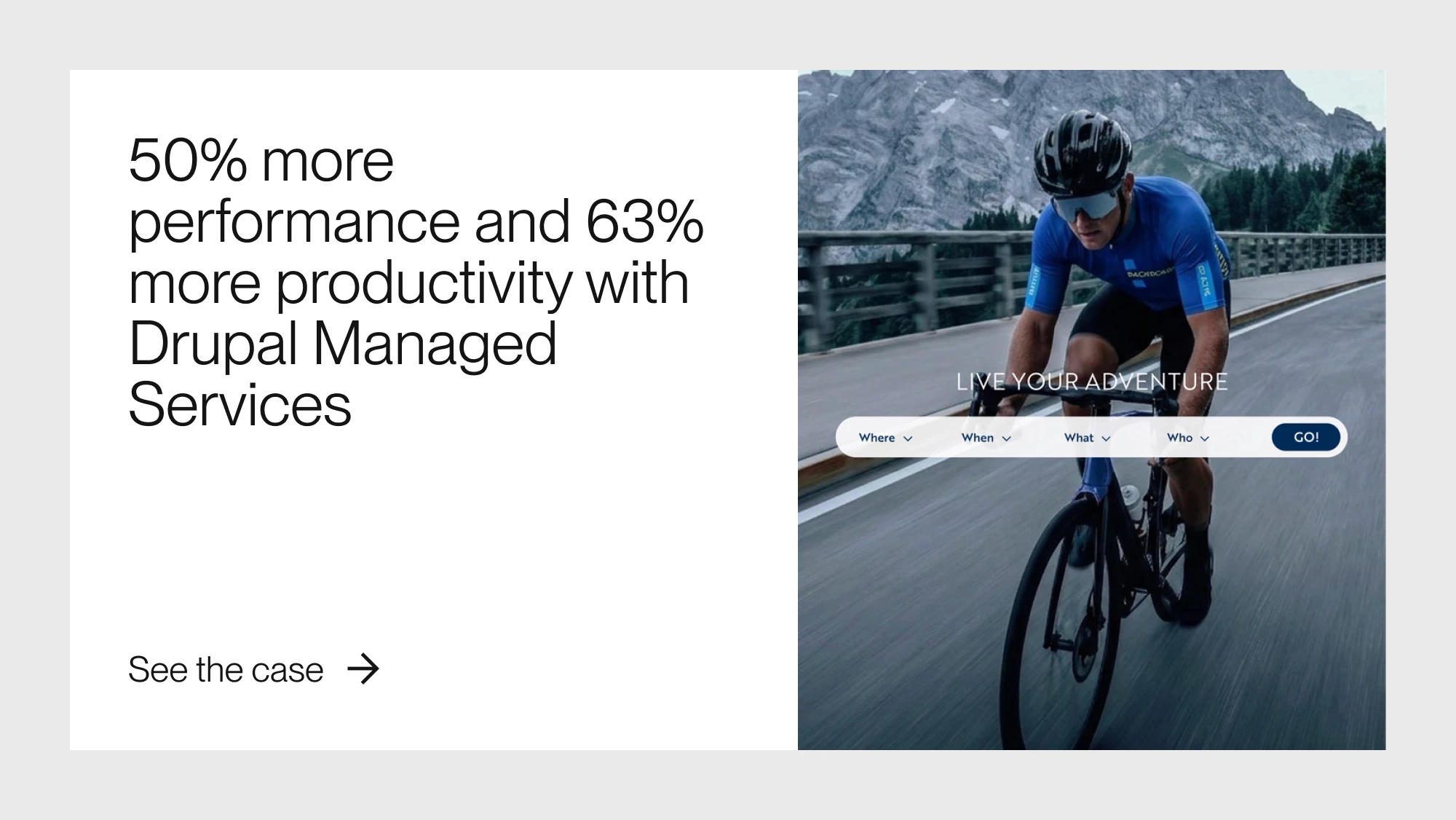
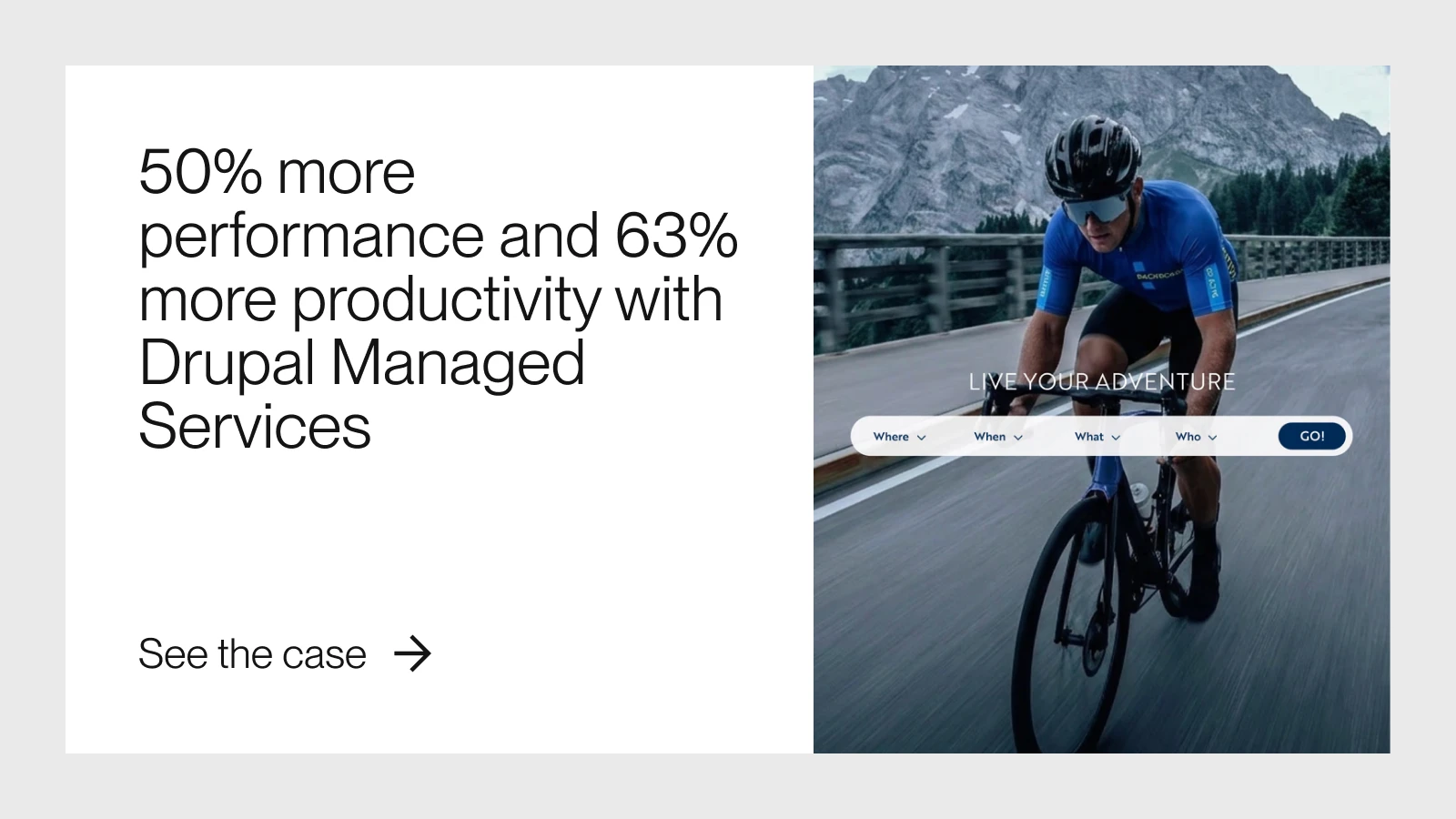
The alternative is to upgrade continuously. For Backroads, the California-based active travel company, the platform was modernized step by step from Drupal 8 to versions 10 and 11 under an ongoing support contract, with a 50% reduction in response time on trip listing pages.

Ongoing development and opportunity cost
When every new page depends on a developer, a recurring cost appears that the original proposal never showed: vendor hours and delayed campaigns. Performance has a price too. In the Milliseconds Make Millions study, conducted by Deloitte and commissioned by Google, a 0.1-second improvement in mobile load time was associated with a 21.6% increase in the number of users who moved from the first step of a form to submission on lead generation sites.
Redesigning too soon
Sites built without room to grow usually need a redesign within a short time. An early redesign means paying again for discovery, design, development, and SEO migration, with the added risk of losing traffic in the switch. If you're already at that point, our guide on how to plan a website redesign that delivers results covers the steps that protect the investment.
Enterprise corporate websites: when the project doesn't fit a price list
Companies with multiple brands, business units, portals for different audiences, or integrations with critical systems have needs that market price ranges don't describe. An enterprise website is often a group of sites on a shared architecture, with content governance, role-based permissions by department, auditable accessibility and security requirements, and an ongoing support plan backed by a service level agreement (SLA).
In these projects, corporate website pricing is defined after a discovery phase that measures the number of sites and languages, the volume of content to migrate, integrations, regulatory requirements, and the operating model after launch. Any fixed price given before that assessment is an estimate with a wide margin of error, in either direction.
The project for Hospital Sírio-Libanês, one of Brazil's leading hospitals, shows the scale involved: five corporate portals delivered in about five months, with more than 400 pages built through visual editing, more than 2,000 migrated by script, and critical integrations with Salesforce and Banco Safra rebuilt without service interruption. This is the kind of work Dexa's Enterprise Technology team handles, combining enterprise CMS, integrations, and continuous support.
How to compare corporate website proposals
Comparing well means putting proposals side by side against the same questions. The answers show what each vendor understood about your business and where the costs that haven't surfaced yet are hiding.
Question for the vendor | Why it matters | Answer that deserves a closer look |
What goals and metrics will the site serve? | Shows whether there was an assessment before the price | The proposal mentions no business goals |
How many page templates and components are planned? | It's the real basis of design and development effort | Only the number of pages |
Who produces and migrates the content? | Content is the most common cause of delays | 'Content provided by client,' with no deadline or support |
Which CMS will be used, and how much autonomy will the team have? | Determines the cost of evolving the site after launch | Every change requires a ticket to the vendor |
How will SEO migration be handled? | Protects the organic traffic you've earned | No mention of redirects |
Whose name will the domain, hosting, code, and licenses be under? | Ensures the company controls its own site | Everything registered to the vendor |
What happens after launch? | Reveals the total cost of ownership | A 30-day warranty and no support plan |
What similar projects has the vendor delivered? | Indicates experience at your level of complexity | A portfolio of screens with no context or results |
To evaluate the vendors themselves, and not just their proposals, our article on how to choose the right digital agency covers what to look for in a partner before you sign.
Get a quote for your corporate website
Dexa builds corporate websites and enterprise portals by combining Experience Design and Enterprise Technology, from defining goals and journeys to ongoing support after launch. To find out what a website will cost for your company's needs, request a quote and receive a plan that spells out phases, deliverables, code ownership, and maintenance.
Frequently asked questions
How much does a custom business website cost?
Why does corporate website pricing vary so much?
What should a corporate website quote include?
How much does it cost to maintain a corporate website each year?
Is Wix or a WordPress theme a good option for a corporate website?
Who should own the website's domain and code?
When does a corporate website need an enterprise project?