Many companies expand their portfolios, enter new markets, and launch modern websites without changing how the market perceives them. Their services evolve, but their communication remains tied to an earlier stage of the business. When each department presents a different version of the company, the audience is left to figure out the brand’s true value.
Brand strategy brings order to this situation. It defines the position the company intends to occupy, who it wants to matter to, and which associations it needs to build.
This clarity supports practical day-to-day decisions and determines how the portfolio is presented, which messages take priority on the website, how products and sub-brands relate to one another, and which elements should remain consistent across different touchpoints. Marketing, sales, product, and design can then work from a shared point of reference.
In this article, you will learn which components make up a brand strategy, how to develop one, and when to revisit it. You will also see how to turn these definitions into a digital experience that can sustain the company’s positioning over time.
Your brand with more power, clarity, and intent
We combine diagnostics, positioning, and visual identity to strengthen brand perception and support strategic decisions.
What is brand strategy beyond a logo and visual identity?
Logos, colors, typography, and graphic elements make a brand recognizable. Before any of them come into play, however, a deeper set of decisions must be made. This is where brand strategy operates. It connects business goals, the competitive landscape, audience behavior, and the organization’s actual capabilities. The result is a shared direction for communication, experiences, products, and relationships.
Consider a technology company that wants to be perceived as a strategic partner. If its website highlights only programming languages, tools, and development capabilities, while its proposals focus on scope and price, the market will continue to see it as a technical vendor.
Its consulting capabilities may exist internally but remain largely invisible. Changing this perception would require demonstrating them across different touchpoints:
Case studies that explain decisions, methods, and business impact.
Service pages organized around challenges and outcomes.
Proposals that demonstrate strategic thinking.
Content that interprets market developments.
Client service processes consistent with a consultative approach.
In this way, strategy narrows the gap between the position the company intends to occupy and the perception its audience forms. Visual identity translates this direction, but cannot define it on its own.
Brand strategy versus marketing strategy
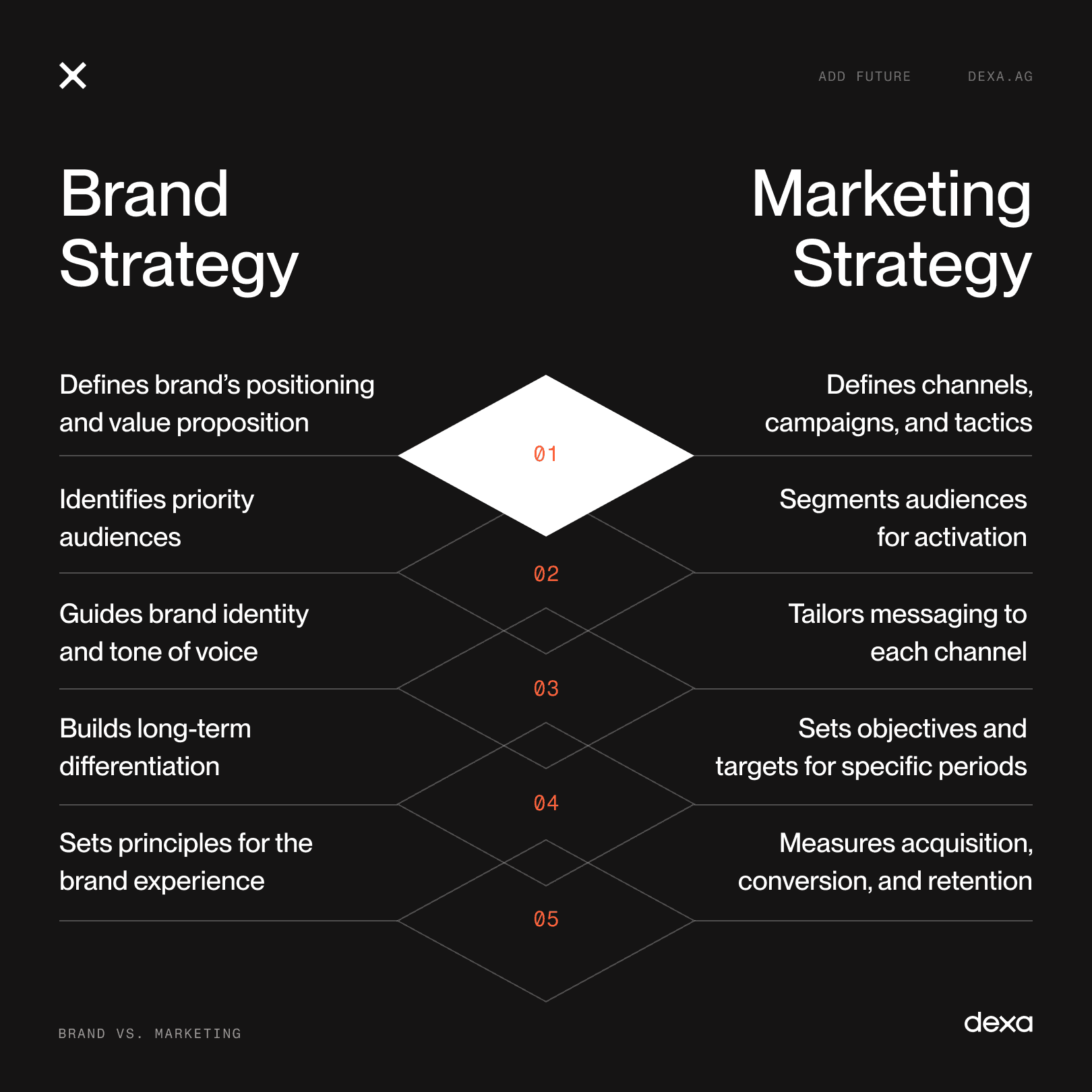
Brand and marketing shape the same perception, but they begin with different questions. Brand strategy defines who the company is, the position it wants to occupy, and the associations it needs to build. Marketing strategy determines how to take that proposition to market, generate demand, and convert opportunities.
The relationship can be understood as follows:
A campaign can generate traffic and leads without strengthening the brand. This happens when the message captures attention but fails to establish a recognizable point of difference. The opposite can also occur: a company has a consistent proposition but does not invest in the channels needed to make it known.
Marketing extends the brand’s reach. The brand gives marketing direction and coherence. When the two strategies are disconnected, the company may gain visibility but struggle to turn exposure into preference.
What are the components of a brand strategy?
There is no single model that works for every organization. The appropriate level of depth depends on the industry, stage of the business, number of audiences, and portfolio structure. Even so, several components frequently appear in actionable strategies.
→ Business and market context
The strategy begins with an analysis of the revenue model, growth goals, portfolio, markets served, and shifts in the category. It also examines how customers, employees, and partners perceive the company.
This assessment identifies recognized attributes, perception gaps, and points of difference that are not yet fully understood. As a result, the strategy is grounded in actual capabilities and evidence, rather than the organization’s internal perspective alone.
→ Personas
Personas turn audience data into profiles that guide brand, content, and communication decisions. They can be developed using a combination of research, interviews, sales data, search behavior, and insights from sales and customer service teams.
The analysis considers goals, needs, barriers, objections, decision criteria, research habits, and communication preferences. This mapping helps define the right messages, proof points, and touchpoints for each persona’s context.
→ Brand purpose and guiding principles
Purpose explains why the company exists and the contribution it intends to make through its work. To guide decisions, it must be connected to the business model and reflected in the organization’s practices.
The strategy may also include vision, values, principles, and long-term ambitions. These elements guide behavior, support opportunity assessment, and preserve coherence during periods of change.
→ Brand positioning
Positioning defines the space the company intends to occupy in the audience’s perception relative to the available alternatives. It establishes who the brand is relevant to, the category in which it competes, the value it offers, how it differs, and the evidence that supports this difference.
Positioning requires companies to prioritize associations. Terms such as quality, innovation, and customer focus provide little distinction without specific meaning and proof.
→ Value proposition
The value proposition explains the benefit the company delivers, who it serves, and why its offering deserves to be chosen. While positioning organizes the competitive space, the value proposition makes the delivery behind that position tangible.
A company specializing in the modernization of mission-critical digital platforms, for example, might demonstrate its value by reducing migration risks, ensuring operational continuity, and preparing the architecture for future development. This proposition should guide service pages, content, presentations, and sales conversations.
→ Verbal identity and tone of voice
Verbal identity translates the brand’s personality into guidelines for language. It defines vocabulary, level of technical detail, rhythm, sentence structure, the way arguments are presented, and adaptations for different audiences and channels.
The voice preserves the brand’s recognizable traits. The tone changes according to the situation. A corporate page, an error message, and a customer service interaction require different approaches, but should remain consistent with the same identity.
→ Visual identity and distinctive assets
Visual identity translates the strategy into a recognizable system composed of a logo, colors, typography, shapes, graphic elements, iconography, photography direction, and interface patterns.
When people recognize these elements and correctly associate them with the company, they become distinctive assets. They make the brand easier to identify and preserve its unity across channels and touchpoints.
How does brand strategy contribute to brand equity?
Brand equity is the value a brand accumulates through the awareness, associations, trust, and preference it builds among its audiences. This asset influences how the company is perceived, considered, and chosen, even when technically similar offerings are available in the market.
It develops over time. Every campaign, sales interaction, product experience, published piece of content, or customer service interaction strengthens or weakens certain perceptions. Brand strategy organizes this process by defining which associations should be built, which evidence will support them, and how they will appear across different touchpoints.
Brand equity can be assessed through dimensions such as:
Brand awareness: The audience’s ability to recognize or recall the company in situations related to its category.
Brand associations: The ideas, attributes, benefits, and contexts connected to the brand in people’s minds.
Perceived quality: The audience’s assessment of the company’s delivery capabilities, even before experiencing the offering.
Trust: Confidence that the company will deliver on its promise and reduce the risks involved in the choice.
Preference: The tendency to consider or choose the brand over the alternatives.
Loyalty: The willingness to stay, buy again, renew contracts, or recommend the company.
Strategy contributes to these dimensions by turning positioning into an actionable system. Visual identity supports recognition. Verbal identity reinforces messages. The value proposition makes the benefits understandable. Reasons to believe build trust. The experience confirms whether the promise matches the delivery.
This coherence is particularly relevant in B2B or highly complex markets. The greater the financial, technical, or operational risk of a decision, the more weight reputation tends to carry. A brand known for security, expertise, or predictability may appear earlier on a shortlist of potential vendors and face less resistance during the evaluation process.
Does your brand compete for high-stakes decisions? See how brand experience supports perceived value and preference.
10 signs it is time to rebuild your brand strategy
Not every change calls for a complete rebrand. In some cases, adjustments to messaging or governance solve the problem. In others, the existing strategy no longer reflects the business the company has become.
A review is generally needed when:
The company has grown but is still associated with an old offering.
New services have no clear place in the portfolio.
Marketing, sales, and leadership describe the company in different ways.
Price is the company’s primary sales argument.
The visual identity no longer supports the company’s current channels and products.
Mergers or acquisitions have created overlap between brands.
The audience does not clearly understand the value proposition.
Communication changes completely from one campaign to the next.
The website presents capabilities but does not help customers understand why they should choose the company.
The desired reputation does not match the associations found in research.
Another important sign emerges when growth increases inconsistency. Each new department creates its own presentation, materials, and way of explaining the company. The problem is no longer limited to communication. It begins to affect efficiency, recognition, and governance.
How to develop an actionable brand strategy
The process needs to combine market analysis, positioning decisions, and practical implementation. A well-structured document has little impact when teams cannot use it in their day-to-day decisions.
1. Assessment
The first step examines the business, market, competitors, audiences, culture, and current perceptions. Interviews, research, data analysis, and communication audits help reveal strengths, inconsistencies, and opportunities.
It is also important to map the gap between internal and external perceptions. Attributes that leadership values are not always recognized by customers. Likewise, characteristics seen as ordinary within the company may represent meaningful points of difference in the market.
2. Strategic decisions
The assessment informs decisions about priority audiences, positioning, value proposition, guiding principles, personality, and brand principles. This step requires difficult choices. The more generic the definitions, the less useful they will be in guiding marketing, design, or technology decisions. Each attribute should connect to an objective and to evidence that makes it credible.
3. Visual and verbal expression
The strategic direction is translated into a visual identity, verbal identity, key messages, and behavioral standards.
The goal is to create a system that is flexible enough to work in different contexts while preserving recognizable elements. The brand needs to adapt to a technical report, a media campaign, or a sales conversation without appearing to be a different organization in each situation.
4. Documentation
The guidelines should be recorded in a clear, usable format. Depending on the project, this may involve:
Strategic positioning document.
Brand book and design guidelines.
Tone of voice and writing guide.
Corporate messaging framework.
Asset library and Design System.
Documentation needs to help teams address real situations. Excessively abstract materials increase the need for interpretation and make new inconsistencies across digital channels more likely.
5. Implementation
Implementation should prioritize the touchpoints with the greatest influence on customer perception and choice. These include the corporate website, digital products, sales presentations, customer service channels, and growth campaigns.
Internal teams also need to be prepared. Successful branding depends on people who can apply the guidelines to day-to-day development and marketing work.
6. Governance
Governance defines responsibilities, approval processes, update procedures, and criteria for new brand applications. Without an active structure, the brand becomes fragmented again as new demands, vendors, and channels emerge. Governance maintains consistency without preventing digital platforms from adapting and evolving naturally.
How does brand strategy shape the digital experience?
The digital experience is one of the main environments where brands are built today. In many businesses, the website or platform is the first meaningful touchpoint and also the space where users evaluate whether the corporate promise holds up in practice.
For this reason, the strategy should guide decisions such as:
Information architecture
Positioning and the value proposition help define how content, services, and products are organized in the user interface. An architecture based only on the company’s internal structure can make the website difficult for visitors to understand.
Message hierarchy
The strategy determines which ideas need to appear first, which benefits should be explained, and which evidence reduces uncertainty during the buying process. This avoids pages that present numerous technical capabilities but obscure the central value.
UX writing
Interface copy also expresses the brand. Buttons, forms, confirmations, and error messages need to combine functional clarity with the verbal identity defined in the strategy.
Interface and Design System
Colors, typography, components, and interaction patterns translate visual principles into a consistent experience. A Design System allows teams to apply this logic at scale and maintain unity across digital products and pages.
Content and acquisition
SEO, paid media, and content marketing bring the brand into different moments of the search journey. The strategy helps preserve coherence between the intent that attracts users and the experience they find after clicking.
The digital experience needs to confirm the desired market position. A brand that promises autonomy should offer simple journeys and accessible information on its website. A company positioned around technical expertise needs to demonstrate depth in its digital content and products.
Want to align your brand and interface? Learn how the user journey supports conversion and retention.
How does Dexa connect brand strategy and digital experience?
At Dexa, our Strategic Branding work begins with an analysis of the business, market, audiences, and current brand perception. Based on this assessment, we define positioning, value proposition, visual identity, verbal identity, and governance.
As a full-service digital experience agency, we can also bring this strategy to the company’s main touchpoints:
Experience Design: Translates the brand into journeys, interfaces, and Design Systems.
Digital Growth: Expands its presence through content, media, SEO, and GEO.
Enterprise Technology: Supports the experience through secure, integrated, scalable platforms.
This integrated approach keeps the brand from being confined to a manual. The same strategic direction can guide the website, digital products, campaigns, and corporate communication.
Want to turn your positioning into a recognizable, actionable brand? Discover Dexa’s Strategic Branding solutions.