User Journey: The invisible structure that sustains conversion and retention
Experience Design

The user journey is no longer a conceptual tool limited to UX. It now plays a strategic role in digital operations that aim for consistent growth. Companies that still organize their online presence through isolated pages, fragmented campaigns, or disconnected functionalities may generate traffic, interaction, and attention. What they fail to sustain, however, is progression. The result is activity without real advancement.
For many years, improving experience meant reorganizing menus, reducing clicks, adjusting CTAs, and making interfaces more intuitive. This still matters. But it is no longer enough to address the complexity of digital behavior.
Users research, pause, compare, return days later, switch devices, consult multiple sources, refine their perception of value, and distribute their decisions across multiple touchpoints. What we see today is a non-linear and distributed decision process.
The experience is no longer confined to a single screen or a single visit. Its relevance lies in making the user path readable. What matters is not where the interaction happens, but how the progression unfolds over time.
The user journey reveals where the relationship between user and brand begins, what drives progression, which barriers create hesitation, what signals build trust, and why many users engage without converting or staying. Its value is not in mapping steps visually, but in structuring behavior into decision logic.
When properly designed, the user journey strengthens acquisition, improves conversion, reduces friction, supports adoption, and increases retention. More importantly, it creates alignment between SEO, UX, content, technical performance, and business strategy. In other words, it becomes a unifying layer across disciplines.
Throughout this article, we will explore this logic in depth, covering definition, strategic value, journey stages, search intent, personas, mapping, metrics, and continuous optimization tools. If your company wants to stop operating in silos and start building coherent growth, keep reading.
What defines the User Journey
The user journey is the structured representation of the path a person follows from their first interaction with a brand to the consolidation of an ongoing relationship.
This definition may seem simple, but its scope is broader than it appears. The journey does not only describes what users do within a website or platform. It organizes what they are trying to understand, what they expect to find, which obstacles they face, what perceptions they develop, and why they move forward, hesitate, or abandon. It is, essentially, a framework for understanding decision behavior.
At this point, it is important to distinguish journey from flow. A flow belongs to the operational layer of an interface. A journey belongs to the relational layer of the experience. The flow shows sequences of actions inside a feature. The journey reveals progression across discovery, evaluation, decision, use, and retention. Looking only at flows improves internal interactions. Looking at the journey reveals the broader logic that sustains or interrupts progression.
Consider a B2B company searching for a new digital experience platform. The relationship may begin with a broad Google search about digital architecture. Then the user reads a technical article, returns days later to compare solutions, visits service pages, shares content internally, looks for case studies, searches for the company name, contacts sales, and after contracting, goes through onboarding and follow-up.
At no point does this process fit into a single interface or flow. What exists is a distributed sequence of interactions, evaluations, and decisions. That is the user journey. It reflects a multi-touch, multi-moment decision process.
Once a company understands this, it stops trying to solve everything with a well-designed page or a stronger CTA. Instead, it starts building coherence between content, technical depth, information architecture, value proposition, experience stability, and relationship continuity. The focus shifts from isolated improvements to systemic consistency.
Strategic value for conversion and retention
The journey becomes strategic because it exposes the gap between what the company offers and what the user needs to go through to trust, decide, and stay. In low-maturity digital operations, marketing, UX, SEO, product, and sales often work in parallel. There is traffic, content, pages, campaigns, and features, but there is no articulation between the stages that actually sustain progression. This results in fragmented efforts with low cumulative impact.
This misalignment generates silent and recurring losses. Users encounter content that does not match their stage, access pages that push for decisions too early, receive vague arguments when they still need clarity, and go through post-conversion experiences that fail to sustain the promised value. The impact appears in scattered metrics such as low-quality leads, weak activation, high abandonment, churn, and low retention. These are symptoms of a broken progression structure.
The journey organizes this disorder by connecting intention, moment, and response. In conversion, this means delivering the right depth for each stage. Discovery requires clarity and context. Consideration demands substance and differentiation. Decision requires trust, proof, and clarity of value. Without this structure, companies attempt to convert everyone in the same way and reduce efficiency. What changes here is the ability to adapt communication to cognitive readiness.
In retention, the impact is even greater. Many companies treat conversion as the finish line, when it should be seen as a transition point. Retention depends on onboarding, consistency, support, predictability, and continuous value delivery. Loyalty is not created at the moment of conversion. It is built through ongoing relevance after entry.
The five stages of the User Journey
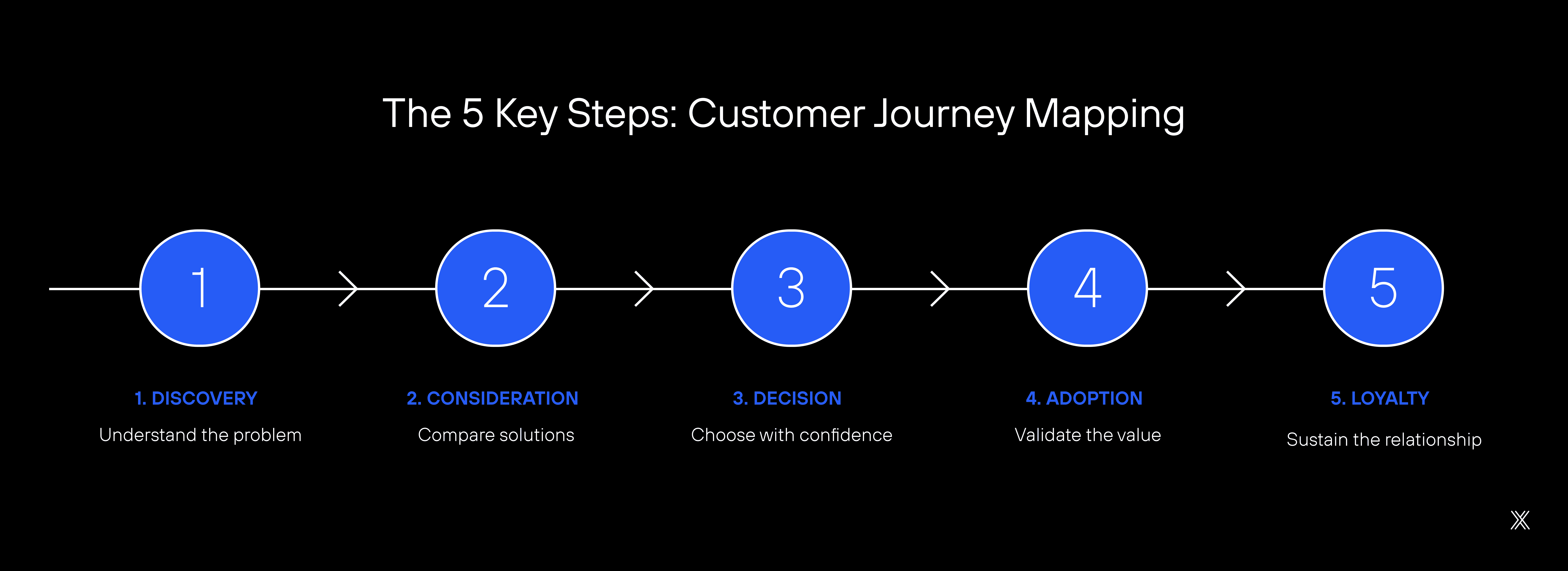
The user journey may vary depending on industry, business model, and solution complexity. However, there is a recurring structure that helps interpret how relationships evolve. It is typically organized into five stages, each representing a level of maturity in the decision process and indicating what the user needs at each moment.
Discovery
Discovery is the moment when the user begins to identify a need, recognize a problem, or explore an opportunity. At this stage, the connection with the brand is either nonexistent or very weak. What drives behavior is the attempt to understand what is happening. The user is organizing knowledge, differentiating concepts, and refining their own question. This is a phase defined by exploration and sense-making.
Search intent is predominantly informational. The user is not ready to buy. They want to understand. That is why well-structured, educational, and semantically aligned content performs strongly here. It acts as an entry point and helps establish authority before any commercial logic becomes relevant. The goal is to support thinking, not push decisions.
Brands that try to convert too early weaken their ability to build trust. Being present at this stage means helping the user think more clearly.
→ Want to attract qualified attention from the first interaction? Create content that clarifies before it sells.
Consideration
In the consideration stage, the user has a clearer understanding of the problem and begins evaluating alternatives. The search becomes more demanding. Introductory explanations are no longer enough. The user is looking for criteria, differences between approaches, technical depth, and evidence that a solution makes sense. This is where evaluation replaces exploration.
Search intent becomes investigative. Users seek comparisons, studies, benchmarks, and structured arguments that reduce uncertainty. This stage separates brands that are remembered from those that are seriously considered. Generic content quickly loses relevance. What drives progression is depth with clarity, not volume with superficiality.
In B2B contexts, this stage is critical. Authority moves from perception to rational judgment.
→ Want to be considered as a real option? Deliver content that helps users decide, not just consume.
Decision
At the decision stage, the relationship reaches a point of definition. The user has gathered knowledge, compared alternatives, and now seeks to reduce risk. The experience must demonstrate consistency between what is promised and what is delivered. This is where confidence becomes the deciding factor.
Search intent becomes commercial and transactional. Users look for service pages, proof points, case studies, demonstrations, differentiators, and trust signals. At this stage, any ambiguity carries more weight. Any friction becomes more costly. Weak or generic promises undermine everything built before.
This stage requires a clear value proposition, strong information architecture, decision-oriented content, and a stable digital environment. Conversion depends on clarity, precision, and credibility.
→ If users reach your decision page but do not convert, assess whether the experience builds real trust or just pushes for action.
Adoption
Adoption is when the user begins to validate, through actual use, whether the promised value holds. Many companies underestimate this stage because they focus heavily on acquisition and conversion. However, entry does not guarantee perceived value. Value must be experienced clearly and consistently. This is the stage where expectation meets reality.
New questions emerge. Users seek guidance, documentation, best practices, support, and ways to accelerate results. In more complex products or services, adoption determines whether trust is reinforced or weakened. Poor onboarding or lack of clarity can quickly erode confidence.
A well-structured journey anticipates this moment and treats it with the same level of intelligence applied to acquisition. The goal is to ensure early success and reinforce the decision made.
Loyalty
Loyalty happens when the experience evolves from a one-time interaction into a continuous relationship. Users stay because they perceive consistency, usefulness, predictability, and ongoing value. They return because the relationship continues to make sense. This stage is defined by long-term relevance.
Loyalty is not driven by superficial delight. It depends on sustained delivery. Users who remain engaged find technical stability, relevant communication, reliable support, and continuous improvement. The experience respects their time and intelligence.
Companies that operate at a higher level do not compete for clicks or attention alone. They compete for retention and preference. One common mistake is creating technically correct content that does not match the user's stage. The page exists, the keyword is present, traffic may even come, but the response is misaligned in timing, depth, or audience.
When content and experience are aligned with progression, SEO becomes a mechanism for qualified advancement, not just visibility.
→ Want to improve organic performance strategically? Ensure each content piece responds to the right stage, not just the main query.
Personas and journey precision
The user journey only becomes truly strategic when it moves beyond a generic path and reflects real behavioral profiles, expectations, and decision patterns. This is where personas gain relevance. Not as illustrative elements, but as analytical tools that make mapping more accurate and applicable. They transform the journey into a realistic representation of decision diversity.
Different users can go through the same stage and still interpret needs, barriers, and trust signals in very different ways. A technical leader and a marketing leader may both be in the consideration phase, yet operate under completely different criteria.
The technical leader wants to understand architecture, integrations, scalability, and governance. The marketing leader seeks clarity of impact, strategic alignment, execution capability, and measurable value. Treating both profiles the same creates friction and reduces effectiveness. The journey loses precision when it ignores decision context differences.
Personas help identify objectives, knowledge levels, barriers, trust triggers, sensitivity to performance, tolerance for complexity, and decision logic. With this, the journey stops being abstract and becomes a reflection of real relationships, real tensions, and real expectations.
Read also: Intuitive Design: usability, efficiency, and organic positioning →
Experience Mapping: Touchpoints, emotions, and actionable insights
Mapping the user journey requires method. Without it, the process becomes a visually interesting exercise, but one that is of little use in guiding decisions related to SEO, UX, content, architecture, and performance.
Steps to map with depth
Define the priority persona
Choose which profile will be analyzed first. Trying to map all personas at the same time usually leads to generalization and a loss of quality.Establish the central objective of the journey
Determine which relationship will be analyzed in greater depth: brand discovery, lead generation, conversion, activation, adoption, or retention.List all touchpoints
Include Google, social media, blog, institutional pages, landing pages, sales contact, onboarding, logged-in areas, support, and post-conversion content.Describe intent at each stage
Document what the user wants to understand, validate, or solve at each moment.Map emotions and tensions
Curiosity, uncertainty, urgency, trust, frustration, doubt, and satisfaction have a decisive influence on progression.Associate barriers and friction
Identify points of friction such as shallow content, excessive complexity, slow performance, misalignment between search and page, lack of proof, or poorly structured onboarding.Connect each stage to metrics and improvement hypotheses
Mapping only becomes valuable when it leads to measurable action.
Specialist insight: The best journey map is the one that clearly reveals where user expectations meet weak responses from the company. That is where real opportunity emerge.
Where experience gains or loses strength

The journey rarely breaks in a single, isolated event. Most of the time, it loses traction through microinteractions that seem insignificant when analyzed individually, but collectively weaken the perception of value. Content that poorly addresses an initial question, a slow page, an excessive form, a vague value proposition, confusing navigation, or poorly guided onboarding. Each touchpoint functions as a silent test of trust.
This is why emotions must be taken seriously. Curiosity, doubt, relief, irritation, confidence, and frustration directly influence how users interpret the experience and decide whether to continue. When companies ignore this layer, they begin to read everything only from a functional perspective. They see clicks, pages, sessions, and drop-offs, but fail to recognize the cognitive fatigue that is undermining progression.
Strong experiences maintain perceptual consistency throughout the journey. Users feel that there is logic, coherence, and respect for their moment. This applies both to the first piece of content accessed and to the support stage after conversion. What sustains progression is not an isolated quality, but consistency across the entire experience.
SEO, UX, and the quality of progression
Separating SEO and UX is a misinterpretation. Both operate within the same territory: the quality of the transition between intention and outcome. SEO contributes to discovery, entry, and content relevance. UX sustains understanding, flow, clarity, and progression throughout the experience. When these disciplines operate in isolation, users perceive the disconnect.
A search may generate a click, but if the page fails to meet the expectation it created, progression stops early. A sophisticated interface may exist, but if the content is misaligned with the user's cognitive stage, the experience loses usefulness. More mature digital growth depends on the integration of these capabilities.
This integration also reshapes the logic of performance. Instead of treating SEO as a channel and UX as a subsequent layer, companies begin to treat both as parts of the same journey. This improves rankings, usability, and the quality of progression between stages. It shifts the focus from isolated optimization to end-to-end experience continuity.
Core Web Vitals and the integrity of the experience
Talking about experience without including technical performance leads to an incomplete analysis. The way an interface loads, responds, and maintains visual stability directly influences the perception of quality at every stage of the digital journey.
Core Web Vitals become relevant because they measure the integrity of this experience. They evaluate how fast content loads, how responsive the interface is, and how stable it remains during interaction. These factors go beyond rankings. They impact trust, readability, engagement, and the willingness to continue.
A slow page in the discovery phase discourages deeper exploration. A delayed interaction in the decision stage weakens the sense of control. An unstable interface during adoption erodes perceived reliability. Performance issues do not just affect metrics. They directly shape how the experience is perceived and whether progression continues.
Technical performance should not be treated as an infrastructure detail. It is part of the experience from beginning to end. The more complex the product or digital operation, the greater the impact of technical failures on user progression. Performance is not a backend concern. It is a core component of perceived value.
Tools that support continuous evolution
The user journey should not remain frozen in a workshop or a static document. It needs to be continuously observed, tested, and recalibrated. This is where analytical tools come into play, serving as instruments to interpret real user behavior. They enable a data-driven understanding of progression.
Heatmaps help identify attention distribution, scroll depth, ignored areas, click concentration, and weaknesses in visual hierarchy. They reveal where the interface is wasting energy or creating noise. A/B testing allows hypotheses to be validated methodically by comparing variations of content, structure, calls to action, forms, or information hierarchy to determine what actually improves progression. These tools turn assumptions into validated insights.
Analytics platforms deepen this understanding by revealing traffic sources, behavior by stage, drop-off points, time on page, recurrence, and the most efficient paths. Session recordings and qualitative analysis help uncover friction that numbers alone cannot explain. Continuous improvement emerges from the combination of data, interpretation, and disciplined decision-making. It is a process of ongoing refinement based on real signals.
When the digital journey is neglected
Neglecting the user journey causes companies to operate on the surface of symptoms without reaching the underlying logic that explains performance loss throughout the experience. Conversion drops are treated as copy or CTA issues, increases in abandonment are reduced to interface problems, and churn is often addressed with commercial actions that attempt to contain the effect without addressing its root cause. This creates a cycle of reactive decisions.
The result is an operation that reacts frequently but understands very little. Without an integrated view of the journey, signals are interpreted in isolation, decisions lose precision, and the structural problem remains active, compromising progression, retention, and growth. What appears as isolated issues is often a systemic misalignment.
One of the most common consequences of this misalignment is the creation of disconnected experiences. SEO attracts users whose content fails to mature. Content educates users that decision pages cannot convert. Conversion happens, but adoption begins poorly. Support ends up correcting issues that could have been avoided with a more structured experience from the start. The cost appears in rework, low operational efficiency, and inconsistent growth. This is what happens when each stage operates without continuity.
Competitive advantage driven by progression
More mature companies understand that digital competition does not happen only at the click level, nor in interface aesthetics or isolated media efficiency. Competitive advantage lies in the ability to build coherent progression across discovery, consideration, decision, adoption, and loyalty. Those who design this journey intelligently reduce waste, improve traffic quality, convert more precisely, and retain more consistently. The difference is in how well progression is orchestrated.
This advantage is difficult to replicate because it does not depend on a single asset. It emerges from the articulation between content, SEO, UX, architecture, performance, strategic clarity, and behavioral understanding. It is a systemic capability. The more integrated it becomes, the harder it is for competitors to replace it with fragmented efforts. What is being built here is not a tactic, but a sustainable competitive structure.
Caring about the user journey means recognizing that sustainable growth requires control over the entire path, not just the optimization of isolated moments.
→ If your company wants to turn experience into a real competitive advantage, the starting point is understanding the full journey and designing it with strategic intent.
Consistent experience does not happen by chance
The user journey should not be treated as a secondary UX artifact or as a diagram used only to organize interactions in presentations. It serves as a framework for interpretation and decision-making, enabling companies to understand how intention, expectations, content, experience, and performance interact throughout the digital journey. When this structure is missing, operations tend to react only to what is visible on the surface. When it matures, companies begin to understand what truly sustains progression. It shifts the focus from reaction to structured understanding.
This shift elevates the maturity of digital experience by replacing reactive responses with a more precise understanding of the journey. Companies begin to identify where the relationship gains strength, where it loses momentum, which touchpoints build trust, and which frictions block progression. The journey organizes this intelligence and transforms fragmented behavior into a strategic design criterion. It becomes a decision framework, not just a visualization tool.
The real differentiator lies in connecting areas that typically operate in isolation. SEO, UX, content, information architecture, technical performance, product, sales, and retention stop acting as separate parts and begin to operate on the quality of the journey as a system. The gain is a more precise, coherent operation that can turn effort into sustained results. This is where alignment becomes performance.
Revisiting the user journey is essential to reassess a company's ability to attract with relevance, educate with depth, convert with confidence, activate with consistency, and retain with real value. When this path is treated with rigor, growth stops depending on isolated fixes and starts relying on an experience designed to evolve intelligently. It becomes a scalable growth engine.
Want to review your company's digital experience with a more strategic perspective on SEO, UX, and architecture? Talk to Dexa and discover where your journey can gain more strength.
Want to learn how we can support your project?