UX Agency: When to hire one, what it delivers, and how to evaluate a good partner
Experience Design
You can tell right away when a digital product makes life easier. The navigation flows naturally, information appears at the right moment, actions are clear, and confidence builds with every step. On the other hand, when the experience fails, the effect is immediate: conversion drops, adoption rates fall, user journeys are abandoned, internal rework piles up, and the platform becomes harder to evolve.
In many companies, this problem surfaces when the UX backlog grows and the internal team gets absorbed by day-to-day operations. In others, the challenge comes even earlier: there is no team with the technical knowledge in UX to conduct research, map journeys, test hypotheses, and guide product decisions.
The scenarios differ, but they point to the same need: treating experience with method. A UX design agency helps identify bottlenecks, understand user behavior, and turn the digital experience into a more strategic, measurable, and scalable asset for the business.
In this article, you will learn when it makes sense to hire a UX agency, what this type of service actually delivers, and how to evaluate partners who combine user research, design, and hands-on technical implementation.
What is a UX design agency?
A UX design agency is a specialized service focused on analyzing, planning, and improving the user experience across digital products. The work can involve UX Research, usability auditing, behavioral metrics analysis, information architecture, prototyping, usability testing, Design System creation, and strategic recommendations for product evolution. This work follows the human-centered design principles described in ISO 9241-210, the international standard for designing interactive systems around users, their tasks, and their context of use.
The starting point is always diagnosis. Before proposing any interface, it is essential to understand the business context, the platform's goals, user behavior, and the real friction points along the journey.
In more mature digital products, what appears to be a visual issue often reveals deeper problems: confusing information architecture, unintuitive navigation flows, too many steps, unclear actions, or a disconnect between product, technology, and business goals.
That is why a UX agency acts as a partner for diagnosis and continuous evolution. Its role is to separate symptoms from root causes, identify priorities, and build solutions that make sense for the people using the product, those managing operations, and the company's overall objectives.
What are the main UX challenges for companies?
As a digital operation grows, user experience starts to depend on many variables at once: legacy systems, disconnected flows, decisions spread across teams, technical constraints, and very little time to investigate real user behavior.
In B2B products, there is an additional layer of complexity: the person who buys the solution is often not the one who uses it. Leadership tends to evaluate ROI, cost, efficiency, security, and business fit. End users need clarity, speed, and an experience that supports their daily workflow. When these interests are not balanced through UX Analysis, the product may sell well but struggle with adoption.
Internal team dynamics also play a role. In-house designers are essential for their business knowledge, roadmap alignment, and proximity to product, technology, marketing, and sales teams. But they are frequently trapped in tactical work, supporting squads and resolving urgent requests. That leaves little room for Product Discovery and long-term hypothesis validation.
This is not a competence issue. It is a complexity issue. When operations consume all available time, there is little space left for mapping journeys, conducting research, reviewing flows, validating hypotheses, and organizing experience standards.
The main UX challenges companies face include:
Balancing the perspectives of decision-makers and end users, especially in B2B products where these groups have different needs.
Mapping complex flows inside authenticated systems that involve multiple teams, manual steps, and asynchronous decisions.
Reducing friction in legacy products without ignoring technical constraints, existing integrations, and architectural dependencies.
Eliminating organizational silos when product, technology, marketing, sales, and support do not share a unified view of the journey.
Turning data into experience decisions by connecting conversion, retention, drop-off, support, and feature usage metrics.
Prioritizing improvements with real impact instead of treating every visual or operational request as urgent.
Building consistency across channels, screens, and flows, especially in products that grew quickly or evolved without a structured design system.
Documenting standards and educating stakeholders so that UX is understood as part of product strategy, not just aesthetic opinion.
A UX agency brings focus, method, and analytical distance. While the internal team keeps operations running and contributes business context, the external partner investigates specific problems, organizes evidence, engages stakeholders, and proposes better-grounded solutions.
5 signs your company is ready for a UX agency
Not every company needs external support at the same time. In some cases, the internal team can drive continuous improvements independently. In others, the pressure for results, product complexity, or lack of method starts to stall important decisions.
1. The internal team is always busy, but problems keep coming back
When the team can only react to incoming requests, the company enters a cycle of isolated fixes. The interface improves in patches, but the journey still has friction. Users still get lost, abandon flows, or need help completing tasks that should be straightforward.
A UX agency helps move the product out of reactive mode and introduces Design Ops. The work starts looking at root causes, behavioral patterns, and priorities rather than treating each adjustment as a standalone problem.
2. Product decisions are still made based on opinion
Product meetings can turn into preference disputes when data is missing. One team thinks users do not understand the interface. Another believes the flow should mirror a competitor. Leadership pushes for conversion. Support flags complaints. Everything feels urgent.
User research, usability testing, and heuristic analysis help structure this conversation. Decisions stop relying purely on internal perception and start drawing from clearer evidence.
3. The company is about to launch or redesign a strategic product
High-impact projects leave little room for error. When a platform is being launched, redesigned, or repositioned, validating the experience before development begins reduces uncertainty and prevents costly rework.
At this stage, UX helps test flows, understand real user needs, review information architecture, and anticipate friction points before they reach production.
4. The journey involves many teams, systems, or steps
Corporate portals, B2B platforms, transactional applications, and intranets often have journeys shaped by business rules, integrations, permissions, content, governance structures, and internal processes.
When each team only looks at its own piece, the final experience tends to feel fragmented. Users experience that fragmentation as confusing paths, duplicated information, unnecessary steps, or lack of continuity between channels.
5. Leadership wants results, but UX is still seen as aesthetics
This is one of the most common signals. The company wants better conversion, retention, adoption, and efficiency, but still treats UX as visual finishing. As a result, research, validation, and prioritization end up as afterthoughts.
A UX agency helps connect experience to business indicators. Conversion, support reduction, feature adoption, task completion time, and rework reduction become part of the conversation.
What does a UX agency deliver at each stage?
Deliverables vary depending on scope, but a well-structured engagement typically combines four areas: diagnosis, strategy, execution, and validation. This structure transforms scattered problems into a clearer product evolution plan.
In the diagnosis phase, the agency works to understand the product, the users, and the main friction points. This can include stakeholder interviews, behavioral metrics analysis, journey reviews, UX audits, heuristic evaluations, competitive analysis, and a review of recurring issues from support or customer service.
In the strategy phase, the information gathered is turned into priorities. The agency identifies which problems carry the highest impact, which opportunities yield faster results, and which changes require greater technical or organizational effort. This step prevents the trap of trying to fix everything at once, which tends to dilute focus and delay decisions.
In the execution phase, recommendations start taking shape. Depending on the project, this can involve information architecture, navigation flows, wireframes, navigable prototypes, interface components, and documentation for development. The solution is born connected to the diagnosis, not just to a visual reference.
In the validation phase, usability tests, metrics analysis, and iteration cycles help refine the solution before or during implementation. This reduces rework and prevents the team from moving forward on internal assumptions alone.
Phase | What happens | Common deliverables |
|---|---|---|
Diagnosis | Understanding the product, users, metrics, and friction points | UX Audit, UX Research, Journey Map |
Strategy | Prioritizing problems, opportunities, and directions | Product Discovery, Information Architecture |
Execution | Creating solutions and documentation | Wireframes, Design System, high-fidelity prototypes |
Validation | Testing hypotheses and refining based on evidence | Usability tests, metrics analysis, iteration plan |
The most important deliverable, however,is the documented rationale behind each decision: the reasoning behind each decision, why a given change should be made, what problem it solves, and how its impact can be tracked.
This clarity reduces one of the biggest invisible costs in digital products: rework. When a company develops a feature without validating the journey first, it may discover too late that users did not understand the flow, could not find the information, or saw no value in the release. Well-structured UX reduces that risk before it becomes a development cost.

How to measure the ROI of a UX agency?
Results in UX depend on context. A commercial website, a B2B platform, an internal system, and a customer relationship app do not measure success the same way. That is why the first step is defining which indicators make sense for that product and for the company's current stage.
On a commercial site, UX can impact conversion rate, time on site, CTA clicks, and form abandonment. On a B2B platform, it can influence feature adoption, task completion time, retention, and support ticket volume. In an internal system, it can affect team productivity, autonomy, and the reduction of operational questions.
These metrics should be defined before the project begins. Without clear indicators, the agency risks being evaluated only on the aesthetic perception of the deliverable. The key question is whether the experience made a task clearer, more efficient, and more aligned with the user's objective.
ISO 9241-11 offers a useful reference for that question: it defines usability as the extent to which specified users can achieve specified goals with effectiveness, efficiency, and satisfaction in a specified context of use. Each of those three dimensions can be turned into a metric.
Metrics that can be tracked:
Journey drop-off
LTV
Task completion time
Error rate in critical flows
Support ticket volume
NPS, CSAT, or other satisfaction indicators
Adoption of new features
Reduction of rework in design and development
Not every return shows up immediately as revenue. Some improvements reduce cost, prevent rework, increase productivity, or improve the perceived value of the product. In companies with complex digital products, these gains can be just as relevant as a direct conversion.
A mature UX agency helps define which signals to track, how to interpret them, and how to connect learnings to the next product evolution cycles.
To go deeper, see how to calculate the ROI of UX and which UX metrics connect to business goals.
How much does a UX agency cost?
The value of a project depends less on a fixed price list and more on the combination of depth, complexity, and type of deliverable. A usability audit, for example, has a very different structure from a project that involves user research, full journey mapping, usability testing, prototyping, and product evolution recommendations.
The greater the number of flows, user profiles, integrations, business rules, and teams involved, the greater the diagnostic and validation effort tends to be. The same applies to products with poorly documented decision history, an incomplete design system, or heavy dependence on legacy systems.
The main factors that influence the cost of a UX agency include:
Complexity of the digital product, including number of screens, flows, user profiles, integrations, and business rules.
Current experience maturity, considering whether data, research, a design system, documentation, and decision history already exist.
Depth of research, which may include interviews, user testing, behavioral analysis, benchmarking, and metrics reviews.
Number of stakeholders involved, especially in companies where product, technology, marketing, sales, support, and compliance all participate in the journey.
Type of expected deliverable, which can range from a diagnostic report with recommendations to prototypes, redesigned journeys, information architecture, and an evolution roadmap.
Need for validation, when the project requires testing hypotheses with users before defining next steps.
Urgency and team availability, since tighter timelines typically require greater dedication from the consulting team.
The investment should be evaluated by the agency's ability to reduce uncertainty and guide better decisions. A strong UX engagement helps avoid rework, prioritize improvements with confidence, reduce journey friction, and connect user experience to business goals.
In mature digital products, UX influences conversion, retention, adoption, operational efficiency, and perceived value. When the experience improves, the impact shows up in the indicators that sustain product growth, not only in the interface.
How to choose a good UX agency?
A visual portfolio matters, but technical depth is what decides. A beautiful interface can hide a poor journey, a confusing flow, or a decision that was never validated with real users. That is why choosing the right partner requires evaluating method, expertise, process clarity, and the ability to connect experience to results.
A strong UX agency starts by investigating the business, the product, and the journey before talking about screens. If the partner jumps straight to visual references without understanding the problem, there is a risk of addressing only the most visible layer of the experience.
It is also important to observe how the agency works with evidence. A consistent process crosses data, listens to users, involves stakeholders, and accounts for technical constraints before proposing solutions. It also makes clear which artifacts will be delivered, how decisions will be validated, and how the internal team will participate in the project.
The best choice is usually the partner that helps the company make decisions with greater clarity. Improving the experience can mean increasing conversion, reducing drop-off, improving adoption, minimizing rework, or making the daily work of internal teams easier.
Questions to ask before hiring a UX agency
Question | Why it matters |
|---|---|
How do you approach the initial diagnosis? | Shows whether the agency understands the problem before proposing solutions |
What research methods do you use? | Helps assess whether decisions will be grounded in evidence |
How does the internal team participate in the process? | A strong agency transfers knowledge, not just deliverables |
What deliverables will be presented? | Gives clarity on what the company actually receives at the end |
How will hypotheses be validated? | Prevents decisions from moving forward based only on visual perception |
What metrics can be tracked? | Connects UX to business results |
How will the handoff to technology be handled? | Reduces gaps between design, product, and development |
These questions help distinguish a purely operational engagement from work that can genuinely guide decisions. That distinction is decisive in projects involving multiple teams, significant investment, and direct impact on the user experience.
How Dexa works with UX design consulting
At Dexa, strategy, design, technology, and marketing work together from the very first diagnosis. This integration allows us to analyze user experience as part of a larger system, connected to business goals, technical constraints, digital channels, and internal operations.
Before proposing any solution, we understand the environment in which the product exists: who the users are, what tasks they need to complete, where the journey breaks down, what goals are at stake, and what constraints need to be considered. From that diagnosis, we build recommendations that make sense for the product, for the team, and for operations after delivery.
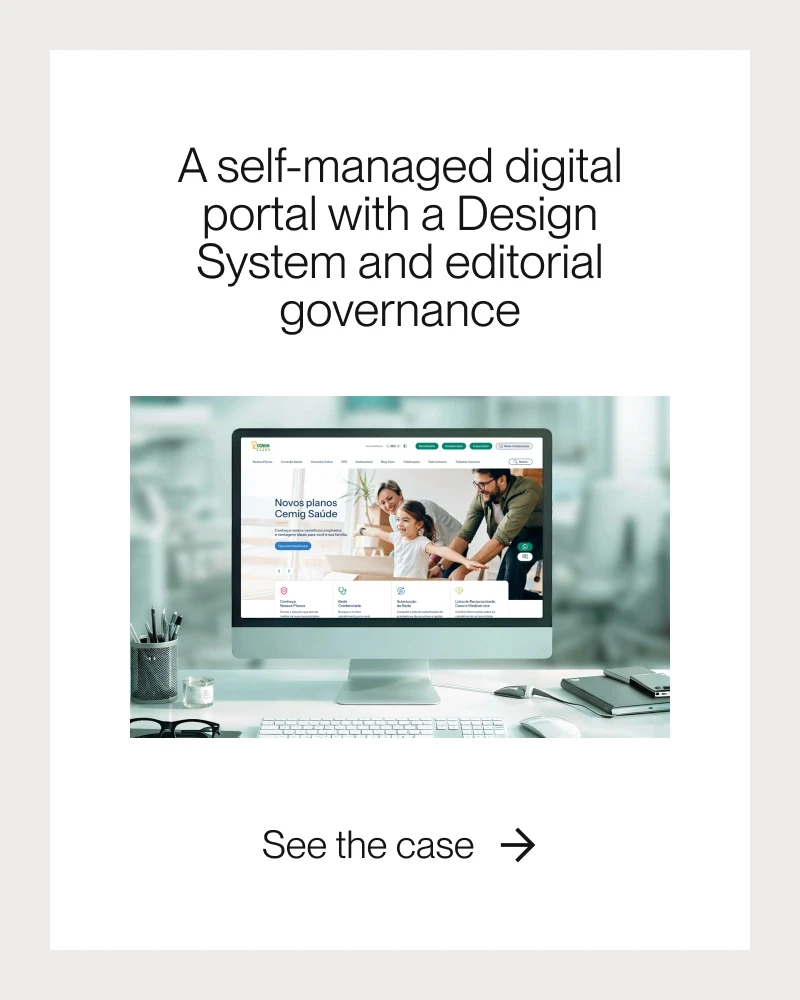
With over 20 years of experience and more than 700 projects delivered in Brazil and internationally, we combine technical depth and strategic vision to support more consistent digital decisions. In the Cemig Saúde customer portal, for example, the design system and CMS structure we built cut the time to publish new pages and content by 70% and made new feature development 60% faster.


Want to understand whether a UX agency engagement makes sense for your project right now?
Frequently asked questions about UX agencies
How long does a UX engagement take?
What is the difference between UX and UI?
What is the difference between a UX audit and UX consulting?
Does a UX agency replace the internal design team?
Does UX consulting include accessibility?
Start with a diagnosis of your product experience
If your product is losing conversions, struggling with adoption, or piling up rework, a UX diagnosis shows where the journey breaks down and which fixes deserve priority. Dexa’s Experience Design team combines user research, design, and technical implementation to turn those findings into a roadmap your team can execute.


