
Drupal is one of the most robust CMS platforms on the market and powers websites for governments, universities, global enterprises, and organizations that require security, scalability, and content governance. More than a content management system, the platform provides a solid foundation for building digital projects that demand a high level of customization, complex integrations, and the flexibility to evolve.
In this guide, you'll learn how Drupal works, what its key differentiators are, and the scenarios in which it is the best choice. Along the way, you'll explore its evolution, its modular architecture, the role of its global community, and the initiatives shaping the platform's future, such as Drupal Starshot, Experience Builder, and Artificial Intelligence integrations.
What is Drupal?
Drupal is a content management system (CMS) and modular framework built with PHP for creating secure, flexible, and scalable websites and digital platforms. As a free and open-source solution, it is used by organizations of all sizes to create, manage, and publish content with a high level of customization and control.
Its modular architecture allows the platform to be tailored to the unique requirements of each project, from corporate websites to complex, high-traffic digital experiences. Drupal also provides native multilingual support, advanced security features, and a global community of developers that continuously contributes to its evolution. These capabilities have established Drupal as a trusted choice for organizations seeking governance, flexibility, and long-term scalability.
The Evolution of Drupal: A Timeline
Drupal was created in 2000 as an academic forum by Dries Buytaert. In 2001, it was released as an open-source project under the GNU General Public License (GPL), marking the beginning of its continuous evolution into one of the leading platforms for complex digital projects.
Since then, each new version has introduced technical advancements, performance improvements, and new features, expanding the platform's capabilities.
2000: Drupal is created as an academic forum.
2001: Released as an open-source project under the GPL.
2005: Drupal 5 is launched, introducing the Views module, which revolutionizes the creation of dynamic content.
2011: Drupal 7 is released, featuring significant improvements to the user experience.
2015: Drupal 8 introduces technologies such as Symfony and Twig, along with REST API support and major accessibility enhancements.
June 3, 2020: Drupal 9 is released, focusing on stability, compatibility, and easier upgrades.
December 14, 2022: Drupal 10 launches with performance improvements, a streamlined development experience, and new integrations, including Artificial Intelligence capabilities.
August 2, 2024: Drupal 11, the platform's latest version, is released with further performance enhancements, improvements to the Field UI, and updates to the taxonomy system.
This evolution reflects the Drupal community's ongoing commitment to modernizing the platform, ensuring compatibility with emerging technologies, enhanced security, and the capabilities required to support everything from corporate websites to highly complex digital ecosystems.
Drupal Version End of Life (EOL)
Keeping track of the End of Life (EOL) status of Drupal versions is essential for maintaining the security, stability, and operational continuity of any digital project. Once a version reaches EOL, it no longer receives security updates, bug fixes, or official support, increasing the risk of security vulnerabilities and compatibility issues.
The lack of updates can also impact compliance with regulations such as the LGPD and GDPR, make it more difficult to integrate with new technologies, and limit the platform's ability to evolve. For this reason, keeping Drupal up to date should be an integral part of any digital platform management strategy.
Since each Drupal version has a defined lifecycle, planning migrations in advance helps reduce risks, prevent service disruptions, minimize unexpected costs, and simplify the adoption of new features.
Drupal 11 is currently the latest version, with its End of Life (EOL) scheduled for 2027. The next major release is expected in 2026, reinforcing the importance of continuous planning to ensure security, compatibility, and access to the platform's latest innovations.
Core vs. Modules: The Architecture That Makes Drupal So Flexible
Drupal is built on a lightweight core that provides the essential functionality required to run any website. What truly sets it apart from other CMS platforms, however, is its high level of extensibility and customization.
The core includes features such as:
User management
Role-based access control
Taxonomy system (for organizing content with categories and tags)
Dynamic menu management
Caching system for performance optimization
Drupal's real strength lies in the flexibility and customization provided by its modules. These software components extend the platform's functionality to meet a wide range of business needs.
Examples include:
Advanced SEO optimization features
Custom forms
Integration with CRMs (Customer Relationship Management), ERPs (Enterprise Resource Planning), and eCommerce solutions
Workflow automation
Detailed reporting
These are just a few of the more than 50,000 modules available through the Drupal community. By combining a lightweight core with an extensible ecosystem, Drupal enables organizations to build tailored solutions with security, performance, and long-term scalability.
Explore some of these modules and their capabilities.
Creating Engaging Digital Experiences with Drupal
Once the platform's functional structure is defined through modules, the next step is shaping the visual and interactive experience users will have. This is where themes come into play, defining the website's look, feel, and usability.
Themes: A collection of files that defines a website's appearance and user interface, including colors, typography, layouts, and visual elements. Themes control how content is presented to visitors and allow organizations to customize the site's design without changing its underlying functionality, giving each project a unique identity tailored to its audience.
Themes also ensure a consistent experience across devices, allowing websites to function seamlessly on desktops, tablets, and smartphones.
Built on Twig, a templating engine that separates presentation from application logic, themes such as Olivero (for the public-facing interface) and Claro (for the administrative interface) provide a secure, flexible, and modern foundation. They enable development teams to build interfaces that reflect the brand's identity, adapt to multiple channels, and maintain both accessibility and performance.
Together, these capabilities help create consistent, functional, and user-centered digital experiences.
How Drupal Supports Accessibility
Accessibility is another key strength of Drupal. The platform includes features that promote digital inclusion and help organizations meet legal accessibility requirements. This commitment is embedded in Drupal's core and extends to its modules, themes, and the best practices embraced by its global community.
Drupal stands out as a CMS built with accessibility at its core. From its foundation, the platform incorporates internationally recognized standards such as WCAG 2.1 (Web Content Accessibility Guidelines) and ATAG (Authoring Tool Accessibility Guidelines). Its default themes are designed with careful attention to color contrast, keyboard navigation, semantic markup, responsive design, and screen reader compatibility.
The Drupal community also plays an active role in ensuring that modules and features follow accessibility best practices across every layer of the platform, from the user interface to content creation. This collaborative effort benefits both organizations and the people who use their digital experiences.
By choosing Drupal, your organization becomes part of an ecosystem built around accessibility, innovation, and social responsibility. This decision demonstrates a commitment to legal compliance while helping create more inclusive, user-friendly, and sustainable digital experiences.
Drupal as a Strategic Choice
Now that you understand how Drupal works and what sets it apart, a common question arises: when is Drupal the right choice? Drupal is particularly well suited for organizations that require security, scalability, advanced customization, and integration with other systems, essential capabilities for complex digital projects.
Some of its most common use cases include:
Corporate websites
Corporate intranets
Multilingual platforms
Collaboration and knowledge management environments
Its architecture makes it easy to integrate with CRMs, ERPs, and other enterprise applications, while also supporting granular user permissions, custom editorial workflows, and complex content structures. As a result, Drupal can scale alongside your organization without compromising performance, governance, or security.
Key Features of Drupal
The features below help explain why Drupal is one of the leading platforms for complex digital projects.
Feature | Practical Description | Competitive Advantage |
Open Source | Free software with no licensing fees. Its source code is openly available and maintained by a global community. | Freedom to customize, lower costs, and reduced vendor lock-in. |
Modular Architecture | A lightweight core with additional functionality added through modules. | Exceptional flexibility—you choose only the features you need, avoiding unnecessary functionality that could impact performance. |
Enterprise-Grade Security | Dedicated security teams monitor vulnerabilities. Security updates are frequent and well documented. | Trusted for handling sensitive data and powering government and enterprise applications. |
Responsive Design | Offers ready-to-use, highly customizable themes that adapt seamlessly to desktops, tablets, and smartphones. | A consistent, optimized user experience that supports both SEO and accessibility. |
Modern APIs (REST, GraphQL) | Native APIs simplify integration with mobile apps, ERPs, CRMs, and legacy systems. | Enables omnichannel and headless solutions without requiring a complete website rebuild. |
Native Multilingual Support | Advanced multilingual capabilities without relying on third-party plugins. | Ideal for global organizations and institutions with an international presence. |
Advanced Performance | Supports advanced caching technologies such as BigPipe and integrates easily with CDNs. | Fast websites even under heavy traffic, improving both SEO and user experience. |
Advanced Editorial Control | Customizable workflows, granular permissions, and built-in revision and approval management. | Enables content teams to work independently and securely, making it ideal for large organizations. |
Accessibility | Native support for rigorous accessibility standards, including WCAG guidelines. | Promotes digital inclusion and helps organizations meet accessibility requirements across different markets. |
Built-in SEO | Features clean URLs, customizable meta tags, and granular control over site structure. | Improves search engine visibility without relying on complex extensions. |
Proven Scalability | Supports everything from small websites to large government and enterprise portals serving millions of users. | A platform that grows with your business, eliminating the need to migrate as your organization expands. |
Active and Vibrant Community | One of the world's largest open-source communities, with frequent events, active forums, and extensive documentation. | Continuous platform evolution and collaborative support for virtually any challenge. |
How Drupal Works in Practice
With these capabilities in mind, it's easier to understand how Drupal works in real-world scenarios. The platform is designed to manage information in a structured and efficient way, streamlining content workflows while enabling the development of high-performance, enterprise-grade digital solutions.
Built around entities (such as articles, pages, products, and user profiles) and custom fields, Drupal organizes content in a flexible way that adapts to the specific requirements of each project. This approach makes it possible to create dynamic administrative interfaces that can be configured for different user roles and complex editorial workflows.
Here are a few real-world examples that demonstrate Drupal's versatility and broad adoption:
Government Websites: Government agencies around the world rely on Drupal to power their public-facing websites. According to The Drop Times, Drupal is used by organizations such as the European Commission and the Australian and Canadian governments.
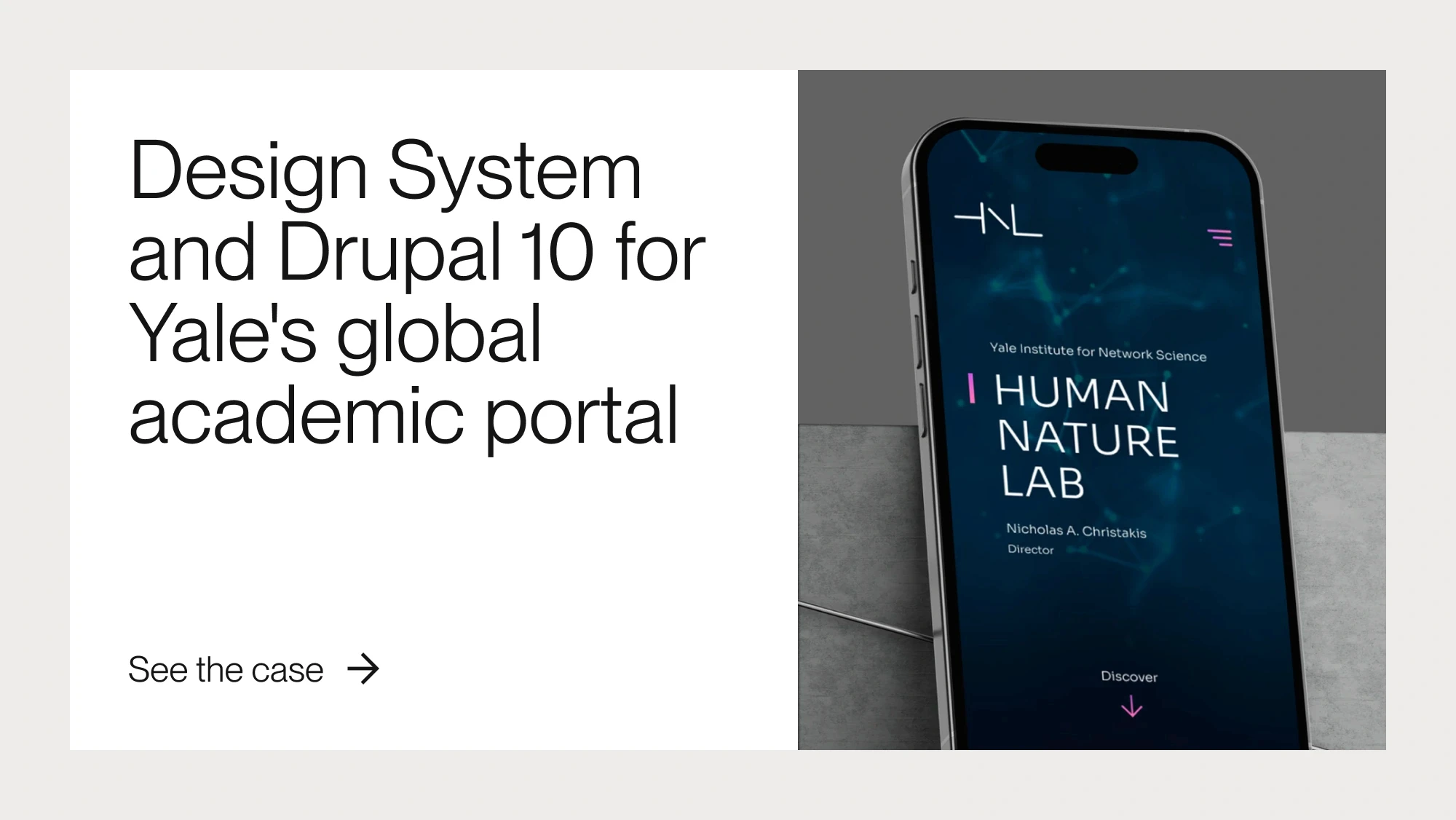
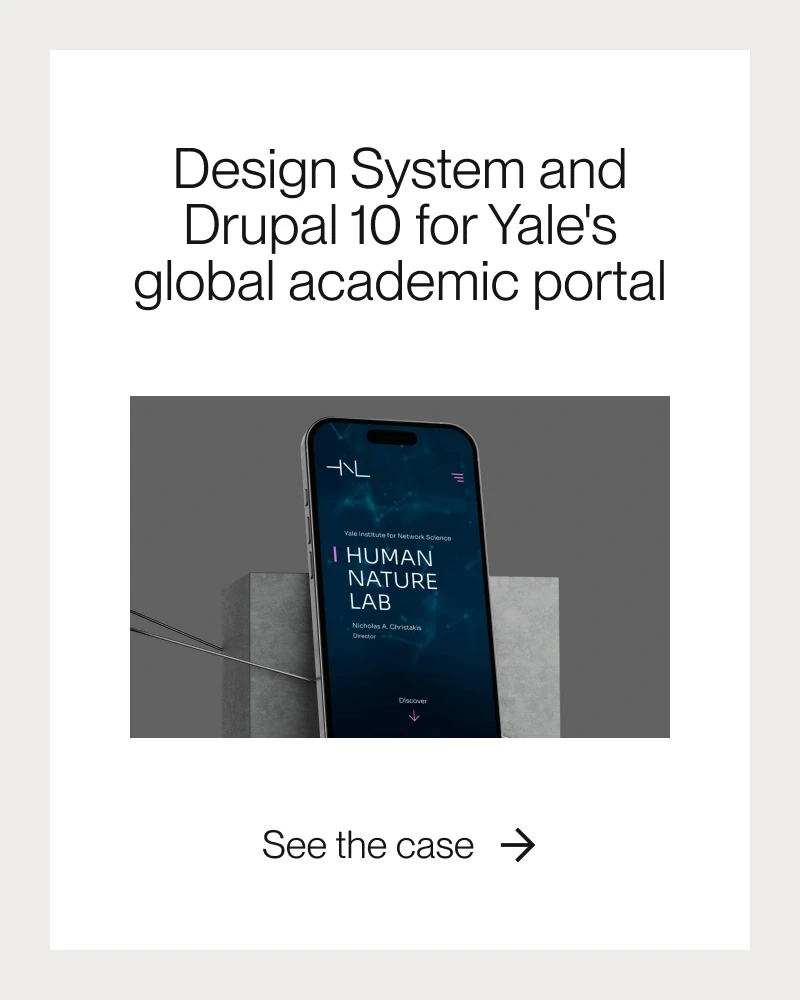
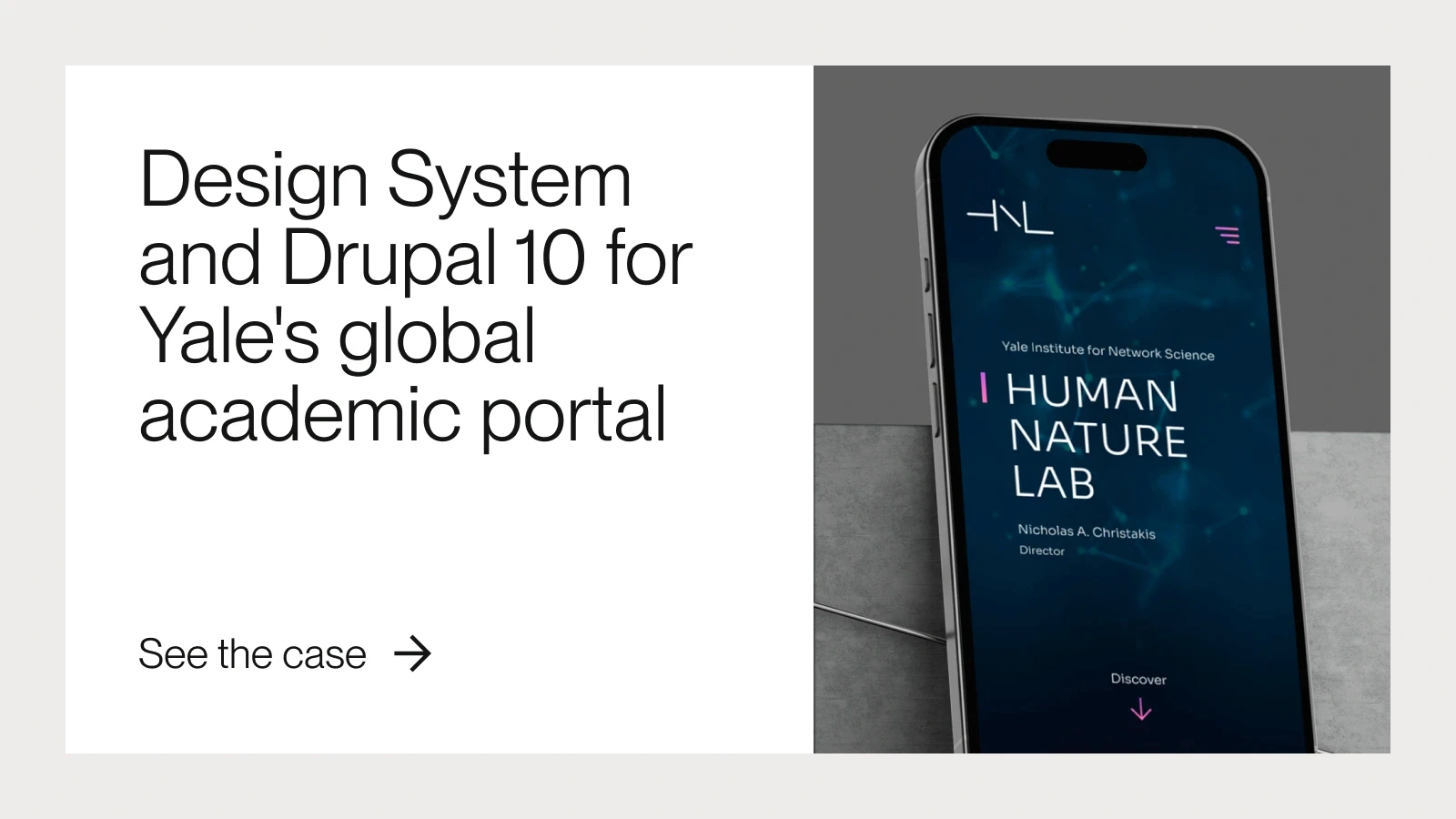
Universities and Educational Institutions: Leading universities, including Yale University, use Drupal for interactive academic websites, enrollment systems, research laboratories, and digital learning platforms. In Brazil, many federal and state universities also rely on Drupal to manage complex content and support interactions between students, faculty, and staff.
Corporate Portals and Intranets: Major organizations, including Fortune 500 companies such as Pfizer and NASA, use Drupal to build internal portals and intranets that automate editorial workflows, improve internal communication, and integrate seamlessly with ERP systems, helping optimize operations and strengthen information governance.
Dexa developed the entire digital platform for the Human Nature Lab, a research laboratory at Yale University dedicated to studying social interactions and human behavior. Explore the case study.
The Heart and Driving Force Behind the Platform
Drupal's widespread adoption is also driven by the strength of its global community. Developers, designers, system architects, accessibility specialists, translators, and other professionals continuously collaborate to enhance the platform, develop new modules, and share best practices.
This community consists of a vast global network of developers, designers, system architects, translators, accessibility specialists, digital marketing professionals, journalists, and passionate users. Together, they work tirelessly to improve the platform and ensure its continuous evolution.
Drupal Benefits for Specific Areas
Drupal's capabilities deliver value across multiple areas of an organization. Each team can leverage the platform's features to address its specific needs. Here are a few examples:
Marketing: Gains a powerful platform for creating and optimizing high-converting landing pages, updating campaigns quickly, and implementing SEO improvements without relying on the IT team.
IT: Benefits from an enterprise-grade platform that strengthens governance, standardizes data, simplifies integrations with legacy systems, and supports robust, transparent audit and compliance processes.
Developers: Take advantage of well-structured APIs, comprehensive documentation, a culture of automated testing that ensures code quality, modern development standards, and extensive code reusability, significantly improving development speed and efficiency.
CMOs (Chief Marketing Officers): Gain access to centralized reporting that provides a 360-degree view of digital performance, seamless CRM and ERP integration, and marketing automation tools, enabling more strategic and data-driven decision-making.
CIOs (Chief Information Officers): Benefit from complete control over critical data, enterprise-grade security, the scalability needed to support business growth, and a resilient multichannel digital ecosystem with strong governance.
As Luiz Petri, Drupal Specialist at Dexa, puts it:
"Drupal wasn't built for basic websites; it was designed to solve complex challenges with elegance, security, and scalability. Organizations that choose Drupal are thinking beyond today's needs."
Challenges of Drupal and How to Maximize Its Potential
Although Drupal is an exceptionally powerful platform that delivers significant strategic value, it's important to understand the challenges that may come with adopting it. Like any enterprise-grade technology, Drupal has unique characteristics that require careful planning and expertise to unlock its full potential.
One of the primary considerations is its learning curve. Because of its technical depth and extensive capabilities, Drupal requires an experienced team for implementation and ongoing maintenance. Platform upgrades, while essential for maintaining security and performance, also require strategic planning and thorough compatibility testing for custom modules and themes, which can affect project timelines. In addition, extensive customizations required for highly specialized projects may increase both development costs and delivery schedules.
To maximize Drupal's capabilities, it should also be deployed on a well-architected infrastructure that includes Content Delivery Networks (CDNs), advanced caching mechanisms, and load balancing. Without this foundation, the platform may not achieve the level of performance it was designed to deliver. While these considerations require planning and investment, they ultimately result in a secure, scalable, and future-ready digital platform capable of supporting long-term business growth.
The Future of Drupal
Drupal continues to evolve, making the development of digital experiences faster, more intuitive, and more efficient. Initiatives such as Drupal Starshot, Experience Builder, and expanded Artificial Intelligence capabilities demonstrate the platform's commitment to reducing technical complexity while preserving the flexibility that has made it a leading choice for enterprise-grade digital projects.
Drupal Starshot
Drupal Starshot is an initiative designed to simplify and accelerate website development by providing a more complete and intuitive out-of-the-box experience. Its goal is to deliver a preconfigured set of essential features and an optimized interface, reducing initial complexity and shortening the time required to launch new projects.
This initiative makes Drupal more accessible to new teams while preserving its ability to support complex enterprise environments. The objective is to reduce the learning curve and make platform adoption easier.
Drupal Experience Builder
Experience Builder was created to give designers and marketing teams greater autonomy when building pages and digital experiences. The tool enables users to create layouts through an intuitive visual interface, featuring advanced drag-and-drop functionality and greater control over content presentation.
As a result, teams can create and update pages more efficiently, accelerating prototyping and supporting the continuous evolution of digital experiences.
Artificial Intelligence in Drupal
The latest versions of Drupal have significantly expanded the platform's Artificial Intelligence capabilities. Drupal now supports features powered by natural language APIs to assist with content generation, create intelligent metadata, automate SEO-related tasks, and deliver more personalized user experiences.
These capabilities help organizations increase team productivity while creating more relevant digital experiences without compromising governance or content quality
Drupal vs. Other CMS Platforms: When Is Drupal the Best Choice?
To fully understand Drupal's capabilities and position within the web platform landscape, it's helpful to compare it with other popular solutions. Every CMS (or web development framework) has its own strengths and ideal use cases, and Drupal stands out in a highly specialized segment of the digital market.
While platforms such as WordPress are an excellent choice for blogs and small to mid-sized corporate websites, thanks to their ease of use and extensive plugin ecosystem, Drupal excels in projects that require a complex architecture, advanced permission management, custom editorial workflows, and robust integrations with enterprise systems.
Although Joomla is also an open-source CMS, it does not offer the same level of flexibility and granular control that Drupal provides, particularly for scalable enterprise applications.
When comparing Drupal with development frameworks such as Laravel or Symfony, the key difference lies in their purpose. These frameworks offer complete development flexibility but require developers to build every component from the ground up. Drupal, on the other hand, provides a powerful core, advanced content management capabilities, enterprise-grade security, and a rich modular ecosystem that significantly reduces development time and effort for projects involving multiple teams across an organization.
In short, if you're wondering how Drupal compares with these alternatives, think of it as a powerful foundation for complex digital experiences, built around content governance, enterprise integration, and scalability.
Choosing Drupal is a strategic decision. It may not be the simplest CMS or the one powering the largest number of websites, but it is undoubtedly one of the best platforms for organizations that require high performance, security, and flexibility to support mission-critical digital experiences.
FAQ
Is Drupal free?
When should you use Drupal?
When might Drupal not be the best choice?
What is the difference between Drupal and WordPress?
Which companies and organizations use Drupal?