
When a VP asks ChatGPT, Gemini, or Google's AI Mode for a list of vendors in your category, the answer comes back with a handful of names. If your competitor is on that list and your company isn't, you're out of the comparison before anyone visits your website, and no traffic report will ever record that loss. That's the space AI SEO sets out to win.
The impact usually surfaces later, and indirectly, as fewer organic sessions in the monthly report. Google rolled out AI Overviews, the AI-generated summaries shown at the top of search results, to all US users in May 2024. AI Mode, Google's conversational search tab, started as a Labs experiment in March 2025 and reached every US user in May of the same year. A share of the questions that used to end in a click now get resolved on Google's own results page.
AI isn't the only possible explanation for that curve, though. A page that lost rankings, a quarter that's soft every year, or an accidental block after a site update all produce the same chart. Investing in the wrong cause burns the budget the right fix would have needed.
AI SEO is the work of getting your brand found, understood, and used as a source by these systems, and it starts with a diagnosis that separates the effect of AI from every other reason traffic falls. This guide covers what explains the gap between your company and the competitor, what it costs to be missing from AI answers, how to run that diagnosis, and what to track to know whether the investment is paying off.

What is AI SEO?
AI SEO is the set of practices that get a company's content found, understood, and used as a source by systems that generate answers: Google's AI Overviews and AI Mode, ChatGPT, Perplexity, Copilot, and Gemini.
The market also calls this work GEO (Generative Engine Optimization), when the focus is on answers assembled by generative models, and AEO (Answer Engine Optimization), when the focus is on direct answers to a specific question. For Google, the label makes little difference: in its guide to optimizing for generative AI, the company states that, from Search's perspective, optimizing for these features is still SEO.
For decision-makers, the most useful way to understand the work is to split it into three stages, because each one depends on the one before:
Access: AI systems can crawl, read, and index the pages that matter to the business.
Understanding: the site makes it clear who the company is, what it does, who it serves, and what evidence backs it up.
Use as a source: the page offers information worth citing, and the brand has a reputation that can be verified outside its own website.
The first two stages are classic SEO. Without them, the third never happens, and a project that promises AI visibility without reviewing the site's foundation starts at the end. Our comparison guide breaks down the differences between SEO, GEO, and AEO.
Why does your competitor show up in AI answers and your company doesn't?
In most cases, the competitor's pages answer the buyer's question more clearly, offer proof that can be verified, and are accessible to the systems that build the answers. No AI vendor publishes its exact selection criteria, but these are the points where the gap usually shows up when a specialist compares the two companies side by side.
Mentions, citations, and recommendations: what showing up actually means
An AI answer can feature a brand in three ways, and each carries different weight for the business:
Type of presence | How it appears | What it delivers | Limitation |
Mention | The company name appears in the text, with no link | Brand recall and a spot on the list of options | Drives no visits and can't be attributed |
Linked citation | A page from your site is shown as a source for the answer | Topical authority and a chance at a click | May support a generic point unrelated to what you sell |
Vendor recommendation | The answer names the company as an option for someone looking to hire | Direct entry into the shortlist of vendors under evaluation | Varies by prompt, user, and timing |
The same competitor may be cited often for informational questions and almost never recommended, or the other way around. Recommendations matter more for pipeline, while citations build authority on a topic. None of the three automatically replaces the traffic that stopped coming in.
Five factors behind the gap between brands
The page answers the buyer's question. The competitor has content that addresses exactly what the buyer asked, such as 'how much does implementation cost', 'how to choose', or 'what's the difference between'. On your site, the topic is covered generically or buried inside a service page.
The positioning is clear. The competitor's site states what the company does, for which industry, and for what size of client. A site that describes itself as 'innovative solutions for your business' gives AI systems nothing to tie the brand to a category.
There's proof of experience. Case studies with numbers, a documented methodology, named authors, and proprietary data all work as evidence. Google's guide recommends content with an original point of view and first-hand experience, as opposed to summaries of what's already on the web.
Other sources confirm what the company says. According to Google, the AI features in Search can draw on what's said about a topic across the web, from blogs and videos to forums. Trade publications, industry associations, customer reviews, and conference talks reinforce reputation. Manufactured mentions don't help, because the same systems that assess quality also filter out spam.
Nothing technical blocks the site. A block on AI crawlers, pages that rely on JavaScript to render content, or key pages missing from the index take the company out of contention. These problems often go unnoticed by teams that don't monitor the technical side of the site.
Picture a CFO asking AI Mode which tax advisory firms work with manufacturers in the Midwest. The answer tends to rely on pages that say exactly that, plus outside sources that confirm it. A firm whose manufacturing case studies sit in a PDF, or on a page with no real text, is unlikely to make that list, even with the experience to back it up.
What it costs your business to be left out of AI answers
The cost shows up in two places: in the visits that no longer reach your site, and in the opportunities that never come to exist because the buyer built a vendor shortlist without your company. The first shows up in your reports. The second almost never does.
Fewer clicks when the answer is already on the results page
When Google shows an AI Overview, the user gets a summary at the top of the page and often ends the search right there. A site can hold the same ranking and earn the same number of impressions while receiving fewer visits.
The most widely cited study on this effect comes from Pew Research Center, which tracked the real browsing behavior of 900 US adults in March 2025. On pages with an AI summary, users clicked a traditional search result in 8% of visits, compared with 15% when no summary appeared. Links cited inside the summary itself rarely got clicked.
Not every search loses at the same rate. Definition and explanation queries, such as 'what is' and 'how does it work', are the easiest to resolve in a summary. Searches closer to a purchase, such as vendor comparisons and cost drivers, also trigger AI answers, but the decision usually requires evidence the summary can't fully deliver: case studies, methodology, a conversation with a specialist.
Pipeline impact depends on which pages lost traffic
A 30% drop in sessions might change nothing in the pipeline, or it might cut qualified leads in half. What makes the difference is which pages lost traffic and where they sit in the buyer journey.
To see this, a specialist cross-references three sources: Search Console shows clicks by page, Analytics shows conversions by landing page, and the CRM shows which contacts became opportunities and revenue. Without the CRM, the analysis stops at the form submission, which doesn't always reflect real demand. Our article on how to calculate SEO ROI explains how to set up that tracking.
With the data side by side, the drop usually fits one of these patterns:
Where the drop is concentrated | What it usually means | Priority |
Informational articles, with stable conversions | Loss of top-of-funnel traffic, often from visitors who wouldn't have bought | Medium: check whether this content still feeds retargeting, nurture, or authority |
Service pages, case studies, and comparisons | Loss close to the buying decision, with direct impact on leads | High: investigate rankings, competition, and technical issues first |
Branded searches | Lower brand recall, a change in paid media, or an issue with the brand page | High: review spend and off-site presence |
The whole site, proportionally | Technical cause or algorithm update | Urgent: technical diagnosis before any content changes |
“When traffic drops, the first step is to separate the traffic that leads to sales conversations from the traffic that builds brand awareness. Depending on which group took the hit, we take a different route to get growth back on track.” - Micaela L. Rossetti, Head of Marketing at Dexa
Two precautions prevent hasty conclusions. The B2B sales cycle delays the impact: a drop in visits in March may only show up in opportunities in June. And part of the discovery that happens inside an AI answer reaches your site through other paths, such as branded search or direct traffic, which makes the organic channel look smaller than the real influence of search. A rise in branded searches that no campaign explains is an indirect sign of that shift.
How to tell whether a traffic drop comes from AI or something else
Organic traffic drops usually come from one of these sources: a technical failure, a change applied to a group of pages, ranking losses, lower demand, or answers that resolve the search before the click, AI answers among them. Each one calls for a different response, and more than one can be at work at the same time. An SEO specialist separates these causes before proposing any change in strategy, and the starting point is Search Console, not Analytics.
Analytics counts the sessions that reached the site. Search Console shows what happened before the click: how many times the site appeared in search (impressions), at what average position, with what click-through rate (CTR), and for which queries. Google's guide to debugging traffic drops recommends looking at the last 16 months to spot seasonality, and comparing the drop period with the previous period and with the same window a year earlier.
The infographic below summarizes this triage. Each 'yes' points to hypotheses and where to verify them without closing the diagnosis: even after a positive answer, the analysis runs to the end, because more than one cause can be at play.

Sudden sitewide drop: technical failure or manual action
Many sudden drops start with a site change: a website redesign that changed URLs without redirects, a staging version published with a block on search engines, a configuration that pulled the site out of the index. Security issues and manual actions, applied when a Google reviewer identifies a violation of its spam policies, belong in the same triage.
In Search Console's indexing, crawl, and manual action reports, these cases usually show up as a spike in errors or an alert on the same date traffic started falling. Dexa's SEO migration guide covers the precautions that prevent this kind of loss.
Gradual drop across a group of pages
When the loss is concentrated in a set of pages, such as blog articles or product pages, the cause is usually a change applied to that group. The most common ones are a page template update, a tag that tells Google not to index the page (noindex), and a canonical tag pointing to the wrong URL.
Running Search Console's URL Inspection tool on a few pages from the group shows how Google is reading each one.
Ranking losses across many queries
A ranking drop reads differently depending on its size. Slipping from position 2 to position 4 is a common fluctuation that can reverse on its own, and Google advises against making radical changes to pages that already perform well.
Falling from the top 10 to position 29 across a broad range of terms is a different problem. It usually points to an algorithm update or to competitors with more helpful content, and it calls for a quality review of the site as a whole, not of a single page.
Lower demand and seasonality
If impressions fell along with clicks, the site may be appearing less because fewer people are searching for the topic. In B2B, demand follows budget cycles, holiday periods, and industry calendars: a K-12 software vendor tends to see more searches in the months leading up to back-to-school. When interest in the topic drops in Google Trends at the same rate as impressions, and the year-over-year comparison shows the same pattern, the drop comes from the market, not from a problem with the site.
Separating branded searches from the rest completes the picture. A decline in branded searches usually signals lower brand recall or reduced media spend, while losses on non-branded queries are more closely tied to competition and to the layout of the results page.
Still visible, fewer clicks: the effect of AI answers
When none of the previous questions explains the drop, the site keeps showing up but gets fewer clicks. An unappealing title or other features crowding the results page can explain the loss, and this is where AI answers come in as a hypothesis. The loss doesn't always appear in isolation, because Google counts appearances in AI features together with the rest of web search traffic.
To confirm it, the specialist isolates the queries that lost the most clicks, searches each one, and records whether an AI Overview appears. If the drop is concentrated in queries with an AI answer, the hypothesis gains weight. If it also shows up in the others, the cause is probably somewhere else.
The test points to a trend, because answers vary by user, location, and timing. For sites that already have access, Search Console's generative AI report, covered later in this guide, provides official impression data for these features. Attributing the entire loss to AI without this check leads to investments that miss the real cause.
Traffic dropped and nobody can explain why?
Dexa diagnoses your site, finds what's holding back your SEO performance, and executes an improvement plan built for measurable growth.
How a specialist builds brand presence in AI answers
The work follows the order of the AI SEO stages: first make sure AI systems can read the site, then give them content worth citing and a reputation that confirms what the company says. Reversing that order is a common mistake, because great content on a blocked page never reaches a single answer.
Technical review: what keeps AI systems from reading your site
The first stage is a technical review, led by the SEO team together with the people who develop the site. The issues that most often keep companies out of AI answers are few and, in general, quick to fix:
Pages missing from the index or without a snippet. To appear in AI Overviews and AI Mode, a page must be indexed and eligible to show a text snippet in search, according to Google. A misconfigured page template can take dozens of pages out of contention at once.
Blocked AI crawlers. A page in OpenAI's documentation distinguishes OAI-SearchBot, which powers ChatGPT search, from GPTBot, which is tied to model training. Sites that block the first don't appear in ChatGPT search answers; blocking only the second has no such effect. These blocks sometimes live in firewall and CDN rules the marketing team doesn't even know about.
AI features opt-out turned on by mistake. Search Console has a control that lets a site opt out of Google's generative AI features. The specialist confirms it wasn't switched on unintentionally.
Information that depends on JavaScript to render. What the company does, who it serves, and the data in its case studies should be in the page's HTML, without depending on a click or heavy scripts.
Key pages without internal links. Service pages, case studies, and articles on the same topic should link to one another so AI systems understand how they relate.
The same Google guide lists what isn't necessary, and that list helps when evaluating vendor proposals: llms.txt files (Search ignores them), breaking content into tiny chunks, rewriting copy 'for AI', or creating a page for every variation of a question. That last practice can be treated as scaled content abuse. Structured data isn't a requirement for appearing in AI answers either, though it remains useful for describing the organization, its authors, and its articles consistently.
Content that AI systems use as a source
Google calls content that any company could have written commodity content, such as generic lists of tips. AI already summarizes that kind of text without needing a specific source. Proprietary information, found nowhere else, gives a page a reason to be used as a source, although it doesn't guarantee a citation. During the content review, the specialist looks for:
Service pages that answer the buyer's questions: who the service is for, how delivery works, typical timelines, the factors that drive investment, and what isn't included.
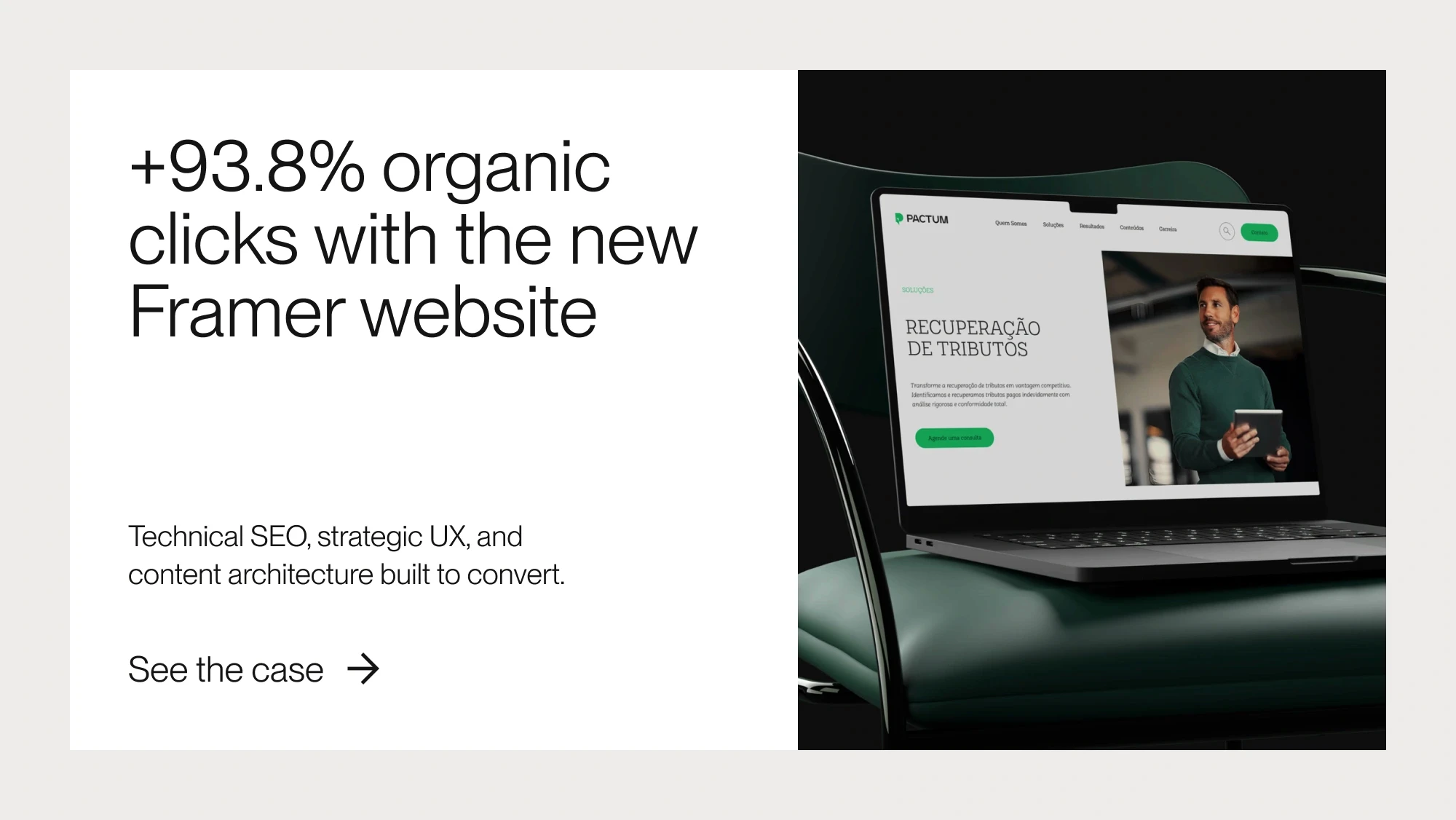
Verifiable case studies: context, challenge, the decision made, and results with numbers and a timeframe. The Pactum case study follows this structure.
Clear authorship: who wrote or reviewed the content, with their title, experience, and an author page.
Proprietary data: project benchmarks, customer surveys, or analyses of internal datasets, with the methodology explained.
Consistent company information: name, services, industries, address, and experts described the same way on the website, LinkedIn, Google Business Profile, and directories. Contradictory data lowers the confidence of any system trying to describe the brand.
Rewording generic information doesn't solve the problem. The question that guides the review of each page is simple: what does this page say that a competitor couldn't?
“When we analyze the answers where a competitor shows up, the cited pages usually have something only that company could say: a well-explained selection criterion, a number from a real project, an industry-specific example. Content that repeats what the rest of the internet already agrees on rarely becomes a source, because AI can say it on its own.” - Tainá Aquino, Content Strategy and SEO Specialist at Dexa
Off-site authority
Company experts publishing in trade media, speaking at events, and keeping active professional profiles generate the external references these systems use to confirm what a company says about itself. The safest criterion is the editorial relevance of each appearance. Google advises against pursuing inauthentic mentions, and proposals that sell mentions in bulk deserve skepticism.
Topics closer to the buying decision
If AI handles definition questions well, the space where your website still makes a difference is evaluation: the moment the buyer compares approaches, vendors, and costs. A content strategy pays off when it moves closer to that stage, along three lines:
Topics that help the buyer decide: comparisons between approaches, criteria for choosing a vendor, cost drivers, industry-specific use cases, and the risks of each alternative. This content serves buyers who are close to hiring, works as a source for AI answers on the subject, and becomes enablement material for the sales team.
Real questions from the sales process: the questions sales hears in first meetings and the objections raised during negotiation show how buyers frame the problem. They're often the same questions buyers ask an AI assistant before reaching out.
Informational content with a defined role: top-of-funnel articles remain useful when they support topical authority, feed lead nurturing, or lead to service pages. Older posts on the same subject can be consolidated into a more complete piece, which reduces competition between pages on your own site.
With fewer clicks, every qualified visit carries more weight. A slow, confusing service page with no clear next step wastes exactly the most valuable traffic. Our article on the conversion funnel shows how acquisition, user experience, and CRO (conversion rate optimization) work together at this point.
Your buyers are asking, and your competitor is the one answering?
Dexa builds and executes a content strategy with SEO and GEO that puts your brand in front of the people searching for what you offer, on Google and in AI answers.
How to track your brand's presence in AI answers
Organic sessions tell only part of the story. A useful AI SEO report separates six layers, because each one answers a different leadership question and has its own limitations:
Layer | Question it answers | Where it's measured | Limitation |
Organic performance | Does the site appear and get clicks in search? | Search Console Performance report | Blends traditional results and AI features |
Exposure in Google's AI features | Do my pages appear in AI Overviews and AI Mode? | Search Console generative AI report, launched in June 2026 with a gradual rollout | Shows impressions by page, country, device, and date, with no clicks |
Citations in Copilot and Bing | Which pages are used as sources, and for which searches? | AI Performance report in Bing Webmaster Tools, in public preview since February 2026 | Covers only Microsoft and partner platforms, with no traffic data |
Mentions and recommendations in AI assistants | Does the buyer hear about the brand when they ask? | A sample of prompts monitored manually or with a tool | Answers vary by user, date, and phrasing |
Traffic from AI assistants | How many visits come from ChatGPT, Gemini, and other assistants, and what do they do on the site? | Analytics, filtering sources such as chatgpt.com, perplexity.ai, gemini.google.com, and copilot.microsoft.com | Volume is still small; part of the influence arrives as direct traffic or branded search |
Business outcome | Does search generate leads and opportunities? | CRM, connecting each lead to its landing page and source | The sales cycle delays the reading |
A help article from OpenAI confirms that ChatGPT referral links automatically include the parameter utm_source=chatgpt.com, which makes these visits easier to isolate in Analytics.
How to monitor brand mentions in ChatGPT, Gemini, and AI Mode
Official tools don't yet show which answers mention or recommend your brand. To fill that gap, the specialist builds a fixed sample of 20 to 40 prompts your ideal customer would ask, from understanding the problem to choosing a vendor, and reruns the test every month on the platforms your audience uses.
Each round records whether the brand appears, in what form (mention, citation, or recommendation), which competitors show up, and which pages were used as sources. Conditions stay stable between rounds: same phrasing, logged-out session or a neutral account, and the same location. A single answer says little. The metric is how often the brand appears, month over month.
The sources cited in answers where your competitor appears are the most valuable output of this tracking, because they reveal what kinds of pages and which outside publications these systems rely on to describe your category. Presence in AI answers and traffic recovery are different outcomes and should be reported separately.
How long does AI SEO take to show results?
The timeline depends on what the diagnosis uncovers. Technical fixes and content changes move at very different speeds, and putting both under the same expectation tends to create frustration with the project.
Technical fixes usually take effect faster, because they depend on AI systems recrawling the pages. OpenAI, for instance, indicates that a robots.txt change takes about 24 hours to be reflected in ChatGPT search. On Google, recovery follows the pace of crawling and reindexing, which can take weeks on large sites.
Content and authority changes are slower. In its documentation on traffic drops, Google says some changes take effect within days and others take months, and that it can take months for its systems to recognize that a site consistently publishes helpful content. External references, such as coverage in trade media, run on their own clock: they depend on editorial calendars and relationships, and rarely appear within weeks.
What to expect from AI SEO
Three points help set expectations with leadership:
Inclusion isn't guaranteed. Meeting the requirements makes a page eligible, but Google is clear that indexing and serving aren't guaranteed, AI features included.
Getting back to previous traffic levels may be the wrong goal. If part of the questions get answered on the results page itself, top-of-funnel traffic is unlikely to return to where it was. The more realistic goal is to maintain or grow the traffic that drives business.
Results show up in the sum of the layers. More citations, more branded searches, better-qualified visits, and steady or growing opportunities indicate the strategy is working, even with fewer total sessions.
How Dexa approaches AI SEO
At Dexa, the work starts with diagnosis: separating the effect of AI answers from ranking losses, lower demand, or technical failures, so the investment goes to the right cause. From there, the Digital Growth team runs content, SEO, GEO, and AEO as a single operation, and the Enterprise Technology team joins the same project when the bottleneck is technical. Reporting shows AI visibility, traffic, and pipeline in separate layers, so leadership sees the impact on the business and not only in the sessions report.
For Pactum, a tax advisory firm with a technical sale and a long sales cycle, this model drove 93% growth in organic clicks and 378% growth in search impressions in six months.


AI SEO FAQ
Does AI SEO replace traditional SEO?
Is AI the reason my organic traffic dropped?
How do I know if my company shows up in AI answers?
Can anyone guarantee my company will appear in ChatGPT or Google?
Do I need an llms.txt file?
Does blocking AI crawlers protect my content?


