When a website stops being just a storefront and becomes part of how a business actually operates, the complexity changes entirely. New demands start to emerge: integration with CRM and ERP, management of multiple sites or business units, operation in multiple languages, access control by user profile, content approval workflows, and more stringent security and compliance requirements. That is exactly where many platforms start to show their limitations.
The problem surfaces as the site grows, gains relevance, and takes on more responsibilities. What was once simple becomes difficult to scale, maintain, and govern.
Web development with Drupal addresses this type of challenge directly. The platform is adopted in projects that require a more robust foundation, capable of organizing content strategically, integrating different systems, and sustaining more complex digital operations with stability and security.
In this piece, we will look at which scenarios this approach makes sense for, what the technical pillars behind a Drupal-built site are, and what should be considered before going down this path.
When a standard CMS starts to limit growth
The limitations of a CMS rarely appear explicitly. They reveal themselves in day-to-day operations, as the business starts demanding more than the structure can sustain, or as the business grows and modernizes, requiring greater customization and reliability.
The clearest warning signs tend to show up in execution:
Critical features start depending on plugins and extensions, increasing coupling and architectural fragility.
Small changes require disproportionate effort, pointing to a lack of structural flexibility.
Content loses consistency as it grows, with difficulty around standardization, reuse, and organization.
Integrations become unreliable, generating rework, manual syncing, and data inconsistencies.
Performance becomes unstable at peak moments, revealing the absence of a solid caching and scalability strategy.
Editorial operations lose control, with limitations around permissions, workflows, and version history.
Marketing teams become increasingly dependent on IT for simple tasks and routine updates.
These signals accumulate and start directly impacting team productivity, information reliability, and the project's capacity to evolve. The most common effect is a growing technical dependency for simple tasks, while more structural improvements start requiring improvised solutions or complex workarounds.
At that stage, the problem is no longer about delivering features, but about the platform's ability to sustain operations consistently. That is the moment to rethink the entire structure.
What changes with Web Development with Drupal
When the problem shifts from functional to structural, the change is not in the interface, but in how the system organizes, relates, and distributes information. Drupal works precisely at this layer, replacing a page-oriented logic with a data-oriented structure.
Content-oriented architecture
Drupal is built on a foundation structured around entities, fields, and relationships, allowing content to be modeled at a granular level. This means information is no longer tied to specific pages and instead exists as independent, reusable, and organized elements.
In practice, this solves common limitations in traditional CMSs, where content is tightly coupled to layout. Here, the same data can be used across different pages, components, or channels while maintaining consistency, standardization, and ease of maintenance. Structural changes no longer require rework across multiple places and are instead made directly at the modeling level.
Integration as part of the structure
In Drupal, integration is not an additional layer but part of the architecture from the start. The system allows data to be exposed and consumed in a structured way, enabling direct connections to CRM, ERP, marketing automation platforms, and legacy systems.
This changes the role of the site within the operation. It stops being an isolated channel and starts acting as a central content layer, responsible for organizing and distributing information to other systems. The result is less data duplication, greater consistency, and reduced dependence on manual processes.
Governance and operational control
Governance is treated as a structural component. Drupal allows you to configure detailed access profiles, granular permissions, and approval workflows, organizing the content lifecycle.
In environments with multiple teams, this ensures that every stage of content creation, review, and publishing follows clearly defined rules. The system maintains a full history of changes, enabling traceability and control. This reduces operational errors and improves the predictability of operations.
Evolution and scalability
Drupal's structure is built for continuous evolution. New features, integrations, or channels can be incorporated without the need to rebuild the system.
This is especially relevant in projects that grow over time. The foundation remains stable while new demands are absorbed in a structured way, avoiding complex refactors and reducing the technical impact of future changes.
SEO, performance, and conversion in practice
Here, SEO and performance cannot be treated as afterthoughts. They are a direct result of how content is structured, organized, and delivered.
Technical SEO and information structure
Modeling by entities and taxonomies makes it possible to create a consistent information architecture, with clear hierarchy, organized URLs, and well-defined relationships between content.
This improves indexability, prevents duplication, and enhances how search engines interpret the site. In addition, control over metadata, redirects, and page structure allows technical SEO to be handled more precisely and in alignment with the actual content of the application.
Performance and content delivery
Drupal operates with a caching logic that allows only the elements affected by a change to be updated, without invalidating the rest of the system.
This approach keeps the application stable even in scenarios with high traffic volume, multiple concurrent users, and frequent updates. When combined with CDN usage and content delivery best practices, it ensures consistent response times and greater efficiency in content distribution.
User Experience
The way content is structured directly impacts the experience. With organized information, clear navigation, and more efficient loading, users find what they need with less effort.
This reduces friction throughout the journey and improves interaction with the site, especially in operations with a large volume of content or multiple navigation paths.
Direct impact on conversion
SEO, performance, and experience work together in an integrated way. A site with a well-defined structure, fast loading, and organized content tends to retain more users and guide navigation more effectively.
The results show up in metrics such as time on page, bounce rate, and conversion. More than attracting traffic, the structure starts contributing directly to generating real results.
Drupal vs. other CMSs: Where the real difference lies
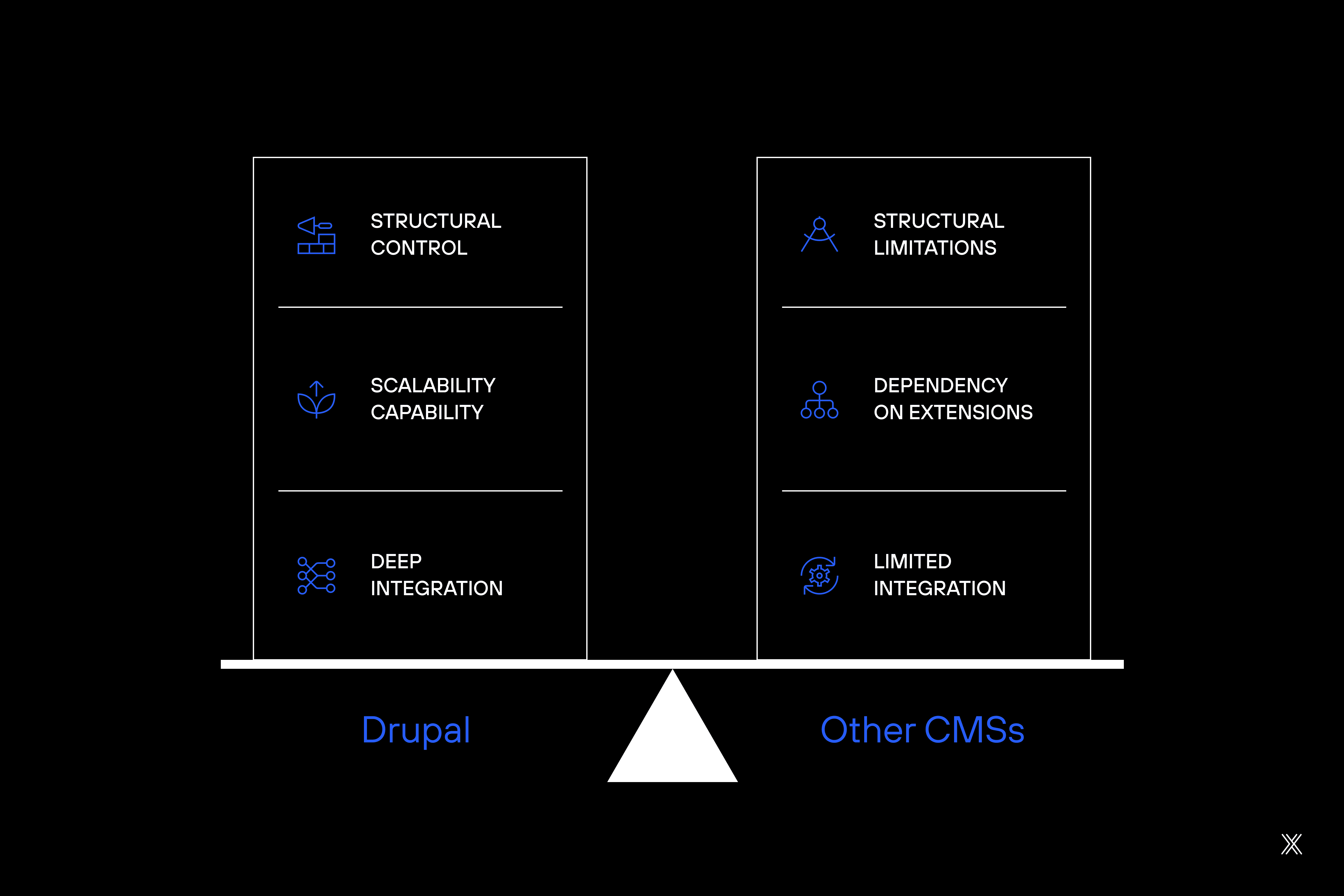
The choice between Drupal and other CMSs needs to be evaluated strategically, going beyond basic feature comparisons. That is because all of them allow you to publish content, create pages, and manage users. The difference appears when the project requires more control, integration, and capacity to evolve.
WordPress: Fast to start, structurally limited
WordPress works well for projects that prioritize speed of implementation and operational simplicity. Its theme and plugin-based structure allows a site to be set up quickly, with low initial investment.
The problem appears when the project grows. More advanced features start depending on multiple plugins, creating a fragmented architecture that is difficult to maintain. Integrations with external systems require additional layers, and management of permissions and workflows tends to be limited.
In scenarios with multiple teams, complex integrations, or the need for governance, the structure starts losing efficiency, predictability, and control.
Webflow, Wix, and other visual platforms
Platforms like Webflow and Wix stand out for their ease of use and focus on design. They allow interfaces to be created quickly, with autonomy for marketing teams and low technical overhead.
However, this simplicity comes with structural limitations. Integration capability is restricted, content modeling is more surface-level, and control over the architecture is limited.
When a project requires multiple languages, integrations with enterprise systems, or more complex editorial workflows, these platforms stop being a consistent fit.
Adobe Experience Manager: Robust, but high cost and dependency
Adobe Experience Manager offers a robust structure, with a focus on large digital operations. It works well in scenarios that require integration with the Adobe ecosystem and advanced experience management.
On the other hand, it involves high licensing costs, greater vendor dependency, and less flexibility for customizations outside of the proprietary stack.
In this context, Drupal positions itself as an alternative with comparable architectural capability, but with more technological freedom, less vendor dependency, and greater control over implementation.
Drupal: Structural control and capacity to evolve
Drupal's differentiator lies in the combination of architectural flexibility, data control, and integration capability. It does not depend on extensions to sustain critical features, nor does it limit the evolution of a project to predefined structures.
Content modeling goes deeper, integrations are treated as part of the architecture, and governance is configurable according to how the operation actually works.
This makes Drupal not the simplest choice to start with, but one of the most consistent for sustaining growth, stability, and operational complexity.
When Drupal is the most coherent choice for your web development
There are scenarios where web development with Drupal becomes the most coherent choice.
Operations with multiple sites or brands
Companies that manage different business units, products, or brands often run into standardization, governance, and maintenance challenges. Drupal allows you to work with multisite from a centralized base, reducing operational effort and ensuring consistency.
Multilingual environments and international operations
When a site needs to operate in different languages and markets, simpler solutions tend to generate rework. Drupal offers native multilingual management, with control at the content and structure level, avoiding unnecessary duplication.
Need for integration with enterprise systems
If the site needs to connect with CRM, ERP, marketing automation platforms, or legacy systems, the architecture needs to support that from the start. Drupal is strong here due to its API-first approach and integration capability.
Editorial governance and multiple access profiles
In larger organizations, publishing content is not a simple task. There are reviews, approvals, and different levels of responsibility. Drupal allows you to configure editorial workflows, granular permissions, and version control, ensuring control and traceability.
Projects with high security and compliance requirements
Sectors such as healthcare, financial services, and government require a higher level of data protection. Drupal is frequently adopted in these contexts for offering a solid foundation in security, access control, and continuous updates.
Continuous growth and project evolution
Projects that tend to grow over time need a foundation that does not limit new features. Drupal allows the solution to evolve in a structured way, without the need to start over with every new requirement.
These scenarios point to a pattern: Drupal is not chosen for its simplicity, but for its ability to handle complexity in an organized way.
When Web Development with Drupal is not the best path:
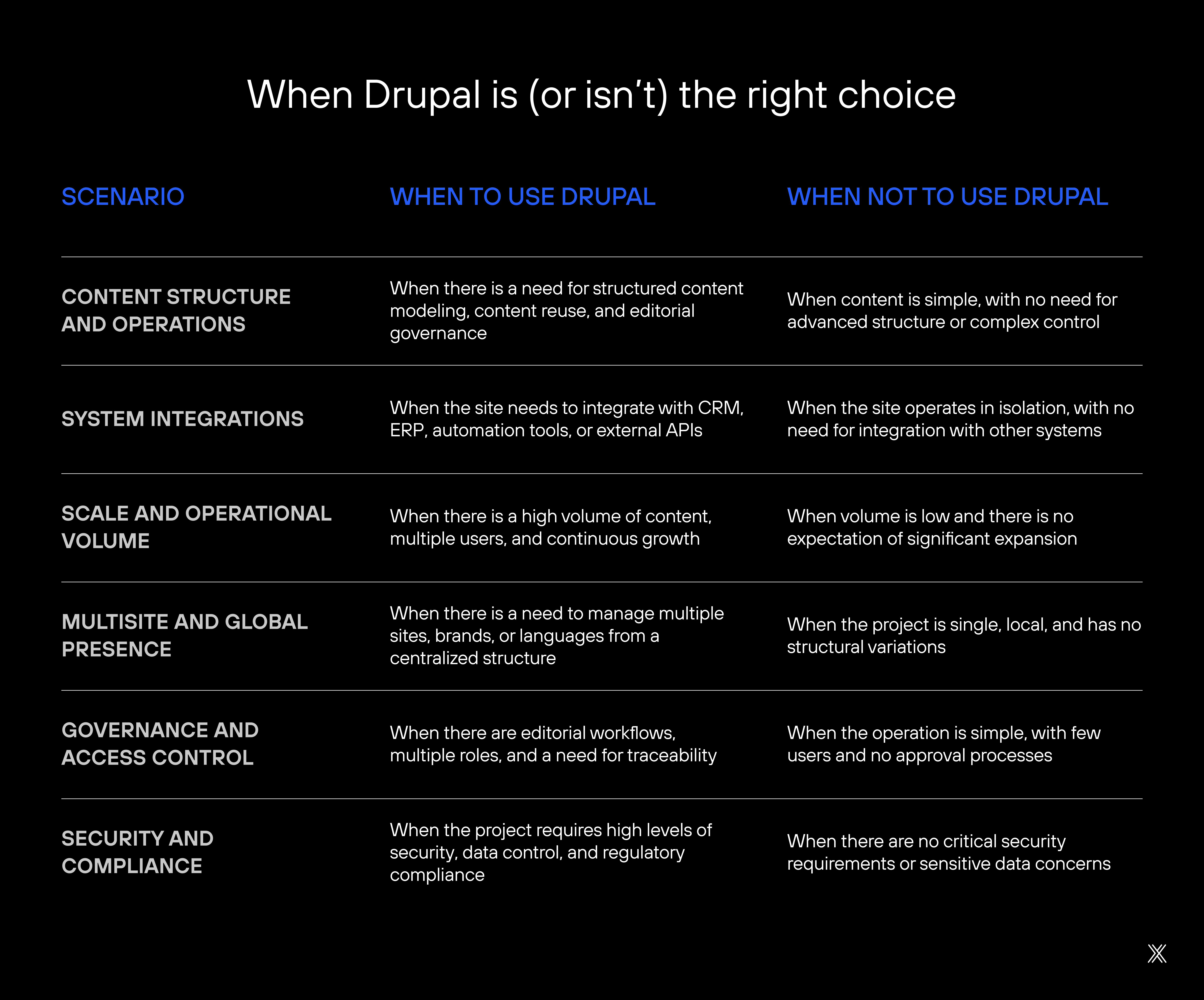
No need for integrations with other systems: if there is no need to integrate with CRM, ERP, or external APIs, Drupal's API-first model loses relevance and adds complexity without practical benefit.
Basic editorial operation: in scenarios with few users and a simple publishing flow, features such as workflows, version control, and granular permissions are not necessary and make operations heavier.
No need for scale or continuous evolution: when there is no anticipated growth in volume, users, or integrations, Drupal's scalability capabilities are not put to use.
The core point is that Drupal solves specific problems. Without a need for integration, governance, and structure, the platform may be more complex than necessary.
How Web Development with Drupal works in practice
In enterprise projects, web development with Drupal does not follow a simple linear path. It is structured to ensure the architecture supports not just the launch, but the ongoing operation and evolution of the project.
Diagnosis and architecture definition
The process starts by reading the business context. It is not just about understanding the site being built, but how it connects with systems, internal teams, and strategic goals.
At this stage, critical points are defined, such as content model, required integrations, access profiles, security requirements, and expected operational volume. A common mistake in this phase is treating the project as a redesign, when in practice, it requires a complete overhaul of the foundation.
The quality of this stage directly impacts the capacity to scale later on.
Experience Design and Design System
With the architecture defined, the focus shifts to experience. Here, Drupal already influences important decisions, particularly in how components are conceived.
The interface stops being purely visual and is built around reusable components aligned with the content model. This ensures consistency across pages, simplifies maintenance, and reduces the dependency on development for future adjustments.
In larger operations, this typically connects with design systems and component libraries.
Development and foundation setup
The development stage involves both configuration and code. Drupal allows much of the structure to be built through configuration, but more robust projects also require custom modules, integrations, and business-specific rules.
At this stage, the following are implemented:
Content types and fields;
Taxonomies and relationships;
Editorial workflows;
Access permissions;
Integrations with external systems.
The quality of this build defines the level of flexibility the solution will have over the long term.
Integrations and flow validation
With the foundation in place, integrations come into play. The site starts consuming and sending data to other systems, which requires careful validation of flows and information consistency.
Here, Drupal acts as a reliable intermediary, ensuring that the data displayed is aligned with real-world operations. Issues at this stage typically generate data inconsistencies or manual rework.
Testing, performance, and security
Before the launch, the focus is on ensuring the application can handle real-world usage. This involves functional testing, validation of editorial flows, performance tuning, and security verification.
Cache configurations, CDN integration, and infrastructure adjustments are refined here. In more critical projects, this stage determines whether the site will be stable under load or whether it will run into problems shortly after go-live.
Launch and continuous evolution
The launch does not close the project. In more complex environments, it marks the beginning of a continuous evolution cycle.
New integrations, structural adjustments, performance optimizations, and security updates become part of operations. Drupal makes this process easier by allowing incremental evolution without compromising the existing foundation.
The key point is that web development with Drupal does not just deliver a site. It delivers a structure prepared to operate, integrate, and evolve without generating rework at every new demand.
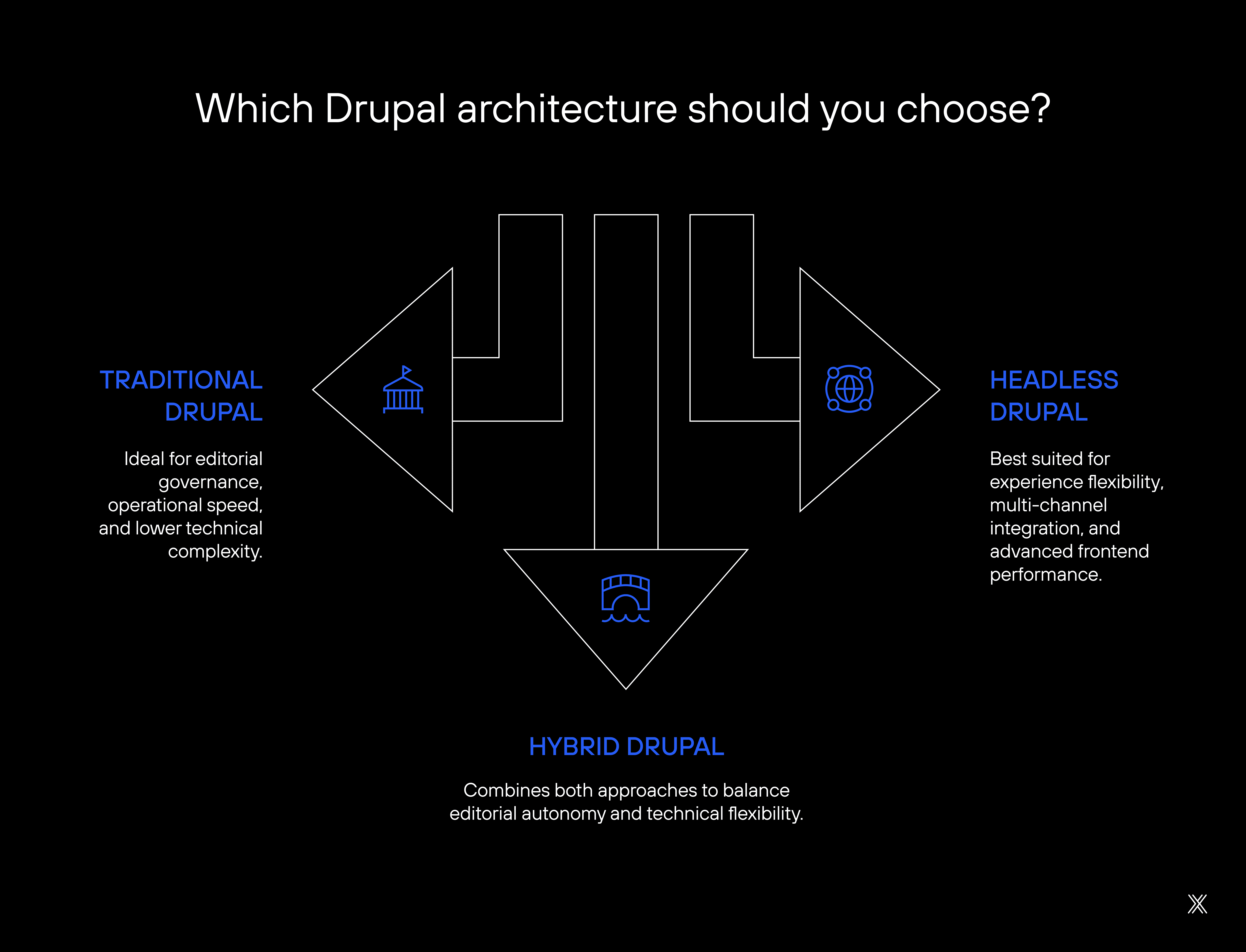
The platform supports different architectural approaches, and the choice directly impacts performance, governance, and project complexity.
Traditional Drupal
In the traditional model, Drupal is responsible for both content management and frontend rendering. That is, the same application controls the entire experience. This approach tends to make more sense when the focus is on editorial governance, operational speed, and lower technical complexity. Marketing teams can operate with more autonomy, creating pages and adjusting content directly within the platform. In addition, control is centralized, which simplifies maintenance and reduces the integration overhead between layers.
Headless Drupal
In the headless model, Drupal acts exclusively as a backend, exposing content via APIs to an independent frontend, typically built with frameworks such as React or Next.js. This approach is adopted when there is a greater need for experience flexibility, multi-channel integration, or advanced frontend performance. It is common in projects where the same content needs to be distributed to different interfaces, such as apps, portals, or omnichannel experiences. On the other hand, it requires greater technical maturity and a more robust development setup.
Hybrid Drupal
The hybrid model combines both approaches. Part of the experience is managed directly in Drupal, while more specific or critical components are decoupled. This format is useful in scenarios where it is necessary to balance editorial autonomy and technical flexibility, without taking on the full complexity of a headless architecture. It allows the solution to evolve gradually, decoupling only what makes sense from a business standpoint.
The choice between these models is not purely technical. It depends on the maturity level of the operation, the need for integration, and how content will be consumed.
In many cases, the most efficient decision is not to start with a fully decoupled architecture, but to build a solid foundation and evolve as the complexity of the project increases.
Read also: Headless Drupal or traditional? How to decide and what the impacts are
Common mistakes in Web Development with Drupal projects
Drupal projects rarely fail due to limitations of the platform. In most cases, the problems are related to poor architectural decisions and flaws in technical implementation, which compromise scalability, governance, and the evolution of the system.
The most recurring mistakes are:
Improper use of the content layer: treating Drupal as a page system rather than a data structure couples content to presentation and limits reuse and integration.
Inconsistent entity and taxonomy modeling: duplicate structures and generic fields undermine organization, hinder evolution, and impact search and performance.
Inadequate configuration of permissions and workflows: incorrect role and flow definitions reduce governance, increase operational risk, and compromise traceability.
Integrations treated as an accessory layer: point-in-time implementations generate data inconsistency and dependence on manual syncing.
Excessive customization without standardization: code outside of core standards makes maintenance harder, reduces reusability, and drives up upgrade costs.
Absence of a deployment and versioning strategy: lack of configuration and environment control generates inconsistencies and production risk.
Lack of planning for the application lifecycle: ignoring ongoing updates leads to outdated systems, security vulnerabilities, and higher evolution costs.
How much does it actually cost to build a website with Drupal?
The cost of a Drupal project is directly tied to the level of complexity, integration, and structure the project requires. More than the initial price, what defines the investment is the role the site will play within the operation.
Simpler projects tend to be faster to deliver on other platforms. Drupal stands out when the scenario involves multiple content types, system integrations, editorial governance, and more advanced security requirements.
For this reason, development involves a more structured initial phase, focused on architecture and content modeling. This effort ensures a solid foundation that reduces rework and increases predictability as the project evolves.
The team also makes a difference. Drupal projects involve different areas of expertise, such as architecture, development, and integration, which contribute to a more consistent implementation from the start.
Over time, investment shifts toward continuous improvements. On a well-built foundation, these evolutions happen incrementally, with greater efficiency and lower impact.
With an experienced team, such as a specialized digital agency, the outlook becomes even more favorable. A well-defined architecture optimizes timelines, reduces risks, and ensures a more consistent delivery. The result is a project with better performance, scalability, and return on investment over time.
The role of a specialized Drupal Partner in complex projects
In simpler projects, the choice of technology is usually the main success factor. In Drupal projects, that changes. The outcome depends directly on the quality of the architecture, implementation, and technical guidance over time. It is at this point that a specialized Drupal partner stops acting solely in execution and takes on a strategic role in building and evolving the solution.
Business-oriented architecture
A Drupal agency does not start with development. It starts with the definition of content architecture, data flows, and integrations, all aligned with business objectives. This stage avoids isolated decisions and ensures the structure is capable of sustaining growth, system integration, and operational governance from the very beginning.
Implementation aligned with best practices
Drupal allows a high level of customization, but it requires technical discipline. A Drupal agency works based on core standards, proper module usage, and development best practices, ensuring greater stability.
This care reduces maintenance risks, makes updates easier, and prevents the flexibility of the platform from generating unnecessary complexity over time.
Integration with the digital ecosystem
More robust projects require integration with different systems. A Drupal agency structures these connections consistently, taking into account data architecture and information flow. The use of well-defined integrations ensures reliability, consistency, and less dependence on intermediary solutions, reducing operational failures.
Governance and structured operations
Beyond the technical layer, operations need to work on a day-to-day basis. A Drupal agency organizes access profiles, editorial workflows, version control, and administrative structure, allowing different teams to use the system with control. This improves operational efficiency and reduces the technical team's dependency on recurring tasks.
Continuous evolution and ongoing support
The launch does not close the project. Drupal requires updates, performance tuning, and continuous functional evolution. A Drupal agency operates within this cycle, ensuring the platform stays up to date, secure, and aligned with new demands, preventing obsolescence and rework in the future.
How to choose a Partner for Web Development with Drupal
The choice of who will develop the project is just as important as the technology itself. In Drupal, this choice directly impacts architecture, delivery quality, and capacity to evolve.
Some criteria help reduce risk and make a more consistent decision:
Proven experience with Drupal: evaluate previously delivered projects, the complexity of the solutions, and familiarity with integration, multisite, and governance scenarios.
Architectural capability: verify that the partner structures content modeling, integrations, and flows before development begins, avoiding improvised decisions.
Adherence to best practices: ensure consistent use of core standards, organized code, and a focus on maintenance and updates.
Long-term vision: assess whether the partner considers continuous evolution, performance, and scalability, and not just the initial delivery.
Clarity in technical communication: understand whether decisions are explained objectively, with a clear impact on the business.
Support structure: verify whether support exists for maintenance, updates, and continuous improvements after launch.
In the end, the choice should consider more than execution. A good partner contributes to a project that has structure, predictability, and the capacity to evolve over time.
Read also: How to Avoid Mistakes When Choosing a Drupal Consultancy? 5 Essential Points
Why Dexa?
As we have seen, choosing Drupal is a technical decision. But the outcome of the project depends on how that technology is applied in practice. In more demanding projects, the challenge is not just developing a website, but reorganizing the structure, improving the experience, and ensuring that content is accessible, scalable, and easy to maintain.

That was the scenario in the project with the Yale Human Nature Lab, where Dexa led the complete reconstruction of the institutional portal in Drupal. Starting from a technical and UX audit, the project reorganized the information architecture, standardized the content structure, and implemented a clearer and more consistent foundation. The result was a more intuitive platform, with better navigability, greater accessibility, and ready to evolve alongside the scientific output of the lab.
That is the level of complexity at which Dexa operates.
Real experience in structural projects: active with Drupal since 2002, in projects involving content restructuring, UX, integration, and scalability;
Architectural vision from the start: definition of content modeling, flows, and integrations, ensuring a solid foundation and avoiding rework;
Technical command of the Drupal ecosystem: consistent use of best practices, with a focus on stability, security, and continuous evolution;
Acquia Partner: operating as an Acquia Partner, aligned with the best practices of the ecosystem and with access to enterprise-grade technologies and standards;
Capability to integrate and scale: building solutions prepared to connect systems and sustain growth without the need for restructuring;
International presence and high-level projects: deliveries for global institutions, with real requirements for performance, usability, and governance.
Is your site today prepared to evolve with your business, or is it already starting to limit your next step? Talk to a Dexa specialist and get your questions answered about your project.