In a digital landscape where agility is essential, adopting a headless architecture in Drupal can transform a project. But what if that choice directly impacts the governance, performance, SEO and scalability of your operation? And how might it affect collaboration between teams?
In traditional Drupal, everything is integrated, from content management to the final rendering of the interface. In the headless model, the CMS becomes a powerful data repository exposed through APIs, freeing the front-end for rapid innovation with tools such as React or Next.js. This separation increases flexibility but also requires technical maturity and strategic planning.
In this article, we explore how Drupal headless works in practice, when it becomes a competitive advantage, the operational challenges that arise and the impacts on SEO and performance. The goal is to help you decide using clear criteria aligned with your business.
What Is Drupal Headless?
In traditional Drupal, the CMS operates as a monolithic and integrated system. It manages content, applies access and permission rules, builds templates with Twig and delivers the final HTML directly to the user's browser. The flow is simple and direct: a request arrives, processing occurs on the server and the response is sent as an HTML page ready to be rendered.
In the headless model, Drupal gives up responsibility for visual rendering. Instead, it focuses exclusively on acting as a data and business logic layer, exposing content through APIs such as JSON:API or GraphQL. The user interface, the visual "head", is built by an external application such as a React, Vue.js or Next.js app that consumes this data independently.
It is essential to clarify two terms that are often confused:
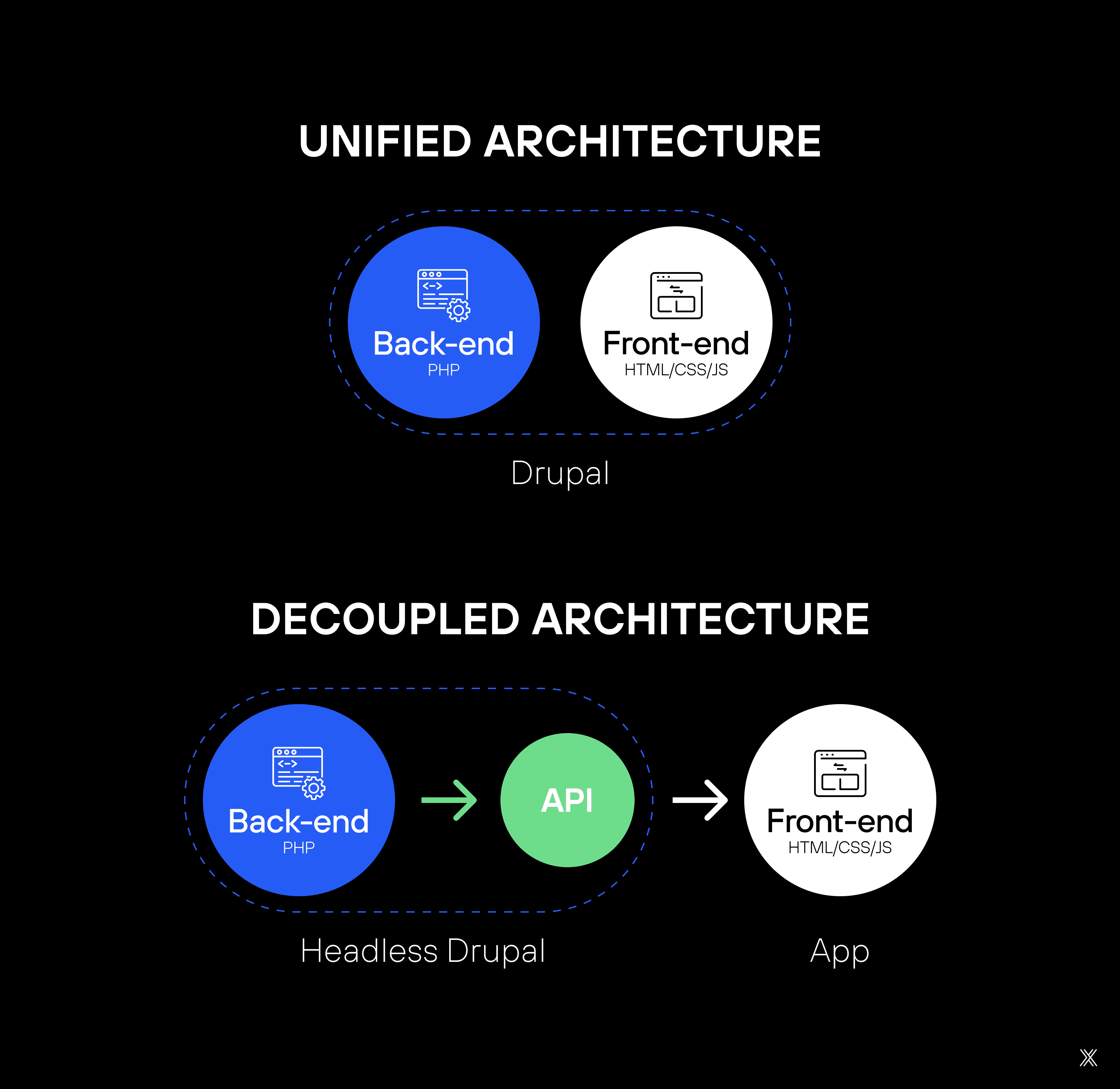
Headless: Refers to the CMS acting purely as a content repository exposed via APIs, without any involvement in visual presentation. It works like a "body without a head", providing only the raw data.
Decoupled: Describes the overall architecture in which the presentation layer (front-end) is separated from the back-end, allowing greater flexibility but not necessarily eliminating all rendering responsibilities from the CMS.
In a fully decoupled model, also called complete headless, Drupal does not participate in assembling the interface. It delivers structured data in JSON format, while the entire user experience layer is handled by the front-end. This approach is especially valuable in multichannel scenarios, such as websites, mobile apps or integrations with other systems.
Other variations include:
Progressive decoupling: Specific parts of the interface are separated, such as an interactive component built in React, while Drupal still renders the main HTML for the rest of the page.
Hybrid model: The main site remains monolithic, but secondary applications such as a mobile app or dashboard consume content through APIs.
The choice between these models is not only technical. It redefines responsibilities, including team structure, scalability and maintenance. For example, in a headless project, the focus shifts to robust APIs and a well-defined contract between back-end and front-end, ensuring that integrations remain stable and versioned.
How does Drupal Headless work in practice?
The main structural change lies in the delivery flow. The focus of the architecture shifts to orchestrating independent layers. The front-end application acts as a client of the API exposed by Drupal. This means that each interface component depends on specific HTTP calls that return data already validated and structured according to the business rules and permissions configured in the backend.
The technical request cycle
The operation can be described in four clear steps:
The front-end application sends an HTTP request to a specific API endpoint.
Drupal performs authentication, validates permissions, resolves relationships between entities and applies access rules.
The CMS returns a structured payload, typically in JSON.
The front-end interprets this payload and assembles the interface according to its rendering logic.
The fundamental difference compared to the traditional model lies in composition. In a monolithic architecture, processing and rendering occur in the same environment. In a headless environment, rendering happens in a separate application, often hosted on a different server or service. This separation affects not only the codebase but also infrastructure, deployment and monitoring strategies.
Rendering Strategies And Their Impacts
After receiving the data, the front-end application must decide how the final HTML will be generated. Frameworks such as Next.js support different strategies, each with technical and business implications.
Server-Side Rendering (SSR): HTML is generated on the front-end server for every request, favoring indexing and offering stronger cache control.
Static Site Generation (SSG): Pages are pre-rendered during the build process, ensuring high performance for predictable or relatively stable content.
Incremental Static Regeneration (ISR): Allows pages to be revalidated on demand without requiring a full rebuild.
Client-Side Rendering (CSR): The interface is assembled in the browser after JavaScript is loaded.
The choice between these strategies directly affects metrics such as Largest Contentful Paint, perceived response time, infrastructure cost and system behavior under traffic spikes.
The data layer as a technical contract
When exposing data, the most common options are JSON:API and GraphQL. The decision between them influences latency, the volume of transferred data and the overall governance of the API.
JSON:API offers standardized and predictable endpoints that are quick to implement. It works well when content modeling is clear and the consumption layer does not require highly customized queries.
GraphQL allows granular queries where the client requests exactly the fields it needs. This reduces overfetching and can improve efficiency in complex applications, although it requires greater discipline in schema definition and versioning.
Regardless of the technology chosen, the API becomes the formal contract between backend and frontend. Any change to this contract directly affects the interface application, which makes strong governance essential.
Impact on infrastructure and operations
In a headless model, there is no longer a single website or a single deployment cycle. The architecture typically involves several components:
A Drupal application dedicated to content management and business rules;
A front-end application responsible for experience and rendering.
Possible use of a CDN to optimize global content delivery.
Independent CI/CD pipelines.
Separate monitoring and logging for each layer.
This structure provides greater flexibility and scalability, but it also increases operational complexity. Authentication mechanisms such as OAuth2 or JWT, cache invalidation and synchronization between editorial publication and application updates must be clearly defined.
Architectural freedom requires technical discipline
Separating the layers creates real autonomy between teams. The front-end can evolve without depending on the backend deployment cycle, as long as the API contract is respected. This enables faster iteration, scalability and technological independence.
However, that freedom requires discipline in versioning, endpoint governance and cache strategy. Without these foundations, flexibility can quickly turn into accumulated technical debt.
In practical terms, Drupal headless works as a robust content engine connected to a highly customizable experience layer. The advantage lies in independence and modular evolution. The challenge lies in the technical maturity required to sustain this architecture over time.
See also: Headless CMS and its impact on multichannel content
Technical advantages of Drupal Headless and why they matter for business
When you decouple Drupal, you are not abandoning the CMS. You are elevating it to its proper role as the central layer for content and business rules. Drupal continues to provide structured content modeling, granular access control by role, field or entity, versioning, editorial workflows and native multilingual support. In a headless environment, these capabilities become even more critical because the API becomes the system's boundary.
This means governance and compliance can be centralized in a single core, even when multiple interfaces consume the same data. For organizations operating across several channels, such as corporate websites, authenticated portals or mobile applications, centralized content governance reduces inconsistency and operational risk.
Predictable and extensible APIs
The adoption of JSON:API in Drupal core eliminates the need to create custom endpoints for many simple use cases. Resources are already exposed through a consistent structure with support for filters, pagination and includes.
When scenarios require more complex queries or optimized payloads, GraphQL becomes a strategic alternative. It allows the client to request exactly the fields needed, reducing overfetching and improving efficiency in complex applications.
This predictability at the data layer accelerates integrations with other systems. Faster integrations mean shorter time to market for projects involving CRM platforms, e-commerce environments or satellite applications.
Real freedom in the front-end
By separating rendering from the CMS, the dependency on the theming layer and Twig disappears. Frameworks such as React, Next.js, Vue.js and Angular gain full control over the user experience.
This opens space for consistent design systems, complex microinteractions, advanced animations and reusable components across different products. For teams managing multiple digital platforms, component reuse and design system consistency reduce duplicated effort and strengthen brand coherence.
From a strategic perspective, this freedom accelerates experimentation. Interface adjustments and A B testing can happen without directly affecting the content core.
Performance as strategy, not as a side effect
Headless is not automatically faster. The advantage appears when the architecture is combined with appropriate rendering and caching strategies. With SSR or SSG in frameworks such as Next.js, it becomes possible to reduce initial load time and improve metrics such as Largest Contentful Paint and Time to First Byte.
Static pages can also be distributed through a global CDN, reducing latency for users across different regions. Performance becomes an architectural decision rather than a side effect of the CMS.
Separating layers also allows the front-end and back-end to scale independently. During traffic spikes, the presentation layer can absorb demand without necessarily overloading the Drupal server.
For businesses that rely on organic traffic or digital conversion, this efficiency has a direct impact on revenue and retention.
Reduced attack surface
In the traditional model, the Drupal server is often directly exposed to the public internet. In a decoupled architecture, the presentation layer can be isolated and protected through CDNs and edge networks.
The API becomes the only communication point with the backend. This makes it possible to apply authentication mechanisms such as OAuth2, JWT tokens or Simple OAuth in a structured way. Access control becomes centralized and auditable.
Separation does not eliminate risk, but it allows more precise security policies and more granular monitoring.
In summary, the technical advantages of Drupal headless go beyond front-end flexibility. They emerge from the combination of centralized governance, predictable APIs, modular scalability and more precise control over performance and security.
The challenges that come with headless architecture
Adopting Drupal headless increases architectural freedom, but it also redistributes technical responsibility. What used to be centralized inside the CMS is now divided between the API, the front-end application and the infrastructure. This separation requires operational maturity.
Duplicated infrastructure
Instead of a single application, you now operate two. The backend runs on Drupal, while the front-end typically runs on Next.js or React. This means separate CI/CD pipelines, different environments, distributed monitoring and constant synchronization between versions.
Without strong deployment governance, the API contract can quickly become a point of fragility.
The API is a critical boundary
In a decoupled model, the API becomes the center of the architecture. Authentication through OAuth2 or JWT is no longer optional. CORS control, rate limiting and granular permissions become fundamental elements of the system.
The advantage is centralized control. The risk is exposure if configurations are poorly implemented. API governance becomes a critical operational discipline.
Features that need to be rebuilt
When adopting a fully decoupled model, you lose automatic rendering, editorial preview and features such as Layout Builder. Parts of the editorial experience must be rebuilt in the front-end.
This effort is both technical and strategic. It affects project timelines, costs and long-term maintenance. Some capabilities that existed inside Drupal must be recreated in the experience layer.
Governance of the contract between layers
Any structural change in the content model can impact the front-end. API versioning, documentation and integration testing become mandatory.
Headless offers real autonomy between teams. But that autonomy only works when supported by strong architectural discipline and well-managed API contracts.
When the headless architecture is strategic
Choosing Drupal headless is an architectural decision aligned with the stage of the product, the complexity of the digital ecosystem and the technical maturity of the organization. There are scenarios in which decoupling becomes a competitive advantage. There are others where the same decision introduces complexity without proportional return.
When headless becomes a real advantage
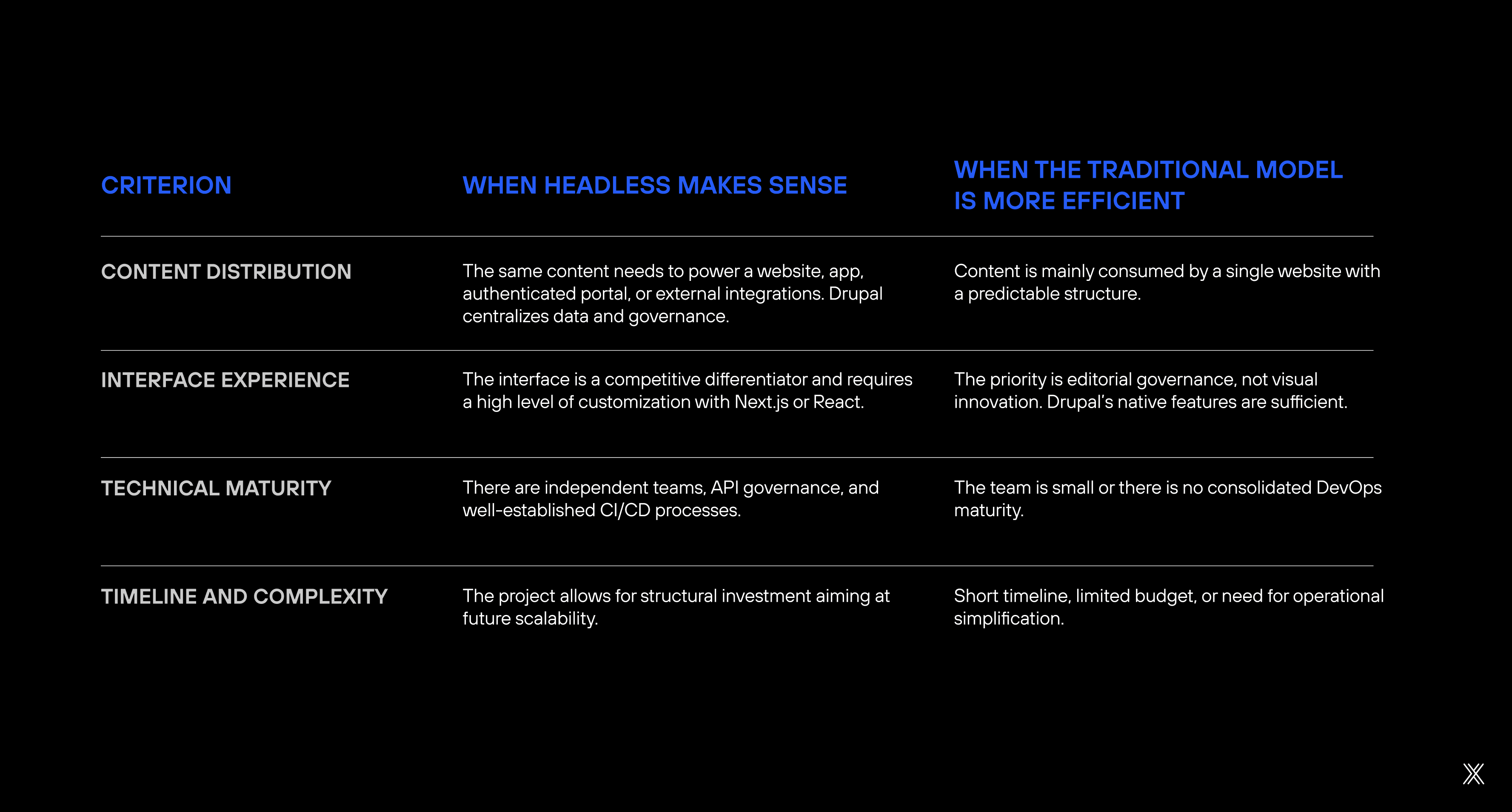
A decoupled architecture makes sense when content needs to feed multiple interfaces. If the same editorial core supplies a corporate website, a mobile application, an authenticated portal and integrations with external systems, using Drupal as a central content repository reduces duplication and improves governance.
It is also a strategic choice when the interface experience is a central part of the value proposition. Digital products that depend on complex interactions, advanced animations or consistent design systems tend to benefit from modern frameworks such as Next.js or React. In these cases, the separation allows the visual layer to evolve without compromising the content core.
There is also a third factor: organizational scalability. When front-end and back-end operate as independent teams, a decoupled architecture creates a clear contract between layers. This reduces dependencies between teams and accelerates delivery cycles, provided that API governance is in place.
When the traditional model is more efficient
Not every project requires this level of complexity. In corporate websites with a predictable editorial structure, where the main challenge is content governance rather than interface innovation, the monolithic model remains highly efficient. Drupal already provides robust rendering, multilingual integration, editorial preview and tools such as Layout Builder without requiring reconstruction in the front-end.
Projects with short timelines or restricted budgets also tend to benefit from the traditional architecture. By keeping rendering and content in the same environment, the team reduces infrastructure variables, simplifies deployment and lowers maintenance effort.
In addition, organizations without established DevOps maturity may find greater stability in a unified system, where logs, security and version control remain centralized in a single application.
The criterion that really matters
The central question is where the experience should be assembled and who should control it. If the experience layer needs to be highly customized and evolve independently, a decoupled architecture tends to be the most coherent approach. If the priority is content governance and operational efficiency, keeping rendering inside Drupal may be the more strategic choice.
Architecture is about balance. In the case of Drupal, the real advantage lies in the ability to move between models without abandoning the platform.
SEO and rendering: where architecture impacts traffic, ranking and conversion
In a headless architecture, SEO stops being a natural consequence of the platform and becomes an explicit responsibility of the interface application.
In the traditional Drupal model, HTML is already delivered fully rendered to the browser. Metadata, semantic markup, canonicals, hreflang and heading structure are part of the standard rendering flow. Indexation occurs over an output already structured by the CMS itself.
In a decoupled scenario, that responsibility moves entirely to the front-end. What was previously implicit now depends on the chosen rendering strategy and on how the HTML is generated. This changes the technical planning from the very beginning of the project.
The choice of rendering strategy
Frameworks such as Next.js offer multiple rendering strategies, and each one directly affects indexing, loading time and infrastructure cost.
Server-side rendering (SSR) generates HTML on the front-end application server for each request. This guarantees complete markup for search engines and stronger cache control, but requires higher computational capacity.
Static site generation (SSG) pre-renders pages during the build process, delivering highly performant static files through a CDN. It works well for predictable content but requires well-structured rebuild pipelines when updates are frequent.
Incremental static regeneration (ISR) allows on-demand revalidation, balancing performance and dynamic updates.
Client-side rendering (CSR) delegates HTML assembly to the browser. Although it simplifies infrastructure, it can compromise indexing and Core Web Vitals metrics if a proper fallback strategy is not implemented.
The decision between these strategies determines how Google accesses the content, how caching behaves and how the system responds under load.
Core web vitals and measurable business impact
Separating front-end and back-end can improve metrics such as Largest Contentful Paint, First Input Delay and Time to Interactive, provided that caching and delivery architecture are well designed.
The use of CDN distribution, caching layers, data fragmentation and optimized GraphQL queries can significantly reduce latency and payload size. However, each additional layer increases the engineering team's responsibility for monitoring and performance tuning.
In competitive markets, milliseconds influence organic ranking, bounce rate and conversion. Performance is not just a technical indicator. It is a revenue factor.
Headless increases the potential for performance. It does not guarantee it automatically.
Technical SEO governance in a decoupled environment
In a headless model, SEO must be treated as part of the architecture, not as a later adjustment. This involves:
Consistent metadata generation in the front-end
Proper implementation of structured data and semantic markup
Synchronization between editorial updates and cache invalidation
Proper management of redirects and HTTP status codes
Without this alignment, the separation between layers can generate inconsistencies that remain invisible to the editorial team but critical for search engines. Governance shifts from content management alone to include rendering control as well.
Check out our article about SEO migration to learn more →
Conclusion
Drupal headless is an architectural tool and, when applied in the right context, allows organizations to scale digital experiences, distribute content across multiple channels and evolve the interface and backend independently. However, this freedom requires strong governance, clear API contracts, a well-defined rendering strategy and DevOps maturity. Without these pillars, complexity can outweigh the benefits.
At Dexa, a digital agency specialized in Drupal, this decision begins with understanding the business, the technical maturity of the team and the long-term goals of the digital product. The architecture is designed to sustain growth, performance and governance, not simply to follow a preferred technology stack.
Headless may be the right path. It may not be. What matters is that architecture serves the strategy, not the other way around.
Want to understand how to apply this potential to your project?