
Market positioning is what gives a brand its axis, defining how it is seen, understood and remembered by its audience. Without it, communication tends to rely on confusing references, visual decisions made at different moments, and inconsistent messaging that ultimately fails to support growth.
Prospective customers get lost. They do not understand why the company looks one way on its website and another on social media, and they do not even recognize it when a digital ad reaches them.
As the business scales, that lack of direction becomes even more visible. The portfolio evolves, and the sales team adapts its approach to close deals day to day, while marketing creates seasonal campaigns and digital channels start following visual trends that change constantly.
This noise creates silent financial impacts. A blurry brand can raise customer acquisition costs, reduce perceived value and weaken competitive differentiators. As a result, the business becomes more dependent on price, sales effort and growing investment in paid media.
That is the gap Dexa’s Strategic Branding practice addresses. For us, branding is not a superficial layer of identity or an isolated design exercise. It is an infrastructure of clarity: a strategic system to organize the brand, guide how it shows up in the market and build companies that are more connected to their audience.
Below, we share what goes on behind the scenes of this practice and how we structured our Strategic Branding services.
Your brand with more strength, clarity and intention
We combine diagnostics, positioning and visual identity to strengthen how your brand is perceived and support strategic decisions.
Our journey with branding so far
Dexa was founded in 2002 with roots in design, but it has always understood a brand as something bigger than visual expression. From the start, form, messaging and experience have needed to come from the same strategic direction. That foundation is what turns identity into recognition, positioning into differentiation and communication into perceived value.
Over more than two decades, we have seen this need appear at different moments in our clients’ journeys. Many companies come to us with demands around growth, digital presence or corporate communication. But before any campaign, website or identity, the diagnosis reveals a central issue: the brand needs to be better positioned to support the next phase of the business.
That happens because a lack of direction is also a form of positioning, and the company may be communicating, as we have identified in many cases, the opposite of the result it expects:
"Every company has an active brand in the market, whether or not it manages that brand consciously. Public perception is inevitable. If the organization does not take intentional control of that narrative, the market builds its own impressions in a disorganized way. Branding works precisely there: to reduce unwanted noise."
— Rafael Andrighetti, Head of Design at Dexa
How Strategic Branding took shape inside Dexa
It was from that recurring diagnosis that the Strategic Branding practice consolidated within our operation. Once we saw that institutional clarity was the determining factor in the success of projects, we began structuring our clients’ brand foundation as an essential step for all the other gears to perform.
Our consulting work, which began as a mapping stage, gained substance and maturity across projects. It became clear that for a Digital Growth operation to generate real traction, for a website to sustain strong conversion rates or for a digital journey to stay consistent, the brand’s premises had to be well defined.
This went far beyond design. It involved reading the market, studying personas in depth, clarifying differentiators and building an identity capable of guiding every brand touchpoint. Even when that structure did not appear directly in the visual layer, it guided the experience.
Our journey consolidated with Dexa’s own rebranding. It was the moment when the agency reorganized its market presence to express the integrated ecosystem it had become, now with the new service added to the portfolio.
"It is not about aesthetics or design best practices in isolation. Strategic branding is about methodology and control: it is about getting your business strategy to become a real, consistent perception in people’s minds."
— Rafael Andrighetti, Head of Design at Dexa
Strategic Branding at Dexa
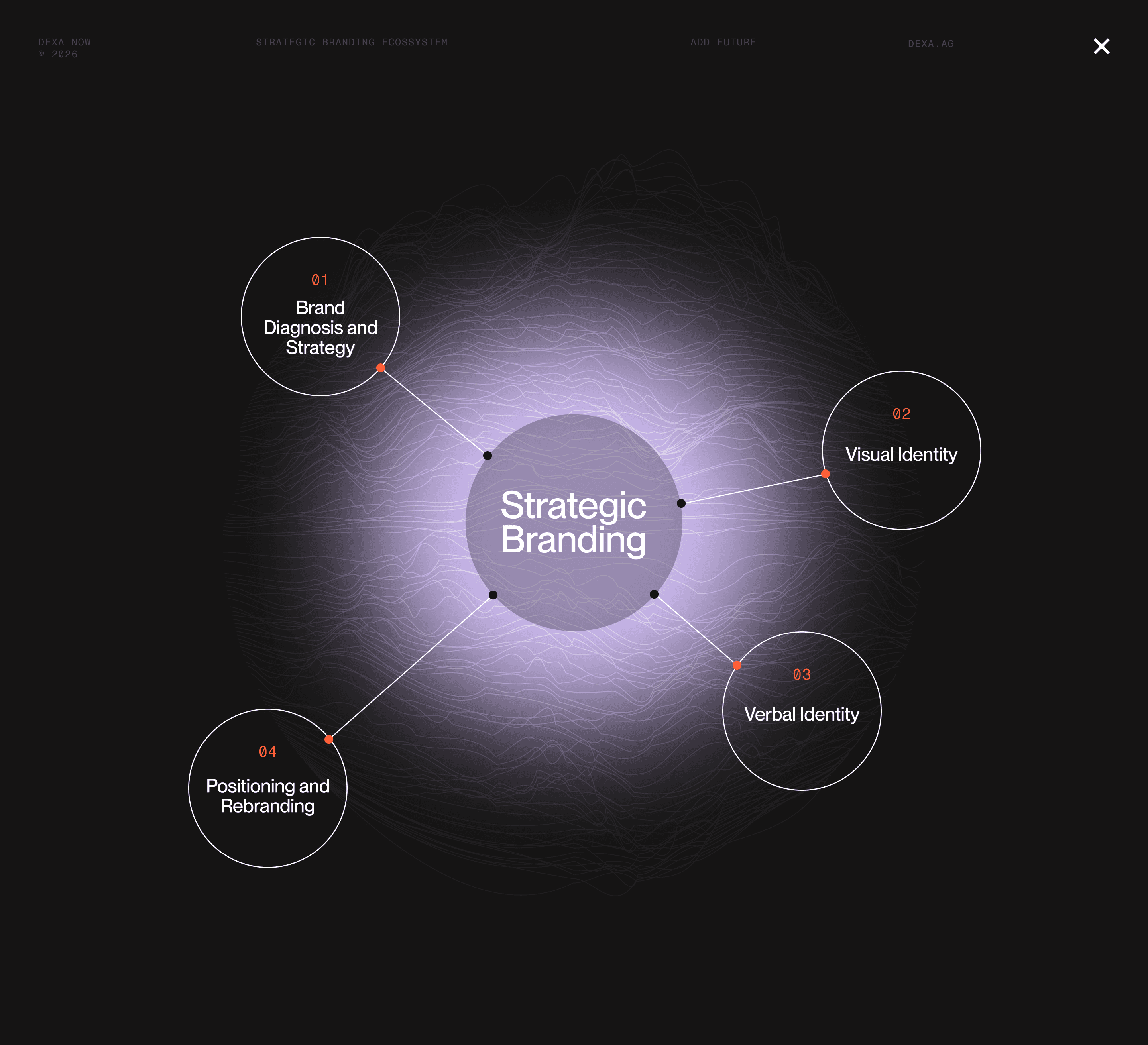
Our model connects four areas of work to solve branding challenges.
1. Brand diagnostics and strategy
Before creating any visual or verbal asset, you need to understand what the brand already communicates, even unintentionally. That is why the work begins with a reading of the business, the market, competitors, target audiences and the noise that shows up across the company’s touchpoints.
This diagnosis helps separate perception from internal preference. The brand stops being discussed only through the taste of whoever decides and starts being analyzed through context, data and business objectives.
Unique value proposition: defining the brand’s competitive differentiator for the ideal customer profile.
Brand platform: organizing the pillars that guide positioning, corporate messaging, marketing and sales.
Culture fundamentals: defining or reviewing vision, values, brand DNA and long-term guiding principles.
2. Visual identity
Visual identity translates brand strategy into a recognizable system. It is not limited to the logo. It involves color palette, typography, graphic elements, iconography, image direction, narrative and application rules.
When well built, the identity creates unity across channels and reduces the need to explain the brand from scratch at every new contact. The audience starts recognizing patterns, associations and visual cues more easily.
Art direction: defining the visual path aligned with the brand’s positioning.
Identity system: creating visual elements ready to work across different formats, channels and contexts.
Brandbook: documenting usage rules to guide internal teams, partners and vendors.
3. Verbal identity
Verbal identity organizes how the brand speaks, argues and adapts to different situations. This is the area that defines tone of voice, vocabulary, key messages and writing guidelines.
This work matters especially because many brand touchpoints are not visual. A sales conversation, a WhatsApp support exchange, a corporate email or a reply on social media also build perception.
Language attributes: defining the principles that guide the brand’s verbal expression.
Key messages: structuring the main corporate, sales and marketing arguments.
Corporate writing guide: a practical manual to standardize internal communication, customer service, public relations and digital channels.
4. Positioning and rebranding
Repositioning becomes necessary when there is a gap between what the company is today and how it is still perceived. This can happen after fast growth, a change in portfolio, entry into new markets or a transformation in the industry itself.
In this process, the goal is not to change everything. The work starts with a Brand Equity analysis, identifying which assets still hold value, which need to be updated and which no longer help sustain the brand strategy.
Brand Equity audit: identifying the brand assets that should be preserved, updated or repositioned.
Rollout planning: organizing the transition and the launch of the new brand for internal and external audiences.
Omnichannel alignment: guidance for applying the brand consistently across digital, physical, commercial and corporate channels.
One important Dexa differentiator is treating branding as the starting point for a more consistent digital presence. The brand can be born in Strategic Branding, but it does not have to stop at the brandbook.
When the client needs to move forward, this strategy can unfold into website, digital experience, content, SEO, campaigns, performance, technology, CMS, DXP and support.
For many companies, this makes a difference because it shortens the distance between defining the brand and putting it into operation. The same partner that structures positioning, identity and narrative can also turn that foundation into real channels, journeys and market experiences.
More than 10 years of consistency for a brand built from scratch
The creation of ViajaNet, in 2009, is one of the clearest examples of our Strategic Branding service. At the time, Dexa, still operating as MMDA, took part in building the brand from scratch, before it even had a digital presence.
The challenge was turning a behavioral shift into a trustworthy brand. Online travel was starting to open space for new consumers, driven by more affordable fares, installment payments and internet purchasing. But selling air travel online to that audience required more than a good offer. It required a name, trust, clarity and recognition.
It was from that reading that Dexa structured ViajaNet’s naming, visual identity, tone of voice, the design of its first website, the brand manual and its communication guidelines. Every decision helped reduce barriers to understanding and create a brand ready to grow across campaigns, digital channels, partnerships and white label models.
The partnership lasted more than ten years. In that period, ViajaNet went from zero to nationwide presence and kept a recognizable identity even as the operation expanded.
Why choose Dexa?
Dexa builds brands to operate in the real world. Brands that need to be understood by the market, defended by the sales team, recognized across digital channels and applied consistently by different teams.
With more than 20 years in digital projects, we connect branding to experience, technology and growth without losing focus on the brand. The result is a strategy that does not stay confined to messaging. It takes form, presence and practical use.
As Rafael Andrighetti, Head of Design at Dexa, sums it up:
"It is not about aesthetics or design best practices in isolation. Strategic branding is about methodology and control: it is about getting your business strategy to become a real, consistent perception in people’s minds."
For growing companies, that is the central point: having a brand clear enough to sustain the next phase of the business.