Low-Code CMS: How it works, risks, and how to choose the best one for your business
Enterprise Technology

A marketing team needs to launch dozens of landing pages within a few days. Each one has variations in content, forms, CRM integrations, and fine SEO adjustments. In the traditional website model, this type of demand inevitably goes into backlog, depends on technical prioritization by the IT team, and, consequently, misses the launch timing.
Now imagine this same scenario operating in a different way: already structured components, ready integrations, and a visual environment where the marketing team itself can build, adjust, and publish pages safely, without compromising technical standards.
This is the inflection point introduced by the Low-Code CMS: it doesn't just accelerate delivery, it reorganizes the digital operation. It reduces dependency, distributes production capacity, and turns speed into a real competitive advantage.
If your operation already faces bottlenecks between marketing and technology, it's worth continuing to understand how the Low-Code CMS solves execution and redefines how digital products are built and evolve.
What is a Low-Code CMS
To understand what a Low-Code CMS is, let's revisit the concepts separately. A CMS is a Content Management System that allows you to create, edit, and organize the content of a website without having to directly handle the source code. Low-Code, on the other hand, is a software development approach that prioritizes the use of visual interfaces instead of traditional lines of code.
This means that both CMS and Low-Code were created to simplify development and content management in websites, systems, software, and applications. Together, they give rise to content management platforms that combine visual building interfaces with programmatic extension capabilities, allowing different professional profiles to participate in the creation and maintenance of digital products.
The Low-Code CMS is positioned between two traditional models:
On one side are No-Code platforms, which allow the creation of pages without the need to write code, therefore, without the need for professional developers. However, they often present limitations when the project requires complex integrations or custom logic.
On the other side is traditional development, which depends on developers and offers full control over the application. It is possible to do everything. But this model requires longer production cycles, which can delay launches and campaigns.
The Low-Code CMS resolves this tension. It preserves the robustness of traditional development, but significantly reduces the effort required to build websites and web apps.
Examples of Low-Code CMS
The Low-Code CMS market is not homogeneous and is full of tools that vary according to the level of technical control, the type of architecture and the usage profile.
Webflow
It has consolidated itself as one of the main visual building platforms, offering detailed control over HTML and CSS within an intuitive interface. This allows the creation of sophisticated experiences without giving up technical precision, being widely used in campaigns and pages with high design demands.
Contentstack
Represents a corporate approach based on headless architecture. It does not focus on visual interface construction, but on structured content distribution across multiple channels. It is common in companies that operate with applications, e-commerce, and complex digital platforms.
Storyblok
Combines these two worlds by offering a visual editor integrated with a headless architecture. This allows content teams to visualize changes in real time, while the technical layer remains decoupled and flexible.
WordPress
With Elementor, it remains one of the entry points to Low-Code, especially in less complex projects. Its strength lies in speed of implementation, although it presents limitations when greater architectural control is required.
Drupal
With features such as Layout Builder and Canvas, it occupies a more advanced position in this ecosystem. It allows visual construction without giving up governance, security, and scalability, being especially relevant in corporate and institutional environments.
Builder.io
Introduces the concept of visual headless, in which marketing edits visually while the front-end is rendered in modern frameworks. This model is particularly efficient for companies that need to maintain a clear separation between experience and application logic.
Also read: Drupal Canvas and the new phase of Low-Code in Drupal CMS 2.0 →
Differentials of the Low-Code CMS
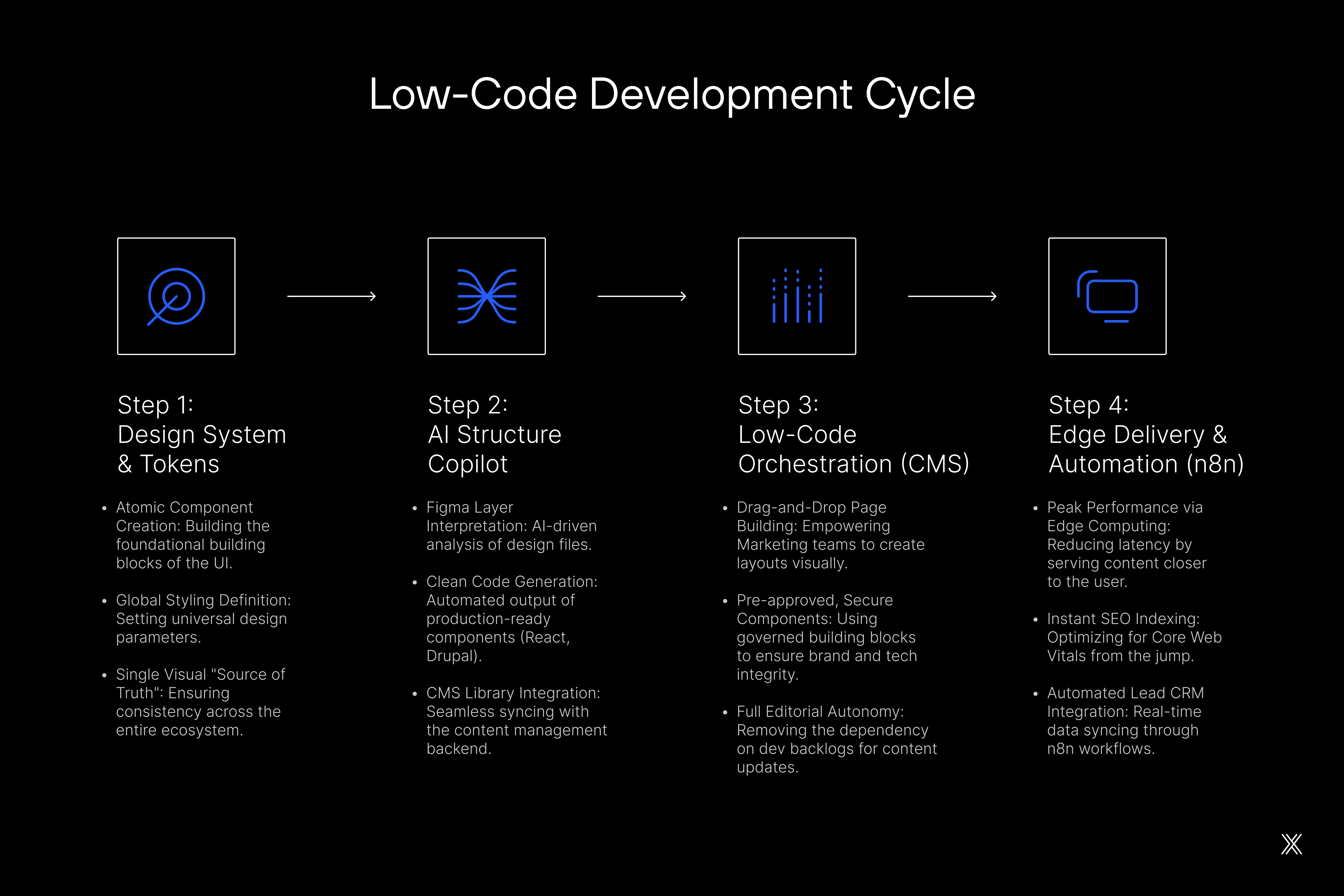
The Low-Code CMS is not limited to simplifying page creation. It redefines how digital production is structured and operated within organizations. By reorganizing responsibilities, reducing technical dependencies and integrating different areas into the same workflow, this model transforms operational logic, making delivery more agile, continuous and data-driven.
The first impact is speed. Component-based construction eliminates the need to develop each interface from scratch, drastically reducing the time between idea and publication. This turns time-to-market into a controllable variable, rather than a bottleneck.
This speed gain comes with efficiency. By removing repetitive and operational tasks from engineering, the technical team starts acting where it truly generates value: architecture, complex integrations and innovation.
Another important difference is the redistribution of autonomy. Marketing stops being dependent and becomes an active operator of the digital experience. This accelerates execution and improves decision quality, since adjustments start being made based on data and real user behavior.
In addition, the CMS stops being an isolated system and starts operating as a strategic layer within the digital architecture. It organizes content, connects services and sustains multiple channels consistently.
Main features
The Low-Code CMS works as a complete operational environment, where visual construction, application logic and integration coexist.
The foundation of this model is component-driven visual construction. Instead of creating pages from scratch, teams use structured blocks that already incorporate design, accessibility and performance rules. This reduces errors, accelerates delivery and maintains consistency at scale.
Drag-and-drop is not just a visual interface. It reduces the technical complexity involved in building pages, allowing layouts to be structured faster without the need to write code.
Another central point is integration via APIs. The CMS connects to CRM tools, marketing platforms, payment systems and analytics services, functioning as an orchestration hub.
Code extensibility ensures that the system does not become limiting. Whenever necessary, developers can intervene to create specific functionalities, adjust performance, or integrate more complex systems.
In practice, this means that the Low-Code CMS does not replace engineering, but redefines where it operates.
Composable, Serverless and Figma architectures
The advancement of the Low-Code CMS follows a deeper transformation in how digital architectures are conceived. We are talking about building interfaces with more agility and structuring technological ecosystems capable of evolving continuously without generating rigid dependencies.
In this context, the CMS stops being an isolated operational layer and becomes an orchestration point within the digital architecture. It connects services, organizes content flows and sustains distributed experiences across different channels, maintaining consistency even in complex environments.
The composable approach materializes this logic by replacing monolithic structures with a set of independent, specialized services connected by APIs. This allows each system component to evolve autonomously, without compromising the rest of the architecture.
The serverless model reinforces this flexibility by eliminating the need for direct infrastructure management. Functionalities are executed on demand, which reduces operational load, improves scalability and accelerates the implementation of new solutions.
Integration with Figma brings design and development closer in a more structured way. Interfaces stop being just visual references and become functional components, aligned with design systems and ready for use at scale. This reduces rework, increases delivery accuracy and shortens the path between conception and execution.
Use cases
The Low-Code CMS stands out in scenarios where speed and consistency need to coexist. In marketing campaigns, it allows the creation of multiple page variations quickly, maintaining visual and technical standards. This enables A/B testing at scale and faster responses to performance data.
In corporate portals, it reduces dependency on the technical team for recurring updates. Editorial teams start operating directly in the CMS, increasing efficiency and reducing operational bottlenecks.
In digital product prototyping, the impact is even more strategic. Interfaces can be built quickly to validate hypotheses before investing in full development.
A practical example
A company needs to launch pages segmented by region, audience, and offer within a few days. With a Low-Code CMS, the team structures a component base and replicates variations consistently, while integrations with CRM and automation are already connected. What used to take weeks is now solved in hours.
Performance and SEO in Low-Code environments
For a long time, visual tools were associated with performance problems, mainly due to excessive automatically generated code. Today, this reality has changed, but it requires criteria in choosing the platform and in the implementation method.
Modern solutions use hybrid rendering, combining static HTML with dynamic activation, which improves indexing and maintains an interactive experience. The use of edge delivery and CDNs reduces latency and brings content closer to the user.
Another critical point is component quality. Well-structured libraries avoid redundancy, reduce page weight, and maintain visual stability.
In practice, avoiding code bloat is not just a matter of the tool, but of the adopted architecture. When well implemented, Low-Code can deliver performance comparable to custom-built projects, maintaining good Core Web Vitals indicators and favoring ranking.
Security and governance
In corporate environments, speed without control can generate risk. Therefore, security and governance are essential pillars in Low-Code platforms.
Mature solutions offer granular permission control, allowing you to define exactly what each profile can access, edit or publish. This avoids improper changes and ensures operational consistency.
A clear example: in an institutional portal, the marketing team can edit content and build pages, but cannot change structural components or critical integrations. Meanwhile, the technical team maintains control over the system foundation.
In addition, the separation between content, presentation and logic contributes to greater data integrity and facilitates audits, compliance and traceability of changes.
Artificial Intelligence and automation in Low-Code
The incorporation of Artificial Intelligence into Low-Code does not just add new functionalities. It changes how digital structures are created, organized and evolve over time.
Teams no longer need to start from scratch and begin working from already structured foundations. AI can interpret design systems, interface patterns, and brand guidelines to automatically generate reusable components within the CMS. This significantly reduces initial setup time and ensures greater consistency between pages.
The impact also appears in continuous operation. With each new publication, the system can execute a series of tasks automatically, such as structuring metadata, adapting content for different channels and generating variations for testing. What previously depended on multiple tools and manual steps now happens within the production flow itself.
In this way, the Low-Code CMS evolves from a construction tool into an assisted production environment, where a relevant part of the work is automated without compromising control or quality.
Example: When creating a new landing page, AI can suggest the ideal structure based on previous high-conversion pages, adjust titles for SEO, automatically generate descriptions and suggest variations for A/B testing. The team stops focusing on operational execution and starts acting on strategy.
What to consider when structuring an efficient digital operation with Low-Code CMS
The Low-Code CMS is not a future trend, but a concrete response to the limitations of traditional digital development models, which no longer keep up with the speed and complexity of current operations.
By balancing speed, technical control and integration with increasingly distributed digital ecosystems, it transforms the CMS into a strategic layer within the architecture, capable of sustaining continuous growth without generating operational dependencies.
For companies that need to operate with agility, reduce bottlenecks between teams and respond quickly to market changes, the discussion is no longer about adoption, but about structuring, governance and choosing the most appropriate approach.
If your operation still faces friction between marketing and technology, this is the moment to evolve with more consistency.
Discover how to implement a Low-Code CMS aligned with the reality, complexity and goals of your business.