Pouring serious money into marketing, whether it's team, vendors, tools, or ads, and seeing no return for the business is more common than you'd think. And often, the problem is fragmentation.
When one agency handles content, another manages paid media, and a third owns the digital platform, the ecosystem breaks. Even if every front delivers its work on time, the channels operate in parallel worlds. The result is noise in the messaging and the absence of a consistent, omnichannel strategy that unites the channels around the same identity and the same objectives.
Unlike other agencies, Dexa treats marketing as a single, integrated operation, not a patchwork of services. Here, strategy, SEO, content, social, paid media, and inbound work together from the same business diagnosis, as an active arm of digital positioning and demand generation for the client.
In this article, we take you behind the scenes of this practice and explain how we structure our Digital Growth services.
Digital marketing built for real growth
Integrated branding and performance strategies that put your brand where your audience already is, with consistent, sustainable digital growth.
Our Digital Growth journey so far
Dexa's Digital Growth took shape out of something the agency had been doing for years: supporting clients who needed to connect strategy, content, and performance into a more integrated marketing operation.
Over time, we realized this was a common pain point across the market. Many companies didn't just need more campaigns, posts, or reports. They needed a partner who understood the business, helped organize priorities, tracked metrics, and maintained a consistent growth routine.
That's how, for many clients, Dexa came to act as a marketing arm outside the internal operation, but with the closeness, context, and cadence of an in-house team.
Out of that experience, Digital Growth became a dedicated practice at Dexa. A practice built on methods and habits that were already part of how we work: multidisciplinary squads, data-driven decisions, integration between content and media, performance tracking, and a focus on what actually moves the business.
“That's why our process is different from the traditional model. Our team works in an integrated way under an agile methodology, sharing the same context. When the content team is part of the same strategy as the media team, the work gains authenticity. And the client is actively involved in all of it, with regular meetings and alignment on objectives at every step.”
— Micaela L. Rossetti, Head of Marketing at Dexa.
In the end, this journey reinforced a simple conviction: volume alone doesn't sustain growth. What moves the needle is strategy, consistency, and continuous execution.
What Digital Growth has become today
With the rise of automation and Artificial Intelligence, producing at scale has become easy. The real challenge today isn't content volume, but making that output translate into real results. Without strategy, marketing just multiplies generic messaging.
At Dexa, the difference isn't in the tool, but in the intelligence behind it. We integrate AI in a systematic way to speed up research and data analysis. That frees our team to focus on what the machine doesn't do. Strategic direction, business vision, and human judgment. Technology is there to raise quality, not to churn out generic volume.
That's why Dexa's Digital Growth has taken shape as an end-to-end operation. We bring together branding, performance, and the potential of AI with a focus on the client's business, not on whatever channel is trending.
“We're living through the consolidation of a hybrid future, with Artificial Intelligence integrated into our processes in a systematic way. The idea is to give teams more productivity and analytical capacity, with technology accelerating scale, without ever giving up the human quality that defines our work.”
— Micaela L. Rossetti, Head of Marketing at Dexa.
Dexa's Digital Growth
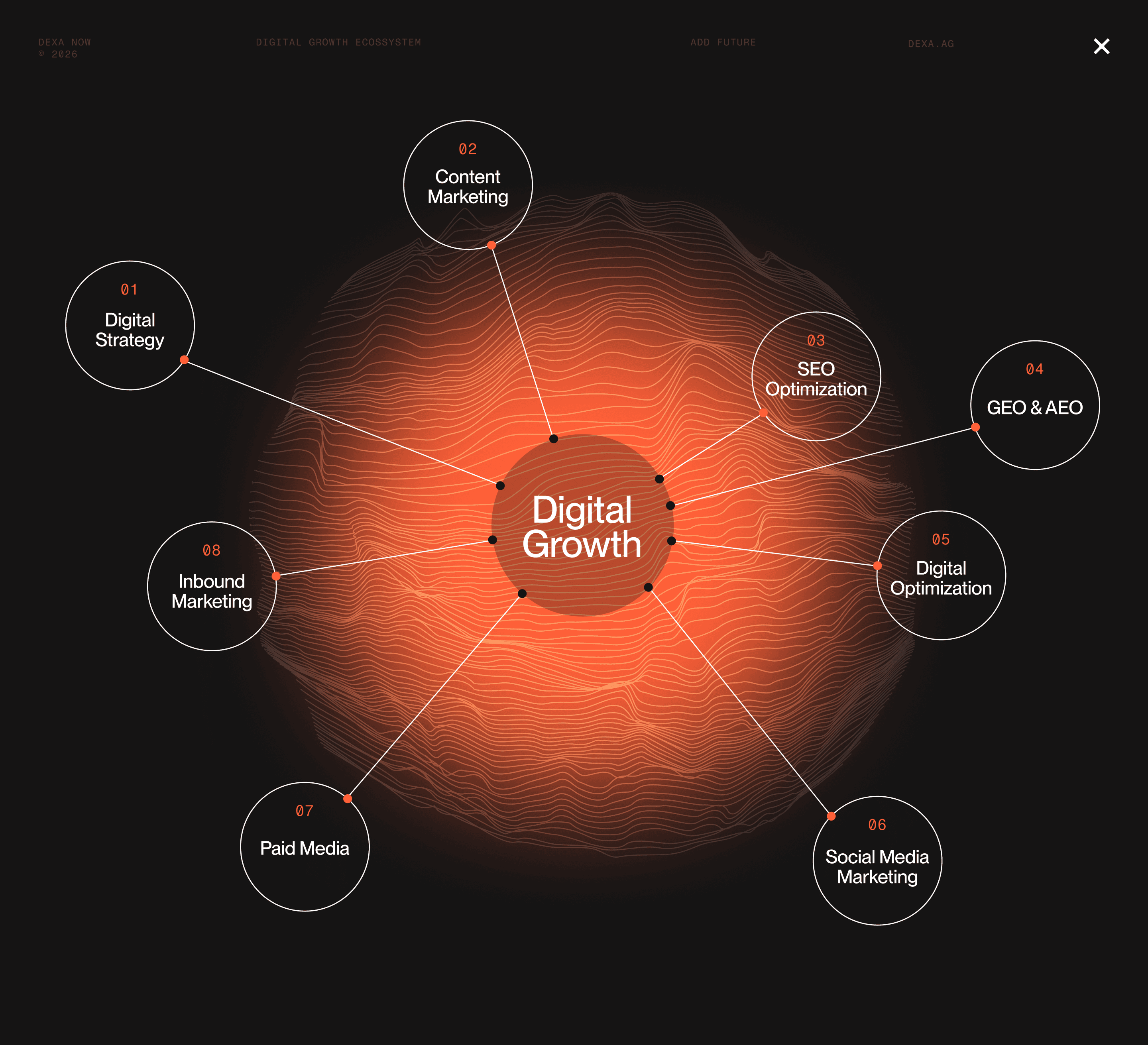
In our model, we connect six practices to solve your business's strategy, traffic, conversion, and relationship challenges.
Digital Strategy
This is where almost every journey begins, since it's rare for a client to arrive with positioning fully sorted out. And there's more: how can a team run your marketing without understanding your business first? That's why analysts, strategists, and designers work together to understand where the company stands, how it positions itself, and what its real growth potential is.
The goal is to take decisions out of the guesswork zone and move them onto solid data. It's this initial diagnosis that defines which channels make sense and where the investment will bring a real return.
Market research: industry analysis to size up the landscape and identify opportunities;
Benchmarking: a study of the digital presence of key players to map gaps;
Proto-personas: building audience profiles to guide language and journey;
Brandformance strategy: defining the balance between brand and performance that will guide the operation and determine which channels get worked.
Visual direction: an initial definition of how the client's social media, blog, and paid ads will look aesthetically.
Content Marketing, SEO / GEO / AEO
This practice solves the pain of anyone who wants to be found online. Content and SEO specialists work to put the brand in front of the audience at the exact moment they're looking for a solution, whether on Google or on the new Artificial Intelligence tools.
We identify the business keywords that generate authority and qualified traffic. We prioritize each term by volume and search intent, turning the blog into a financial asset for the client.
Topic clusters: thematic organization of content to build consistent authority;
GEO and AEO: optimization for generative search engines and AI answer engines;
Content design: production of in-depth, structured content for multiple search behaviors;
EEAT and on-page SEO: applying the experience and trust criteria that sustain organic rankings.
Digital Optimization
Here the focus is on unlocking growth that should already be happening but is being held back. Technical SEO specialists, UX/UI designers, and developers audit the site in search of technical and conversion bottlenecks.
We build improvement plans focused on real growth, not cosmetic tweaks. If the page is slow or the flow confuses the user, the business loses money. We fix that.
Technical SEO: fixing infrastructure and code to ensure accurate indexing;
Core Web Vitals: optimizing the technical speed and stability criteria Google requires;
CRO: adjusting internal flows and paths to turn visits into commercial opportunities;
UX Design: refining the browsing experience to reduce friction in the buying journey.
Social Media Marketing
On this front, we solve the lack of consistent presence on the networks that actually matter for your industry. Social media managers, strategists, and designers build a content operation perfectly aligned with the brand's positioning.
The problem is almost never the number of posts, but the lack of intent behind them. That's why we work on visual and verbal consistency to lock the brand into the right audience's mind.
Social intelligence: monitoring relevant content and behaviors in your market;
Content pillars: defining the editorial themes and format balance that sustain the profile;
Social branding: ensuring the brand's visual and verbal identity is respected on every channel;
Social design: production of graphic assets aligned with strategic positioning.
Paid Media
This practice kicks in when the challenge is showing up in sponsored results and competing head-to-head with your competitors. Media specialists design strategies with a direct focus on return on investment.
Our benchmark for ads isn't a vanity metric, but real ROI and justified spend. We choose the right channels based on your ideal customer profile (ICP).
Media planning: selecting the paid traffic channels best suited to the business objectives;
Multi-platform traffic: coordinated operation across different ad platforms;
Tracking: technical measurement setup to track and prove where conversions come from;
Performance design: creating ads built for qualified clicks and conversion.
Inbound Marketing
When the company's pain is converting and nurturing contacts, Inbound solves it. Analysts structure the full funnel, designing everything from automations to capture pages, turning cold traffic into sales opportunities.
We create nurture tracks to keep the lead warm over time. That way, when they're ready to make the buying decision, your company is the natural answer.
Marketing automation: building email flows that walk the lead through the journey;
Landing pages: high-conversion pages designed to capture contacts with clarity;
Lead scoring: automatic lead qualification to prioritize the hottest contacts for sales;
Email optimization: continuous testing of opens, clicks, and engagement across nurture tracks.
Gated content: ebooks, reports, calculators, and other formats that are useful to your customer and a source of conversion.
If you want to understand how these practices apply to your context, talk to us.
From theory to practice: the Pactum case
This integrated logic plays out in practice in the marketing operation we built for Pactum Consultoria Tributária.
The tax market is highly technical, with a long decision cycle and a high bar for trust. After developing Pactum's new website, we took over the digital marketing operation to turn that positioning into growth. We synced every channel: the site converts, the blog builds authority, social expands reach, and email nurtures the relationship.
The Brandformance results showed up within a few months:
+93% organic clicks on the site;
+378% search impressions;
+282% social media reach;
+1,281% engagement across brand channels;
30% average email open rate.
This format creates a compounding effect: content authority feeds search, which draws a qualified audience to the site, activating demand capture in practice.
Want to see how we apply this method in other markets?
Why work with Dexa?
Impressions, likes, and visits are the means, never the end. What changes the game for a business isn't being everywhere at once, but being where it matters, consistently, generating real opportunities for the sales team. And that's only possible with integration.
“Dexa's big differentiator is being end-to-end. The platforms we build are born as business assets, made to deliver results. When strategy, design, technology, and marketing work together, the ecosystem becomes clear, efficient, and scalable.”
— Micaela Rossetti, Head of Marketing at Dexa.
Dexa exists to build that machine with you. With an experienced team, maturity in branding, and a relentless focus on performance, we're ready to grow alongside your business.
Find out how to turn your marketing into a predictable acquisition channel.